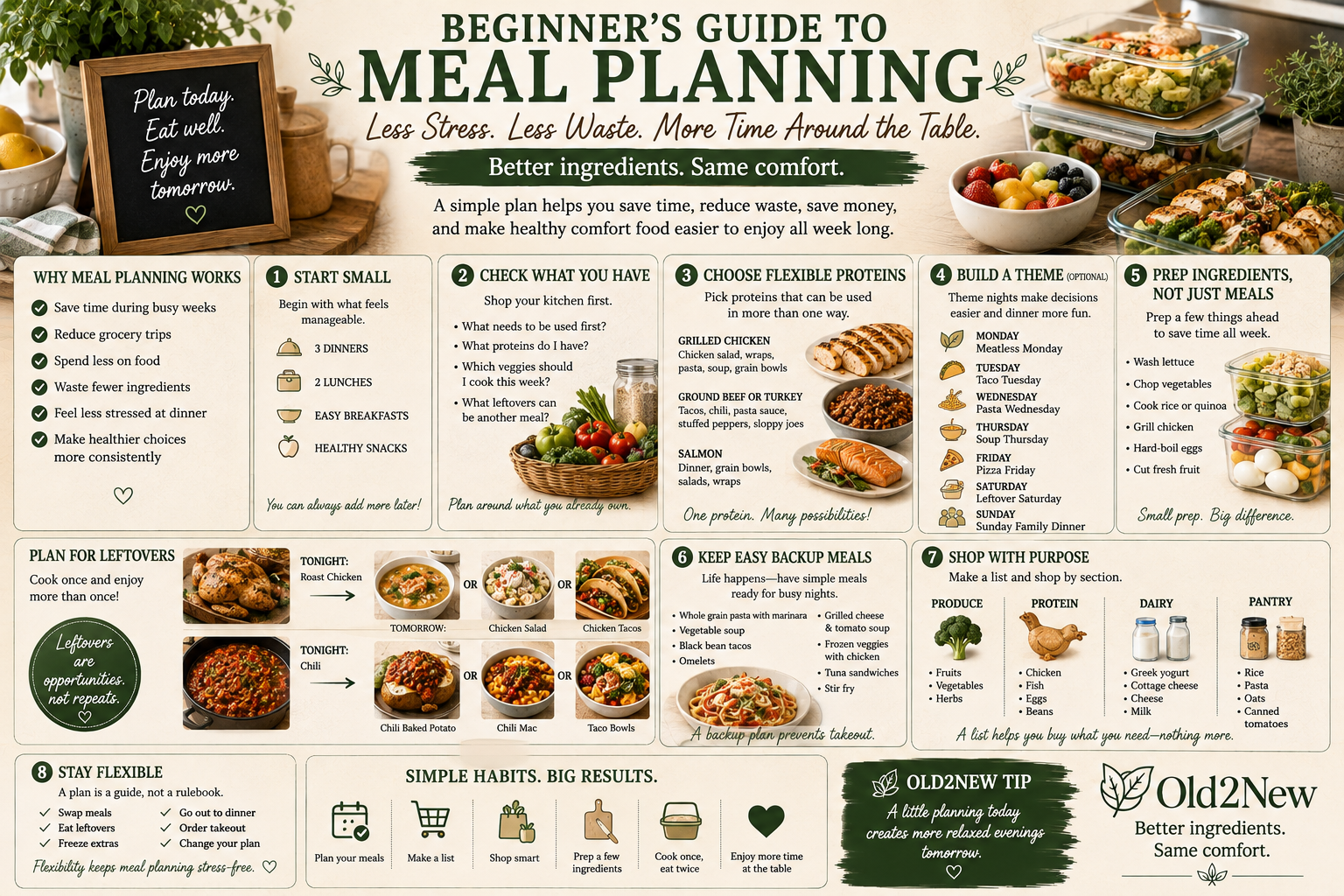
Beginner's Guide to Meal Planning
Meal planning has a reputation for being either a Sunday-consuming production or a rigid system that removes all spontaneity from cooking. Neither is true — or at least neither has to be true. At its simplest, meal planning is deciding a few things in advance so that dinner on Wednesday doesn't require a 45-minute decision-making session in a crowded grocery store after a long day.
It doesn't require batch-cooking everything for the week. It doesn't require following a color-coded spreadsheet. It doesn't mean eating the same five meals on rotation forever. It means spending 20 minutes at some point before the week starts to think through what you'll eat, what you need to buy, and what can be prepped in advance to make the actual cooking faster. That's it.
The payoff — fewer grocery trips, less food waste, less money spent, and significantly less stress at dinner time — comes from that 20 minutes of advance thinking rather than hours of advance cooking.
Why Meal Planning Works
The reason meal planning reduces stress isn't that it makes cooking faster, though that's a side effect. It's that it eliminates decision fatigue at the worst possible moment. The question "what's for dinner?" asked at 6pm after a full day is one of the most draining decisions in daily life — not because dinner is complicated, but because it requires making multiple decisions simultaneously (what do we have, what sounds good, what can be made quickly, what do people actually want) when mental energy is at its lowest.
Meal planning moves that decision to a moment when mental energy is higher and the answer can be made thoughtfully rather than reactively. It also makes grocery shopping more purposeful — you buy what you need for the week's meals rather than whatever seems relevant in the moment, which reduces both spending and waste from ingredients that don't get used.
The habit doesn't need to be elaborate to deliver these benefits. Three dinners planned in advance is better than zero. A few ingredients prepped on Sunday is better than nothing.
Start Small
The most common mistake with meal planning is trying to plan everything at once — all seven dinners, all lunches, all breakfasts, snacks for every day. This creates a plan that's so rigid it collapses the first time something changes, and it requires so much upfront effort that it feels unsustainable.
A more practical starting point is three dinners, two lunch ideas, a simple breakfast plan, and a few snacks. Three dinners covers the most stressful meals of the week and leaves room for leftovers, takeout, or spontaneous decisions on the other nights. Two lunch ideas gives enough variety that the week doesn't feel repetitive but doesn't require planning every individual meal. A breakfast plan — whether that's overnight oats made Sunday night, hard-boiled eggs in the refrigerator, or a smoothie routine — removes the morning decision entirely.
As the habit becomes more natural, the plan can expand. But starting smaller than you think you need to is almost always more sustainable than starting with an ambitious system that requires too much maintenance.
Check What You Already Have First
Before writing a grocery list or deciding what to cook, look at what's already in the kitchen. The refrigerator, the freezer, and the pantry together usually contain the starting point for multiple meals — and planning around them first reduces both spending and waste.
Ask a few practical questions: What needs to be used in the next few days before it goes bad? What proteins are already in the freezer? Which vegetables are taking up space in the crisper drawer? What pantry staples were bought for a recipe that only used half of them? The answers to these questions often determine at least two or three of the week's meals without requiring any additional shopping.
Planning around what you already own is one of the most effective strategies for reducing food waste and grocery spending simultaneously. The most expensive groceries are the ones bought with good intentions and thrown out unused.
Choose Flexible Proteins
The most efficient meal planning builds around proteins that work in more than one application — so one cooking session produces ingredients for multiple meals rather than just one.
Grilled or roasted chicken breast cooked in a batch at the start of the week goes into chicken salad for lunch on Monday, a grain bowl for dinner on Tuesday, a wrap on Wednesday, and a quick pasta or soup by the end of the week. Ground turkey browned with onion and garlic divides into taco filling, pasta sauce, and a stuffed pepper filling for three different dinners that all feel distinct. Salmon fillets roasted for dinner become the protein in a grain bowl or salad the next day.
Planning around proteins that stretch across multiple meals makes the prep investment proportionally more valuable — 20 minutes of cooking one protein produces components for three to four different meals rather than just the one for tonight.
Build Around a Theme
Weekly dinner themes are a practical tool for reducing decision fatigue without locking the week into rigid repetition. The theme provides a direction without specifying exactly what goes in — Taco Tuesday can mean ground beef tacos or shrimp tacos or lentil tacos depending on what's available and what sounds good that week.
Common themes that work well: Meatless Monday keeps plant-based meals on the calendar without requiring a specific recipe decision. Taco Tuesday covers a broad category that includes tacos, burrito bowls, quesadillas, and fajitas. Pasta Wednesday handles a whole category of quick weeknight dinners. Soup Thursday works particularly well in fall and winter and enables make-ahead preparation. Pizza Friday is flexible enough to include homemade, store-bought, and flatbread variations. Leftover Saturday clears the refrigerator and requires no cooking. Sunday family dinner becomes the occasion for something slightly more involved that generates leftovers for the week ahead.
The value isn't the specific theme — it's that the category decision is already made, which removes one layer of the Wednesday evening decision-making process.
Prep Ingredients, Not Just Complete Meals
Meal prep doesn't require cooking everything in advance. For many people, prepping ingredients rather than complete meals is more practical and more flexible — it speeds up the actual cooking without committing every meal to a specific preparation that might not sound appealing when the time comes.
Washing and drying a head of lettuce or a container of greens takes five minutes and means salads happen spontaneously rather than being skipped because the lettuce needs to be washed. Chopping a week's worth of onion, bell pepper, and garlic and storing them in containers means the first step of half the week's dinners is already done. Cooking a batch of rice or quinoa means the grain component of any dinner or grain bowl is ready without additional work. Hard-boiling a half dozen eggs provides a week of quick breakfast and snack protein. Grilling or baking a few chicken breasts creates a protein that goes into multiple different meals.
These ingredient-level preparations are lower commitment than cooking full meals in advance and more useful because they contribute to meals that can still be assembled in different directions depending on what sounds good.
Plan for Leftovers Intentionally
The most efficient meal planning strategy is cooking once and eating twice — making enough of something at dinner to repurpose into a different meal the next day. This isn't eating the same thing twice; it's using the same ingredient in a different application.
A roast chicken for Sunday dinner becomes chicken soup on Monday with the carcass and leftover meat, and chicken salad for lunch on Tuesday with whatever remains. A pot of chili made on Sunday gets bigger with a second night — served over a baked potato on Monday or stirred into pasta on Tuesday as chili mac. A batch of lentil soup serves dinner on Wednesday and lunch on Thursday without any additional work. Roasted vegetables from one sheet pan dinner go into a grain bowl the next day.
Planning these repurposing moments in advance — deciding on Sunday that Thursday's chili will become Friday's chili mac — makes the second meal feel intentional rather than like a compromise.
Keep Easy Backup Meals Ready
Even a well-planned week has nights when the plan falls apart. Someone works late. The recipe takes longer than expected. Nobody wants what was planned. Having a small set of genuinely easy backup meals — things that can be assembled in 15 minutes from what's always in the kitchen — prevents those nights from turning into expensive takeout by default.
The best backup meals are ones that require almost no decision-making: whole grain pasta with marinara from a jar requires boiling water and opening a can. Black bean tacos from canned beans, salsa, and whatever toppings are in the refrigerator take ten minutes. An omelet with whatever vegetables need to be used fills a plate with protein and produce in eight minutes. Grilled cheese with tomato soup from a can is a comfort food dinner that requires almost nothing. Stir fry from frozen vegetables and a protein with soy sauce and garlic over rice is a complete dinner in 20 minutes.
Knowing these backup meals are available — and keeping the ingredients for them consistently stocked — removes the pressure that turns a plan-derailing moment into a stressful one.
Shop with Purpose
Once the week's meals are planned, the grocery list becomes straightforward — you're buying specific things for specific meals rather than shopping by intuition and hoping it comes together. Organizing the list by store section (produce, protein, dairy, pantry) makes the actual shopping faster and reduces the chance of forgetting something that requires a second trip.
The most efficient grocery trip is one with a list based on a plan, which is why the planning step pays for itself in time even before the cooking begins. Shopping without a list means buying what looks good in the moment, which means buying ingredients that don't necessarily go together and missing ingredients that are needed for the meals that were vaguely in mind.
Leave Room for Flexibility
A meal plan is a guide, not a contract. The point is to make weeknights easier, not to create a rigid obligation that generates stress when it isn't followed precisely. It's fine to swap Tuesday's dinner to Thursday because Tuesday was harder than expected. It's fine to eat leftovers on a night when something else was planned. It's fine to go out to dinner and push the whole week's plan back by one night. It's fine to freeze a meal that was planned for Friday when Friday turned into takeout.
The plan exists to reduce the friction of deciding what to eat — not to eliminate flexibility or spontaneity from the week. A plan that's followed six nights out of seven is dramatically more valuable than no plan at all, even if it wasn't perfectly executed.
FAQ
How long does meal planning actually take each week? For most households, 15 to 30 minutes once a week covers checking the pantry and refrigerator, deciding on three to five dinners, writing a grocery list, and identifying any ingredient prep that can be done in advance. The first few weeks take longer as the habit is being established. Once the process becomes familiar, it often takes less than 20 minutes.
Do I have to cook everything on Sunday? No — and for many people, front-loading all cooking into Sunday creates a system that's exhausting and unsustainable. Prepping ingredients rather than complete meals (washing greens, cooking grains, slicing vegetables) is often more useful than cooking full dinners in advance. It provides the building blocks for faster cooking throughout the week without locking every meal into a specific preparation.
What if my family doesn't like the same things? Plan around flexible base components that can be customized at serving time — a taco bar where everyone chooses their own toppings, a grain bowl station with multiple protein and vegetable options, a pasta bar with different sauce options. This accommodates different preferences without requiring multiple separate meals.
How do I avoid food waste with meal planning? Check the refrigerator before planning and build meals around what needs to be used first. Plan meals that share ingredients — if you buy a head of cabbage for tacos on Tuesday, plan a slaw for Wednesday or a soup for Thursday that uses the rest. Use a flexible protein strategy so that a single cooking session produces components for multiple meals. Keep the plan simple enough that the grocery list is specific and targeted rather than aspirational.
Continue Your Recipe Transformation Journey
Meal planning is the foundation that makes everything else in healthier cooking more sustainable. These guides will help you build on it:
- Pantry Staples Every Home Cook Should Keep — the ingredients that make any meal plan executable
- How to Make Your Favorite Recipes Healthier Without Starting Over — the philosophy behind better comfort food
- Easy Ways to Add More Vegetables Without Anyone Noticing — how to improve any planned meal
- Healthy Cooking Methods That Still Taste Amazing — the techniques that make planned meals worth eating
- Stop Throwing Away Food — how meal planning reduces food waste specifically
Old2New — There is good in everything.