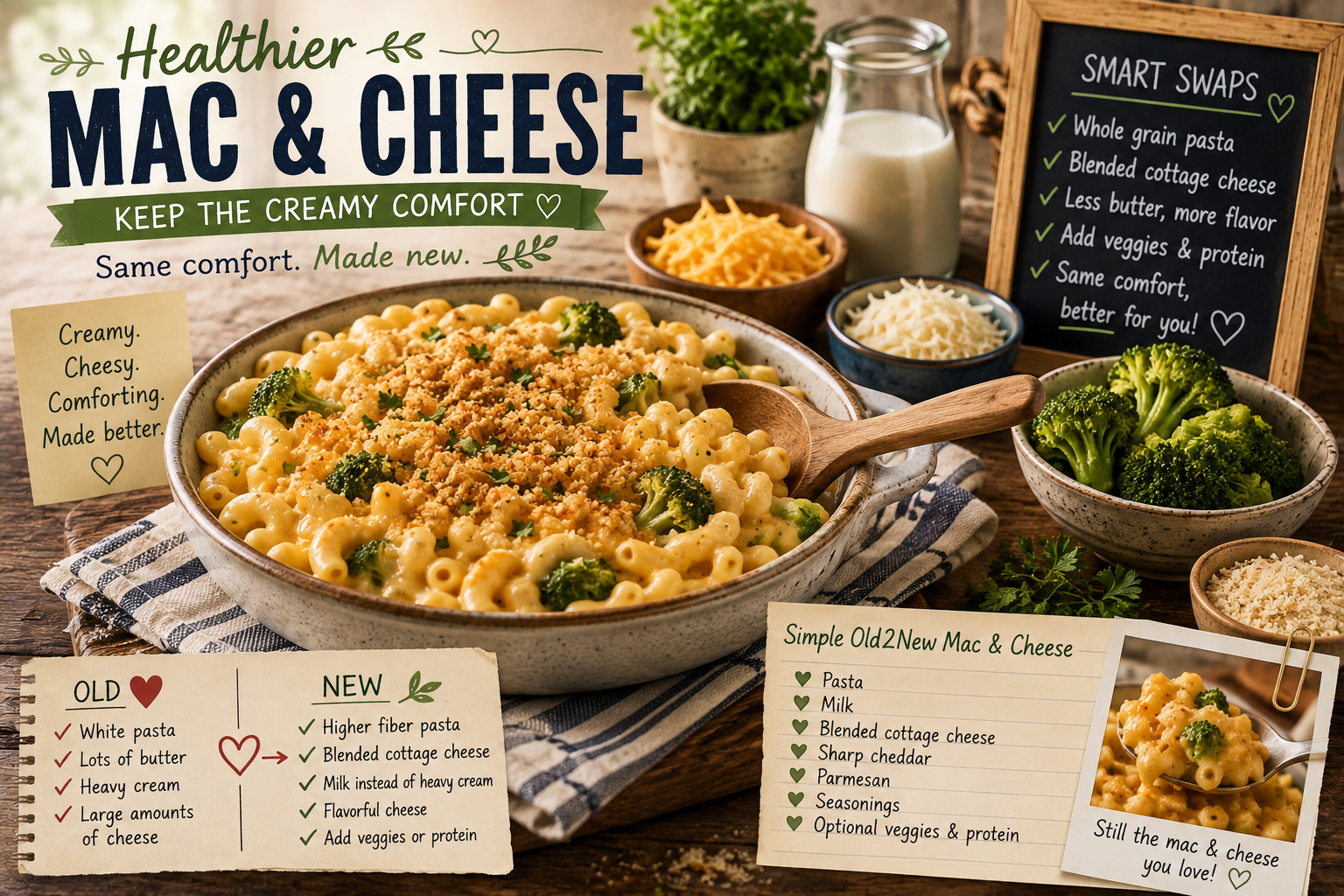
Healthier Mac and Cheese: Keep the Creamy Comfort
Mac and cheese doesn't need an introduction. It's creamy, cheesy, warm, and for most people it's been comfort food since childhood — the dish that appears when someone is sick, when it's cold outside, when dinner needs to be fast and universally accepted, and when nothing else will do.
When someone decides they want to change the way they eat, mac and cheese is often one of the first foods they assume has to disappear. It won't survive the changes. It's not compatible with the new approach. They'll have to give it up.
They don't.
The Old2New approach to mac and cheese isn't about turning macaroni into cauliflower with cheese sprinkled on top and calling it the same thing. Mac and cheese should still be mac and cheese — creamy, cheesy, satisfying, the specific thing a person reaches for when they want it. The goal is finding the places in the recipe where thoughtful changes make a meaningful difference without taking away what makes the dish worth eating.
Start with the Pasta
The pasta in mac and cheese is foundational but not unchangeable. Several options exist depending on what matters most for a specific household.
Whole wheat pasta adds fiber and a slightly nuttier flavor that works particularly well in baked mac and cheese where the pasta spends time in a creamy sauce. The flavor difference is noticeable but not objectionable, especially when the sauce is well seasoned. Higher-protein pasta made from chickpeas or lentils adds meaningful protein — often 13 to 15 grams per serving compared to 7 to 8 in standard pasta — and performs well in mac and cheese because the strong sauce flavor largely dominates the slightly different taste of the pasta itself. A half-and-half combination of regular pasta and higher-fiber pasta is also worth considering for households where the transition feels abrupt.
And there's a completely legitimate option: use the pasta already in the pantry and make the other adjustments. Healthy cooking doesn't require changing every ingredient. Sometimes two or three thoughtful swaps elsewhere in the recipe produce a dish that's meaningfully better without touching the pasta at all.
Keep the Cheese
Mac and cheese has the word cheese in the name. Attempting to make it with very little cheese creates a dish that doesn't satisfy the craving that motivated making it in the first place — and that outcome is worse than the original recipe because it produces neither comfort nor genuine improvement.
The useful adjustment isn't using less cheese — it's using cheese that contributes more flavor per gram so that the total amount can be somewhat lower without the dish tasting less cheesy. Sharp cheddar is the most practical choice for this reason: a modest amount of sharp cheddar delivers significantly more cheese flavor than the same amount of mild cheddar. A cup of sharpest-available cheddar can taste cheesier in a sauce than a cup and a half of mild cheddar.
Combining cheeses also extends the flavor impact. Sharp cheddar combined with a small amount of parmesan creates a more complex, intensely flavored sauce than either cheese alone. Sharp cheddar with a little gruyère adds a nuttiness that makes the sauce taste more sophisticated and deeply satisfying. The cheese stays in the recipe — it's just made to do more work.
Create Creaminess Without Relying Entirely on Butter and Cream
Traditional mac and cheese sauce is built on butter, whole milk or cream, and cheese — which produces the rich, velvety texture that defines the dish. Those ingredients can be balanced differently without abandoning the creaminess that makes mac and cheese worth eating.
A sauce built on low-fat milk, a small amount of flour for body, and sharp cheddar can be genuinely creamy and deeply cheesy without the full butter and cream load of a traditional sauce. The sauce is different but not lesser — the milk provides the liquid base, the flour provides the viscosity, and the cheese provides both flavor and additional fat that contributes richness.
Blended cottage cheese is the other tool worth knowing about for mac and cheese specifically. Blended completely smooth — 60 seconds in a blender — it becomes a thick, creamy, mildly flavored base that disappears into a cheese sauce. It adds significant protein (approximately 14 grams per half cup), contributes to the creamy texture, and is completely imperceptible in the finished dish when combined with enough sharp cheddar. The sauce doesn't taste like cottage cheese. It tastes like a particularly creamy, slightly more substantial mac and cheese sauce.
Greek yogurt stirred in at the end of cooking similarly adds creaminess and protein. It should be added off the heat or over very low heat to prevent separation, and it provides a slightly tangy quality that many people find makes the sauce taste brighter and more complex.
Add Vegetables If You Want Them
Vegetables in mac and cheese can be a genuine addition rather than a compromise — not replacing the pasta or the cheese, but joining them to add color, fiber, and volume to every serving.
Broccoli is the most natural partner for mac and cheese. Steamed or roasted broccoli florets mixed into the finished mac and cheese add a vegetable that pairs well with cheese in a way that feels intentional rather than imposed. The broccoli doesn't dilute the mac and cheese experience — it complements it in a way that most people find genuinely appealing rather than reluctantly acceptable.
Peas stirred in at the last minute add sweetness, color, and fiber with almost no flavor impact on the overall dish. Roasted cauliflower adds a slightly nutty, slightly sweet element that works particularly well in baked mac and cheese. Spinach wilted into the warm sauce adds iron and nutrients without changing the flavor significantly. Butternut squash — roasted and stirred into the sauce — adds natural sweetness and creaminess that actually enhances the sauce's richness.
If the household doesn't want vegetables in the mac and cheese itself, serving vegetables alongside it accomplishes the same nutritional goal without the negotiation. Mac and cheese on one side of the plate, roasted broccoli on the other, is a legitimate complete dinner.
Turn It Into a Complete Meal
Mac and cheese is typically served as a side dish, but adding protein transforms it into a main course that's genuinely filling rather than a carbohydrate-forward side that leaves people hungry an hour later.
Shredded rotisserie chicken stirred into finished mac and cheese with a handful of broccoli produces a complete dinner in five minutes if the mac and cheese is already made. Lean ground turkey browned with taco seasoning turned into a mac-and-cheese-meets-taco-night hybrid satisfies two cravings simultaneously and produces a dish kids and adults both eat without complaint. Canned tuna stirred in with peas and a squeeze of lemon makes a fast, protein-rich dinner from pantry staples. White beans folded in add protein and fiber without changing the flavor in a way most people detect. Any of these additions turn mac and cheese from side dish to complete meal without requiring a separate protein preparation.
Season It Well
Cheese isn't the only source of flavor in a good mac and cheese. Seasonings that enhance the cheese's sharpness and add complexity to the sauce make the dish taste more satisfying with the same amount of cheese.
Mustard powder is the most important mac and cheese seasoning most people haven't tried deliberately. It doesn't make the sauce taste like mustard — it makes the cheese taste more intensely cheesy, amplifying the sharpness of cheddar in a way that's difficult to identify but immediately noticeable. A half teaspoon in a four-serving recipe is enough to make a meaningful difference.
Garlic powder and onion powder add savory depth. Smoked paprika adds a subtle warmth and an appealing golden color to the sauce. Black pepper adds bite. A small amount of cayenne adds warmth that most people don't identify as spicy but that makes the dish feel more complex and satisfying. These seasonings add flavor that might otherwise require more cheese — a useful trade in the direction of a well-flavored, appropriately cheesy sauce rather than a cheese-quantity-compensates-for-everything approach.
Keep the Crispy Top
For baked mac and cheese specifically, the crispy topping is part of what makes the dish special — the contrast between the creamy interior and the golden, slightly crunchy surface is a textural experience that stovetop mac and cheese doesn't provide. Removing the topping removes something genuinely worthwhile.
A lighter topping achieves the same result with less: whole wheat panko breadcrumbs combined with a tablespoon of parmesan and a small drizzle of olive oil, scattered in a thin layer across the top of the baking dish, browns into a golden, crispy crust during baking. The topping tastes indistinguishable from a butter-heavy version and provides the textural contrast that makes baked mac and cheese worth the oven time.
A Simple Old2New Mac and Cheese
This version keeps the pasta, keeps the cheese, and makes the adjustments in the sauce that produce a dish that's genuinely better without feeling like a substitution.
Ingredients (serves 4)
- 8 oz whole wheat or higher-protein elbow pasta
- 1 cup low-fat milk
- 1 cup low-fat cottage cheese, blended smooth
- 1½ cups sharpest available cheddar, shredded
- ¼ cup parmesan, grated
- 1 tsp mustard powder
- ½ tsp garlic powder
- ½ tsp onion powder
- Black pepper to taste
- Optional additions: 2 cups broccoli florets, 1 cup cooked chicken, handful of fresh spinach
For a crispy baked topping:
- ¼ cup whole wheat panko
- 1 tbsp parmesan
- Small drizzle of olive oil
Instructions
Cook the pasta according to package directions until just tender — slightly under rather than over, as it will continue cooking if the dish is baked. While the pasta cooks, blend the cottage cheese completely smooth in a blender.
Warm the milk in a medium saucepan over medium-low heat. Add the blended cottage cheese and whisk together until smooth and warm. Add the cheddar gradually, stirring between additions until each amount is melted and the sauce is smooth. Add the parmesan and stir to combine. Season with mustard powder, garlic powder, onion powder, and black pepper.
Add the drained pasta and stir until everything is coated. Fold in any additions (broccoli, chicken, spinach) at this stage.
For stovetop mac and cheese, serve immediately.
For baked mac and cheese, transfer to a baking dish, combine the panko, parmesan, and olive oil in a small bowl, scatter lightly across the top, and bake at 375°F for 20 to 25 minutes until bubbling and golden.
Make It Your Own
If your family's mac and cheese recipe has been around for decades, it doesn't need to be discarded to make room for a healthier version. It needs to be looked at with one question in mind: where is one place a change could make a meaningful difference?
Maybe the pasta switches to whole wheat. Maybe blended cottage cheese gets stirred into the sauce alongside the cheddar. Maybe the butter amount decreases and a little mustard powder increases. Maybe broccoli joins the dish rather than sitting separately. Maybe the serving size gets modestly smaller and roasted chicken sits alongside it to make it a complete meal rather than a main event.
One change at a time. The recipe evolves rather than being replaced. The people eating it notice it tastes good rather than noticing what's different. That's the standard — not a perfect nutritional profile, not the absence of things they love, but a dish they'd make again without thinking twice.
FAQ
Will people know there's cottage cheese in the sauce? Not if it's blended completely smooth and combined with enough sharp cheddar. The cottage cheese flavor is mild enough that sharp cheddar's flavor dominates completely — what people taste is the cheese. The texture is creamier than a standard milk-and-cheese sauce and slightly more substantial, which most people experience as "this tastes really good" rather than identifying the cottage cheese.
What's the best cheese for healthier mac and cheese? The sharpest cheddar available. Sharp cheddar delivers more flavor per gram than mild cheddar, which means a smaller quantity can produce the same intensity of cheese flavor. Combining sharp cheddar with a smaller amount of parmesan amplifies the effect further — parmesan is intensely flavored and adds a savory depth that makes the sauce taste more complex without requiring more cheddar.
Can I make this ahead and reheat it? Yes — mac and cheese reheats well with a splash of milk added before microwaving or covering with foil and warming in a 300°F oven. The sauce may thicken as it sits and separate slightly on reheating; a little warm milk stirred in restores the creamy consistency. Baked mac and cheese reheats particularly well because the topping retains some of its texture even after refrigeration and reheating.
Is this appropriate for people on GLP-1 medications? The version with blended cottage cheese and higher-protein pasta provides significantly more protein per serving than traditional mac and cheese, which supports satiety and means a smaller portion satisfies. Serving alongside a vegetable and a protein source further extends its value as part of a balanced meal. The dish remains something to enjoy rather than something to avoid.
Continue Your Recipe Transformation Journey
Mac and cheese is one of the most transformable comfort foods in the kitchen — familiar, beloved, and genuinely improvable with the right adjustments. These guides will help you go further:
- How to Make Creamy Recipes Without Heavy Cream — the full guide to cottage cheese and Greek yogurt as cream substitutes
- Easy Ways to Add More Vegetables Without Anyone Noticing — how broccoli, cauliflower, and spinach join mac and cheese naturally
- What Can I Make with Cottage Cheese? — everything cottage cheese can do as a high-protein ingredient
- How to Make Your Favorite Recipes Healthier Without Starting Over — the bigger picture behind every swap
- What Can I Make with Pasta? — the complete guide to pasta and its best applications
Old2New — There is good in everything.