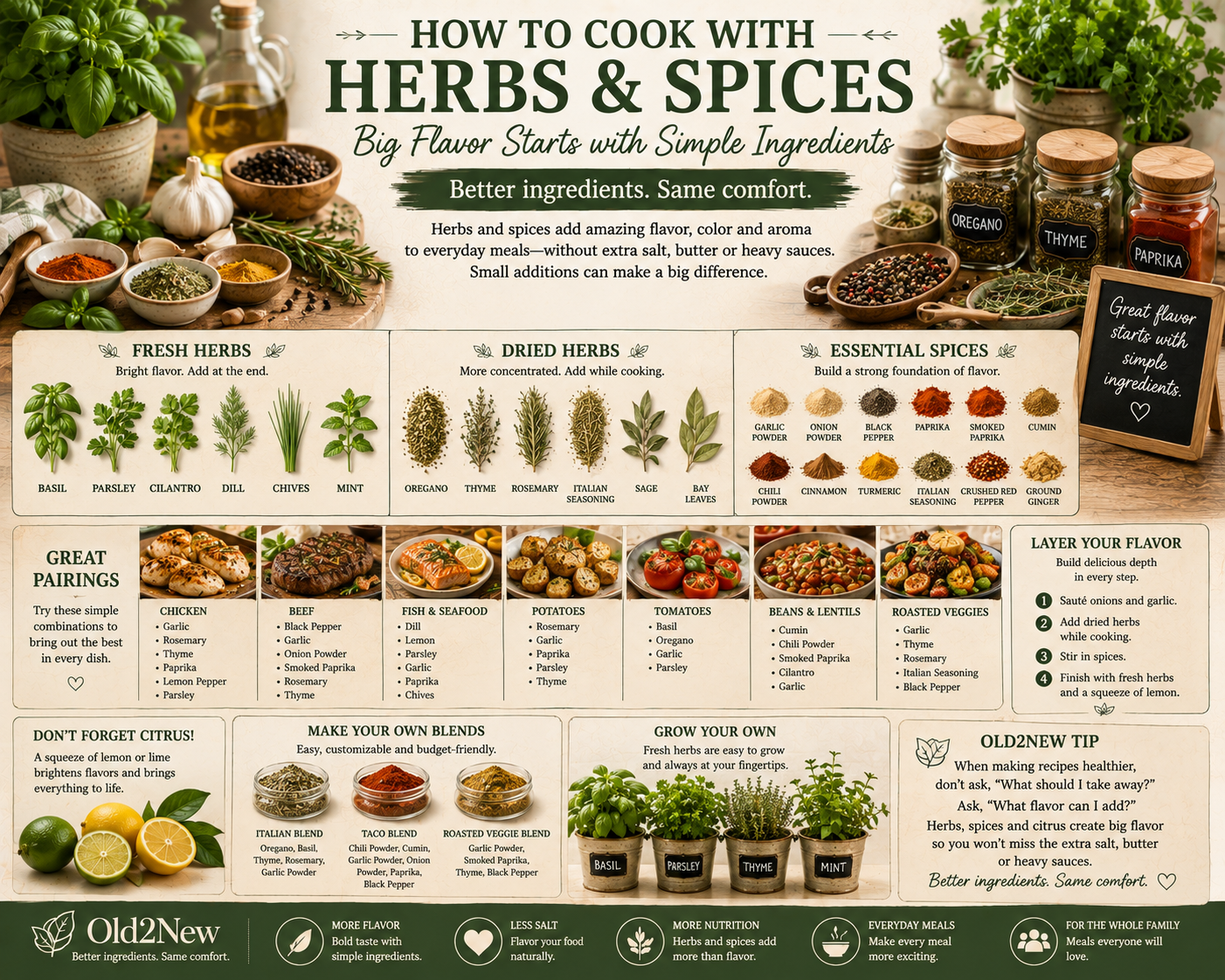
How to Cook with Herbs and Spices
The most common reason home-cooked food tastes less interesting than restaurant food isn't the quality of the protein or the freshness of the produce. It's seasoning. Specifically, it's the confidence to season early, season in layers, and use herbs and spices in amounts that actually make a difference rather than the cautious pinch that adds almost nothing to the finished dish.
Herbs and spices are the least expensive, most calorie-efficient tools in the kitchen. A quarter teaspoon of smoked paprika added to roasted vegetables costs almost nothing and changes the dish completely. Fresh basil torn over a pasta sauce adds brightness and aroma that no amount of additional butter or cream could replicate. Cumin bloomed in olive oil before the beans go in transforms a can of beans into something that tastes like it's been simmering for hours.
Learning to cook with herbs and spices is learning to make food taste more like itself — more defined, more complex, more satisfying — without adding anything heavy. It's one of the most practical skills for building better comfort food and one of the easiest to develop.
Why Herbs and Spices Matter
Herbs and spices build flavor naturally without adding significant calories, fat, or sodium to a dish. They reduce the need for extra salt by providing the complexity that makes food taste well-seasoned even when less salt is used. They add aroma — which is responsible for a significant portion of what we perceive as flavor — in a way that makes the first moment of eating a dish as satisfying as the taste itself. They add color that makes food visually appealing. And they add variety to everyday meals without requiring new recipes — the same roasted chicken seasoned with different herbs becomes a completely different dinner.
For anyone cooking more intentionally, herbs and spices are the most direct answer to the question of how to make food taste good without relying on the ingredients that are being reduced. When garlic, rosemary, lemon, and smoked paprika are doing their work, the dish doesn't need extra salt or heavy sauce to feel complete.
Fresh Herbs vs. Dried Herbs
Both have a place in the kitchen and each works better in certain applications. Understanding the difference makes using both more effective.
Fresh herbs are at their best when added at the end of cooking or used raw — in salads, on pasta, over finished soups, in sandwiches, and as garnishes that add brightness and aroma right before the dish is served. Basil torn over a tomato pasta at the last moment adds a fragrance that dried basil — which would have been added earlier — cannot replicate. Fresh parsley stirred into a finished dish adds color and a grassy brightness that disappears in cooking. Fresh dill over salmon or in a yogurt dressing adds a clean, herbal quality that is the defining element of those dishes.
Dried herbs are more concentrated and more stable in heat — they belong earlier in the cooking process where they have time to hydrate and bloom in the oil or liquid of the dish. Dried oregano in a tomato sauce added at the beginning of simmering becomes part of the sauce's backbone in a way that fresh oregano added at the end doesn't. Dried rosemary in a slow-cooked braise softens and releases its flavor over hours. Dried thyme in a casserole distributes through every layer of the dish. As a general rule, use about one third the amount of dried herb compared to fresh — dried is more concentrated and using the same volume as fresh will overpower the dish.
The herbs worth having on hand in both forms: basil, parsley, thyme, and rosemary. Cilantro, dill, chives, and mint are best used fresh — they lose most of their character when dried.
Essential Spices Every Kitchen Should Have
A well-stocked spice cabinet doesn't need to be large or expensive — it needs to be functional. A small collection of versatile spices covers most cooking situations and can be combined in ways that create dozens of different flavor profiles.
Garlic powder and onion powder are the foundation of savory seasoning in most applications. They add the backbone of flavor that fresh garlic and onion provide when there isn't time to cook them properly, and they distribute through dry rubs and seasoning blends in a way that fresh aromatics don't.
Black pepper adds heat, complexity, and a slight bite that lifts the overall flavor of a dish. Using it freshly ground makes a noticeable difference — pre-ground pepper loses its volatile oils quickly and contributes less to the final flavor.
Paprika and smoked paprika add color, mild sweetness, and (in the smoked version) a depth that suggests slow cooking even in fast preparations. Smoked paprika on roasted vegetables, chicken, or fish adds a quality that reads as sophisticated without requiring any additional effort.
Cumin is the spice that makes chili, tacos, and bean dishes taste like what they're supposed to taste like. It adds an earthy, slightly smoky warmth that is the backbone of most Mexican and Middle Eastern seasoning and works across lentils, chickpeas, roasted vegetables, and ground meat.
Chili powder is a blend rather than a single spice — it typically contains cumin, garlic powder, oregano, and cayenne alongside the dried chili pepper base. It adds warmth and depth to anything that needs it and is the easiest single addition to any protein or vegetable that needs more character.
Cinnamon is worth having in savory cooking as well as sweet — a pinch in chili or a Moroccan-inspired lamb or chicken dish adds warmth and complexity that registers as depth rather than sweetness when used in small amounts.
Turmeric adds golden color, mild earthiness, and anti-inflammatory compounds to any dish it goes into. It works well in rice, soups, scrambled eggs, and roasted vegetables and pairs naturally with black pepper (which increases the bioavailability of its active compounds).
Crushed red pepper adds heat that distributes through a dish differently than black pepper — lower and slower, building as the dish is eaten. A pinch in a pasta sauce, a soup, or a vegetable dish adds life without making the dish spicy in a way that overpowers other flavors.
Ground ginger adds warmth and a slight bite that works in both savory and sweet applications — in stir fry sauces, marinades, soups, and baked goods equally.
Great Herb and Spice Pairings
Knowing which herbs and spices work best with each core ingredient makes seasoning more intuitive and less guesswork.
Chicken responds beautifully to garlic, rosemary, thyme, paprika, lemon pepper, and parsley. A simple combination of garlic, rosemary, lemon zest, olive oil, salt, and pepper applied to chicken before roasting is one of the most reliably excellent preparations in the kitchen. For a different direction, smoked paprika, cumin, garlic powder, and chili powder create a seasoning that works across grilled, baked, and slow-cooked chicken.
Beef pairs naturally with black pepper, garlic, onion powder, smoked paprika, rosemary, and thyme. For a simple roast or steak, the combination of garlic, black pepper, rosemary, and olive oil is the classic for good reason. For ground beef in tacos or chili, cumin, chili powder, garlic, and onion powder build the flavor that makes these dishes taste right.
Fish and seafood are enhanced by dill, lemon, parsley, garlic, paprika, and chives — herbs and seasonings that are light and bright rather than heavy and assertive, which allows the delicate flavor of the fish to remain the focus. A salmon fillet with dill, lemon zest, garlic, and olive oil before baking requires nothing else.
Potatoes take on the character of whatever herb they're cooked with, which makes them one of the most versatile canvases in the kitchen. Rosemary and garlic for a classic roasted preparation. Paprika and thyme for something with more warmth. Parsley and lemon for a brighter finish. Smoked paprika and cumin for a Spanish-inspired direction.
Tomatoes — whether fresh, canned, or cooked into a sauce — pair most naturally with basil, oregano, garlic, and parsley. These four herbs are the flavor backbone of Italian cooking and are the reason tomato sauce tastes the way it does. Adding them early builds depth; adding fresh basil at the end adds brightness.
Beans and lentils come alive with cumin, chili powder, smoked paprika, cilantro, and garlic — the combination that makes legumes taste hearty and satisfying rather than plain. Blooming these spices in olive oil before the beans go in — cooking them for 30 to 60 seconds until fragrant — extracts significantly more flavor than adding them to the liquid directly.
Roasted vegetables work beautifully with garlic, thyme, rosemary, Italian seasoning, and black pepper. The key is adding the dried herbs before roasting so they bloom in the oil and distribute through the vegetables as they cook, rather than sprinkling them over after.
Build Flavor in Layers
The most important technique in herb and spice cooking is layering — adding seasonings at different points in the cooking process rather than all at once, which builds flavor that has depth and complexity rather than a one-dimensional seasoning note.
Start by blooming aromatics in oil. Garlic and onion sautéed in olive oil until softened and slightly golden create a flavor base that carries through the entire dish. Dried spices added to the hot oil for 30 to 60 seconds before the liquid goes in bloom their flavor compounds and distribute them more evenly through the finished dish — this is why a curry or chili made with spices bloomed in oil at the beginning tastes fundamentally different from the same dish with spices added at the end.
Add dried herbs during cooking so they have time to hydrate and release their flavor into the sauce, soup, or braise they're part of. Add fresh herbs and a squeeze of citrus at the very end, off the heat, so their volatile compounds — which are the most fragrant and the most easily lost to heat — stay in the dish rather than evaporating into the kitchen air.
Taste as you go and adjust — not just salt, but the whole seasoning picture. Does the dish need more depth? Add more dried herb or a pinch of smoked spice. Does it need brightness? Lemon juice or fresh herb. Does it need warmth? A pinch of chili or cayenne. Does it need more savory foundation? Garlic powder or a splash of soy sauce or Worcestershire.
Don't Forget Citrus
Fresh lemon and lime aren't herbs or spices but they function similarly — they add brightness, lift the overall flavor of a dish, and make everything around them taste more defined. A squeeze of lemon over a finished soup, fish dish, chicken, pasta, grain bowl, or vegetable preparation brightens the entire dish in a way that more seasoning alone doesn't achieve.
The acidity in citrus juice balances richness, cuts through heaviness, and makes food taste more alive. It's particularly useful as a substitute for some of the salt in a dish — adding lemon juice to a soup or pasta often accomplishes what more salt would have, because the brightness creates the same perception of enhanced flavor.
Citrus zest — the outer colored layer of the peel — contains concentrated citrus oils that are more intensely flavored than the juice and add aroma and flavor without acidity. Added to a marinade, a pasta sauce, or a grain bowl, it's one of the most impactful small additions available.
Create Your Own Seasoning Blends
Making your own spice blends takes five minutes and produces a more customized result than most commercial blends, which often contain more salt than spice. Having a few blends made up in small jars means the decision of how to season a dish is already made — you reach for the blend that fits the direction you're going.
Italian blend — two parts dried oregano, one part dried basil, one part dried thyme, one part dried rosemary (crumbled fine), and half a part garlic powder. Goes on pasta, pizza, chicken, roasted vegetables, and anything heading in an Italian direction.
Taco and fajita blend — two parts chili powder, two parts cumin, one part garlic powder, one part onion powder, one part smoked paprika, and half a part black pepper. Goes on ground turkey, chicken, shrimp, and vegetables for any Mexican-inspired application.
Roasted vegetable blend — one part garlic powder, one part smoked paprika, one part dried thyme, one part black pepper. Toss with olive oil and any combination of vegetables before roasting. Works on everything.
Mediterranean blend — one part dried oregano, one part dried thyme, one part garlic powder, half a part cumin, half a part coriander. Goes on chicken, lamb, chickpeas, and roasted vegetables heading in a Greek or Middle Eastern direction.
Grow Your Own Herbs
Fresh herbs from a garden or windowsill pot are significantly more aromatic and flavorful than packaged fresh herbs from the grocery store, which have usually been cut for days before reaching the shelf. They're also significantly less expensive — a pot of basil that costs a few dollars produces more basil than most households use in a month.
The easiest herbs to grow on a sunny windowsill or small outdoor container: basil, parsley, chives, mint, cilantro, rosemary, and thyme. Basil and cilantro prefer warm conditions and regular harvesting — pinch the tops to prevent flowering, which makes the leaves bitter. Rosemary, thyme, and chives are more drought-tolerant and require less attention. Mint grows aggressively and is best kept in its own container to prevent it from taking over a shared pot.
Even one pot of fresh basil on a kitchen windowsill changes how you cook — knowing that fresh herb is available without planning makes reaching for it a default rather than a decision.
FAQ
How much herb or spice should I use? More than you think, and less than you fear. The most common home cooking mistake with herbs and spices is using too little — a pinch that seasons the smell of the kitchen rather than the dish itself. Start with amounts that seem generous, taste as you go, and adjust. For dried herbs in a sauce or soup, a teaspoon per pound of main ingredient is a reasonable starting point. For spices in a rub or marinade, enough to visibly coat the surface of the protein is the right direction.
Should I use dried or fresh herbs if a recipe doesn't specify? Fresh herbs in salads, as garnishes, and in raw applications. Dried herbs in cooked dishes added at the beginning or middle of the cooking time. When substituting one for the other, use one third the amount of dried herb compared to fresh — dried is approximately three times as concentrated.
How do I know if my spices are still good? Smell them. Fresh, potent spices have a strong, immediately recognizable aroma. Old spices smell faint or dusty rather than sharp and defined. Ground spices typically stay potent for one to two years. Whole spices last longer. If you can't smell the spice strongly when you open the jar, it's not going to add much to the dish.
Can herbs and spices replace salt entirely? Not entirely, but they significantly reduce the amount of salt needed to make food taste well-seasoned. The complexity provided by herbs and spices creates the perception of flavor that salt enhances — with more of that complexity already in place, less salt achieves the same result. A dish well-seasoned with garlic, herbs, and citrus needs less salt than a plain dish to taste complete.
Continue Your Recipe Transformation Journey
Herbs and spices are the foundation of flavor in better comfort food cooking. These guides will help you put them to work:
- Healthy Cooking Methods That Still Taste Amazing — the techniques that let seasoning shine
- Easy Ways to Add More Vegetables Without Anyone Noticing — how herbs and spices make vegetables irresistible
- How to Make Creamy Recipes Without Heavy Cream — flavor depth that replaces the need for heavy additions
- What Can I Make with Tomatoes? — the ingredient that most benefits from proper herb pairing
- How to Make Comfort Food Healthier — the complete guide to comfort food transformation
Old2New — There is good in everything.