Building a Family Recipe Binder
Some recipes are more than instructions. They're Mom's chicken and dumplings on a cold Sunday afternoon. Grandma's sauce that simmered on the stove every Sunday. Dad's pancakes with the specific ratio he never wrote down. The casserole that appears at every holiday without anyone having to ask. The cookies that arrive at Christmas because they always have.
These recipes exist in different forms — scrawled on index cards, tucked inside the cover of an old cookbook, saved as blurry phone screenshots, printed from websites and filed in a kitchen drawer, or carried entirely in someone's memory because they've made it so many times they stopped needing the written version. What they share is a fragility that most families don't recognize until it's too late. The index card gets lost in a move. The person who carried the recipe in memory is no longer there to ask. The photograph of the dish exists but the recipe doesn't.
A family recipe binder gives these recipes somewhere permanent to live. It doesn't have to be elaborate or beautifully organized. It has to exist, and it has to be somewhere the recipes can be found, used, and eventually passed to whoever comes next.
Start with the Recipes You Already Love
The most important starting point is your family's actual food — not a collection of aspirational recipes from cookbooks or websites, but the specific dishes that your household requests again and again. The spaghetti that disappears fastest at Sunday dinner. The chili that gets made every fall. The birthday cake that has been the same for fifteen years because changing it would constitute a family incident.
These are the recipes worth preserving first because they're already proven. They've been made dozens or hundreds of times. They're part of the household's food identity in a way that most recipes aren't. If the binder contains nothing else, it should contain these — the meals that would be missed if they were lost, the recipes someone in the family would someday try to reconstruct from memory and get almost right.
Making the list of these core recipes is often the most revealing part of starting a family recipe binder. The list is longer than expected. And writing it down makes concrete what has existed only as assumption — that of course everyone knows how to make the chili, of course someone still has that casserole recipe.
Ask Your Family for Their Recipes
Once the list of household favorites is established, the more meaningful project begins: asking the broader family. Parents, grandparents, siblings, aunts, uncles, family friends — anyone whose cooking shows up in food memories belongs in the request.
The question is simple: what's one recipe you think belongs in our family cookbook? Some people will produce a carefully written recipe card immediately. Others will describe a dish and be unable to produce a written recipe because they've never made it from one — they cook it from memory and adjustment and instinct accumulated over years. "Add flour until it looks right" is a real answer that a real recipe requires decoding. "Cook the onions until they're done" means something specific to the person who has made it for decades and something uncertain to anyone trying to follow the recipe later.
Write down what can be captured. Ask follow-up questions: what does "done" look like for the onions? Approximately how much flour? What size pan? Is there anything people always get wrong when they try to make this? The goal isn't perfect precision — it's capturing enough that someone who didn't watch the recipe being made can make a reasonable version of it. The irreducible mysteries are part of the recipe too, and worth preserving as notes rather than resolved into false precision.
Keep the Handwriting
If the family has old handwritten recipe cards — from grandparents, from people who have died, from people who are old enough that their handwriting now carries a specific emotional weight — these cards are worth preserving exactly as they are rather than transcribed into a cleaned-up typed version.
The stains on an old recipe card are the record of every time it was used. The crossed-out measurements and corrections are evidence of the recipe evolving over years. The little note in the margin — "use less sugar than it says" or "Chris likes this with extra pepper" — is the accumulated wisdom of many making-it occasions. The handwriting itself is irreplaceable.
Place originals in protective sleeves within the binder. Take high-quality photographs of them as a backup. For recipes received as text or email, printing them and filing them is fine — but if the original is a handwritten card, keep the original.
Organize It Simply
The organizational system matters less than the existence of a system — any consistent structure that makes finding a specific recipe faster than opening the binder and paging through everything is sufficient.
A simple category structure: Breakfast, Soups and Salads, Main Dishes, Sides and Vegetables, Breads and Baking, Desserts, Holiday Favorites, and Family Classics. Tabbed dividers make moving between sections fast. If the family has a strong regional or ethnic food tradition, a section for that tradition makes sense as its own category.
The system that gets used is the right system. A perfectly organized binder that nobody consults because it's too complicated isn't serving its purpose. A binder with imperfect organization that gets pulled out regularly for actual cooking is doing exactly what it should.
Give Each Recipe a Full Page
A recipe page that's only the recipe — the ingredients and the steps — captures the minimum. A family recipe binder page that captures more than the minimum is worth more to the people who use it decades from now.
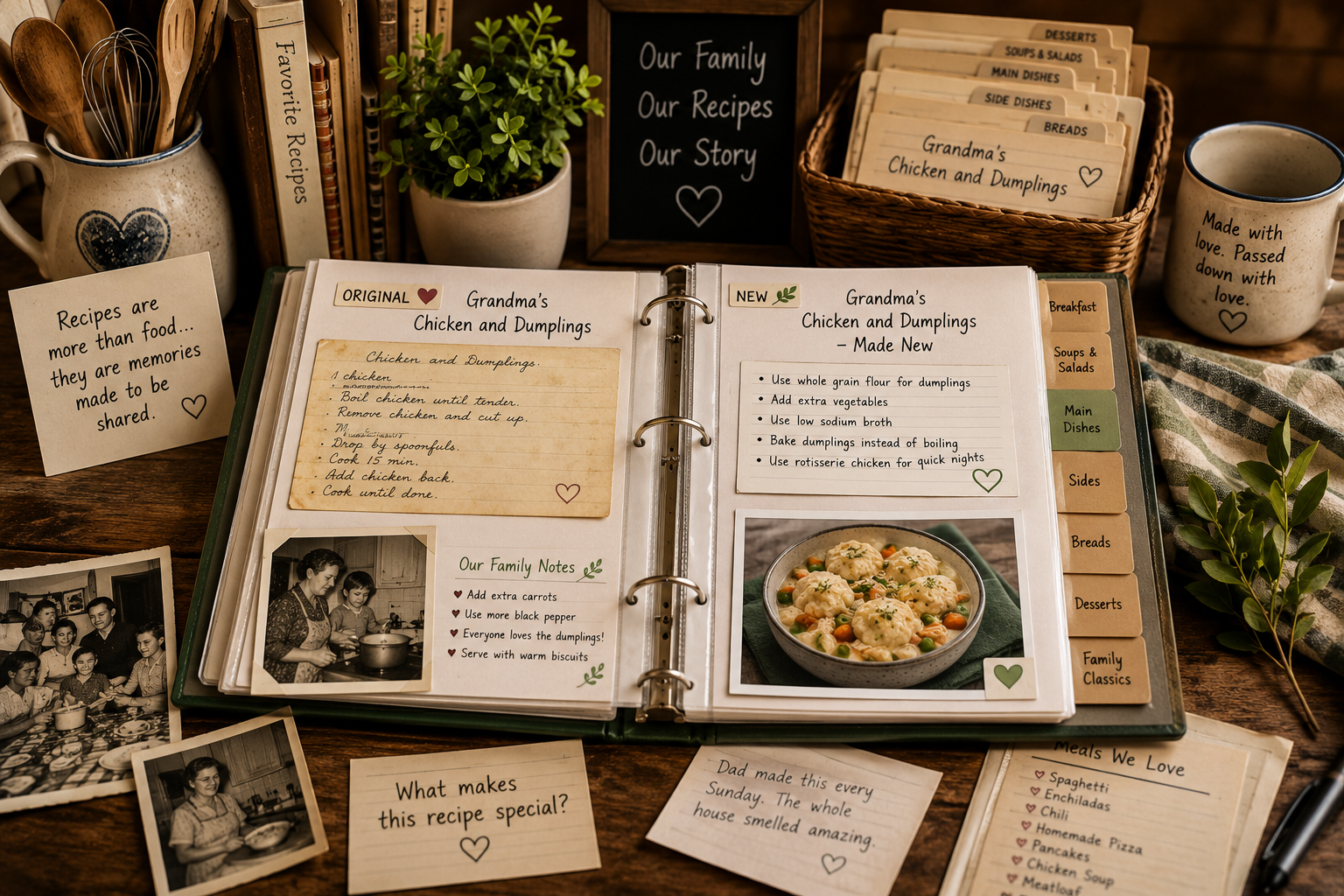
A complete recipe page includes the recipe name, who it came from, ingredients, instructions, cooking time, servings, and a notes section. That notes section is where the recipe becomes specifically yours: "Double this for Thanksgiving." "The kids prefer mozzarella over cheddar." "Grandma always used the big yellow pot." "Start the sauce at least two hours ahead." "This is better the next day." These notes are the difference between a generic recipe for chicken casserole and your family's chicken casserole — the specific adjustments and observations that have accumulated through many makings of it.
Including a "Our Family Notes" section specifically on the page, rather than just a general notes field, creates an explicit invitation to add these observations rather than leaving them to be carried in memory.
Add Photographs from Real Life
The photographs in a family recipe binder don't need professional food styling or perfect lighting. They need to be real.
The Thanksgiving table where everyone is seated. Someone's hands mixing the dough for the cookies. A grandchild's face covered in birthday cake. The slightly crooked pie that was the best tasting one anyone could remember. The photograph of someone teaching someone else how to make something that had been in the family for a generation. These images carry context that a recipe can't — who was there, what the occasion was, what the kitchen looked like, who was still with us then.
Photographs that document the making of food or the eating of it often become more valuable over time than the recipes they accompany. Future generations may know the recipe from having made it themselves and value the photograph for the people in it. Print photographs and include them with the relevant recipes rather than leaving them in phone photo libraries where they become difficult to find and eventually inaccessible.
Keep Both the Original and the New Version
This is where the Old2New philosophy becomes specifically meaningful for a family recipe binder. When cooking changes over time — when dietary considerations, ingredient availability, or health goals mean that the original recipe is made differently now — both versions deserve a place in the binder.
The original recipe stays. It represents the recipe as it was made by whoever created it, in the form it took when it became a family staple. Its specific ingredients and proportions and methods are historical record.
The updated version — the one that adds more vegetables, uses a leaner protein, reduces sodium, substitutes a whole grain, or replaces heavy cream with something lighter — gets its own version on the same page or the following one. "Grandma's Chicken Casserole — Our Everyday Version" honors the original while making room for how the family actually makes it now.
This dual-version approach resolves the tension between preserving tradition and adapting to changed circumstances. The original isn't erased to make room for the new version. The new version doesn't replace the original. Both exist, and the note that connects them — "we started making it this way when" — is itself part of the family food story.
Write Down Why the Recipe Matters
Under each recipe, a few sentences about its place in the family's history may become the most important thing on the page.
"Grandma made this every Christmas Eve without exception." "Dad cooked this whenever Mom worked late — we always knew it was a Dad-cooks night." "This was the first dinner we made in the new house." "The kids requested this for every birthday from about age four until they left for college." "We don't remember where this recipe came from but it's been on the table for as long as anyone can remember."
These sentences are the context that prevents a recipe from being just a recipe. They're why someone would make the chicken soup or the casserole or the pie even when other options might be faster or easier — because making it is an act of continuity with the people who made it before.
Twenty years from now, the sentences matter differently than they do today. The person who wrote "Grandma made this every Christmas Eve" may be the grandparent by then, and the sentence carries a different meaning.
Create a "What Can I Make With..." Reference Page
A family recipe binder that helps solve the daily question of what to cook for dinner is more useful than one that only preserves special occasion recipes. A reference page listing meal ideas by available ingredient brings the binder into regular weekly use rather than reserving it for holidays and special occasions.
The page is simple: a list of core ingredients the household typically has available, each followed by several meal ideas. Chicken leads to chicken tacos, chicken soup, chicken pasta, chicken bowls, chicken casserole. Ground beef leads to tacos, meatloaf, spaghetti, burgers, stuffed peppers. Eggs lead to omelets, frittata, egg muffins, shakshuka. The list grows as new family favorites are added over time.
This page transforms the binder from a recipe archive into a practical cooking reference — something to consult on a Wednesday evening when the question of what to make needs a quick answer grounded in what the household knows and likes.
Keep a Family Favorites List
A page near the front of the binder titled "Meals We Love" — updated as new recipes earn their place through repeated requests — provides a personalized answer to the perpetual dinner question. When the household runs out of ideas, the list provides a starting point drawn from proven success rather than requiring inspiration or internet searching.
The list grows organically over years. A recipe made for the first time this year might appear on the list within months. A recipe that's been on the list for decades might be the one that feels most like home when it appears on the table. The list is the household's own record of what works, what gets requested, and what has become part of the food identity.
Leave Pages Empty
The binder shouldn't be finished. Whatever structure and categories are established, leave room — literal blank pages — for the recipes that will arrive over the years ahead. The new dish that becomes a household staple next year. The recipe shared at a dinner party that gets adopted. The first dish someone in the next generation learns to make well enough to contribute to the collection. The holiday recipe that gets added to the rotation.
The family food story isn't finished, and neither is the binder that holds it. A binder that's completely filled leaves no room for what comes next.
FAQ
What if family members have recipes that haven't been written down? Ask them to make the dish while someone else watches and takes notes. This is more accurate than asking them to write it from memory, because cooking from memory and describing cooking from memory are different processes. The observer can ask questions in real time: how long does that simmer? How do you know when it's done? What does the texture look like at this stage? A session of watching and recording captures what describing never quite does.
What format works best — physical binder or digital? A physical binder has advantages that digital collections don't: it can be handed to someone, it can hold original handwritten recipe cards, it can be annotated with a pen, and it exists independently of any particular technology. A digital backup (photographs of each page, or a parallel digital document) provides redundancy. The original family recipe binder is most meaningful as a physical object that can be passed from person to person and household to household.
How do I handle family recipes that no longer fit dietary restrictions? Include the original recipe and add a section for dietary adaptations. A recipe that's been in the family for generations belongs in the binder regardless of whether everyone can currently eat it — it's part of the family food history. An adapted version that works for current dietary needs can live alongside it, clearly labeled, so both the history and the present version are preserved.
Continue Your Recipe Transformation Journey
A family recipe binder is where the Old2New philosophy becomes most personal — transforming recipes while preserving what makes them meaningful. These guides will help you apply it:
- How to Make Your Favorite Recipes Healthier Without Starting Over — how to update family recipes while keeping what matters
- How to Make Comfort Food Healthier — the specific swaps that work in classic family recipes
- What Is Recipe Transformation? — the philosophy behind preserving recipes while adapting them
- 10 Healthy Ingredient Swaps — practical swaps to apply to family recipes
- How to Use Leftovers Creatively — how family recipes become multiple meals
Old2New — There is good in everything.