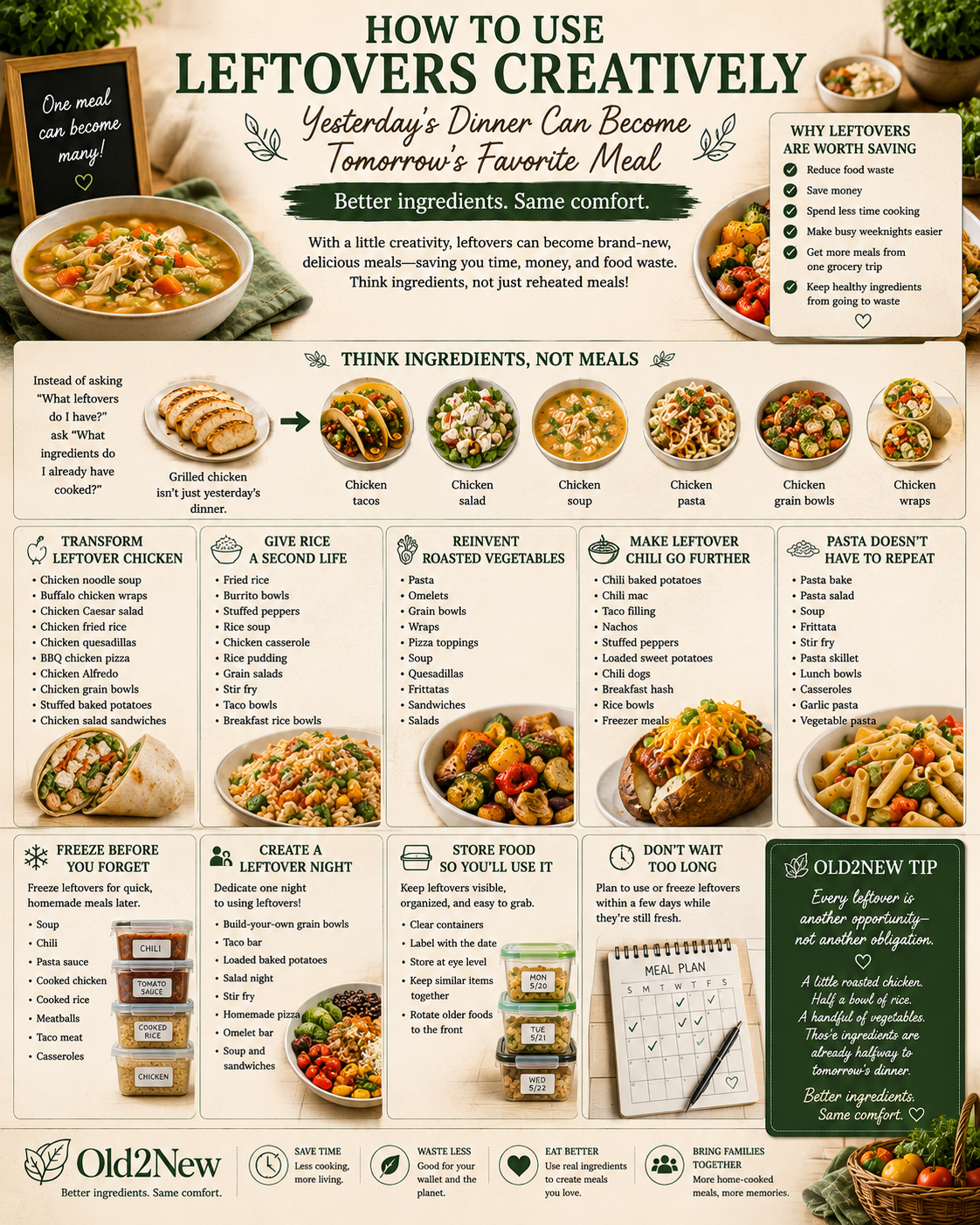
How to Use Leftovers Creatively
Leftovers have a reputation problem. The word itself implies something diminished — the remainder after the real meal is over, something to be tolerated rather than looked forward to. But that framing is entirely wrong, and changing it changes how useful leftovers become.
A leftover isn't a repeat of last night's dinner. It's a cooked ingredient that's already done its hardest work — the time, the heat, the preparation — and is now available to become something completely different with very little additional effort. The grilled chicken breast that was dinner on Tuesday isn't Tuesday's dinner again on Wednesday. It's a protein that goes into a grain bowl, a wrap, a quesadilla, a pasta, or a soup with ten minutes of assembly and no actual cooking required.
That reframe — from "leftover meal" to "cooked ingredient" — is what makes leftovers genuinely useful rather than something that sits in the refrigerator until it's thrown away on Friday.
Why Leftovers Are Worth Saving
Using leftovers consistently reduces food waste, lowers grocery spending, cuts the time required to produce weeknight dinners, and creates a supply of homemade convenience food that's ready when time is short. A pot of chili made on Sunday that's large enough to serve six becomes four different meals over the course of the week with no additional cooking. Roasted vegetables from Monday's sheet pan dinner go into Tuesday's grain bowl and Wednesday's omelet without any reheat-and-repeat repetition.
The financial and environmental benefits compound quickly — food that gets used rather than thrown away is money recovered from what would otherwise be waste, and the time saved by assembling rather than cooking is time that gets returned to everything else a weeknight demands.
Think Ingredients, Not Meals
The most important shift in approaching leftovers is changing the question from "what leftovers do I have?" to "what ingredients do I already have cooked?" The first question invites the assumption that the leftover is a fixed thing — tonight's dinner is Tuesday's chili again. The second question opens up the leftover as a component that can go in any number of directions.
A cooked chicken breast is not specifically Monday's roasted chicken. It's sliced chicken that can go into a Caesar salad, shredded chicken that can fill a taco, diced chicken that can go into a soup, or chicken that can top a grain bowl with whatever vegetables and dressing are available. The preparation that already happened — the cooking time, the seasoning — doesn't determine what the chicken has to become next.
This is the mental model that makes leftovers useful: every cooked ingredient is a building block for something new, not a predetermined meal that has to be eaten in its original form.
Transform Leftover Chicken
Cooked chicken is the most versatile leftover protein in the kitchen because its mild flavor works across virtually every cuisine and every meal format.
Shredded chicken goes into chicken noodle soup with leftover broth and whatever vegetables are in the refrigerator — a dinner that takes 20 minutes when the chicken is already cooked. Sliced chicken fills a wrap with hummus, spinach, cucumber, and tomato for a lunch that requires no cooking at all. Diced chicken goes into chicken fried rice with day-old rice, frozen peas, garlic, and soy sauce — one of the fastest dinners available when the main ingredients are already cooked. Pulled or shredded chicken heated with a spoonful of buffalo sauce fills a quesadilla or goes over a baked potato. Sliced chicken scattered over a grain bowl with quinoa, roasted vegetables, and a drizzle of tahini becomes a complete lunch in five minutes of assembly.
Cooking a larger batch of chicken than needed for one meal is one of the most efficient strategies in weekly cooking — the extra 15 minutes of prep time on Sunday produces protein for three to four different meals throughout the week.
Give Rice a Second Life
Cooked rice is perhaps the most underappreciated leftover ingredient — it sits in the refrigerator and often gets thrown away when it could become some of the fastest, most satisfying meals in the kitchen.
Day-old rice is actually better than fresh rice for fried rice — the drier texture allows it to absorb sauces and season without becoming mushy. Cooked rice with eggs, frozen vegetables, garlic, and soy sauce stir-fried in a hot pan is dinner in 12 minutes. Rice stirred into a soup adds body and makes a simple broth-based soup substantial enough to be a complete meal. Cooked rice heated with a little broth, warmed with cinnamon and honey, topped with fresh fruit and a spoonful of Greek yogurt becomes a warm breakfast bowl. Rice mixed with black beans, salsa, and whatever protein is available becomes a burrito bowl with almost no assembly time.
Reinvent Roasted Vegetables
Roasted vegetables are one of the most useful leftovers in the refrigerator because they've already been seasoned, cooked, and concentrated in flavor — which means they contribute more to a new dish than raw vegetables that still need cooking.
A cup of leftover roasted vegetables goes over pasta with olive oil and parmesan for a complete dinner in 15 minutes. Stirred into scrambled eggs or folded into an omelet, they add color, flavor, and vegetables to breakfast without any additional work. Scattered over a grain bowl with cooked quinoa and a drizzle of tahini or lemon dressing, they become a lunch that takes five minutes to assemble. Layered into a quesadilla with a little cheese, they produce a fast lunch or dinner. Pureed with broth and garlic, they become the base of a soup that tastes like it took much longer than it did.
Roasting a larger tray of vegetables than needed for one dinner is a form of meal prep that pays dividends for three or four subsequent meals without any additional cooking time.
Make Leftover Chili Go Further
Chili is one of the best make-ahead meals specifically because it's so easy to repurpose. A pot of chili made on Sunday can become a genuinely different dinner every night for the first half of the week without feeling repetitive.
Ladled over a baked potato with Greek yogurt and shredded cheese, it becomes loaded chili baked potatoes. Stirred into cooked pasta with a little cheese on top and baked until bubbly, it becomes chili mac. Used as a taco filling in corn tortillas with fresh toppings, it becomes chili tacos. Spooned over a halved roasted sweet potato with avocado and fresh herbs, it becomes loaded sweet potatoes that feel like a completely different meal from the soup it started as. Stirred into a breakfast hash with diced potatoes and topped with a fried egg, it becomes a weekend brunch that uses up the last portion.
Each of these uses the same base but presents it in a context that feels intentional and new rather than repetitive.
Pasta Doesn't Have to Repeat
Leftover pasta is one of the most useful and most wasted ingredients in home kitchens — it often gets thrown away because the only obvious option seems to be reheating the same dish, which is less appealing than the original.
But leftover pasta is actually a building block. Cold leftover pasta tossed with a vinaigrette, cherry tomatoes, cucumber, and olives becomes a pasta salad that's better than one made fresh because the pasta has had time to absorb dressing. Leftover pasta stirred into a soup adds heartiness and body that takes the soup from broth-based to substantial. Leftover pasta pressed into a hot skillet with olive oil and eggs becomes a crispy frittata-style pasta cake. A pasta bake assembled from leftover pasta, a jar of marinara, whatever cheese is in the refrigerator, and any protein available becomes a completely different dish from the original.
Freeze Before You Forget
Not every leftover needs to be eaten in the next two days. Some ingredients and dishes freeze so well that they become homemade convenience food — available on the nights when there's no time or energy to cook and the alternative would otherwise be takeout.
Soups and chili freeze perfectly and reheat beautifully. Pasta sauce freezes in portions that thaw quickly and go over fresh pasta for a dinner that takes 15 minutes total. Cooked meatballs freeze individually and can be added to soup or pasta from frozen. Taco meat freezes in portions and thaws in the microwave for a fast taco night. Cooked rice freezes in portions and can be used directly from frozen in stir fry. Casseroles and baked pasta dishes portion into individual servings and freeze for lunches that are better than anything from a drive-through.
The habit of freezing before forgetting — putting portions in the freezer on the day the meal is made rather than waiting until leftovers are about to go bad — means the freezer contains a rotating supply of real food that requires no planning to use.
Create a Leftover Night
Many families find it useful to designate one evening each week as a leftover night — an occasion for using up whatever cooked ingredients are in the refrigerator before the next week's grocery trip. The format works best when it's framed as a build-your-own situation rather than a reheat-and-eat one.
A grain bowl bar where everyone assembles their own bowl from the available cooked grains, proteins, and vegetables gives everyone customization within the same meal. A taco bar where the filling is leftover protein and everyone chooses their own toppings turns Tuesday's chicken into Friday's taco night with minimal effort. A loaded baked potato bar with whatever toppings are available — leftover chili, Greek yogurt, cheese, black beans, broccoli — uses up multiple small amounts of leftovers simultaneously.
These formats work particularly well for households with picky eaters because the customization means everyone can find a combination they're happy with from the available ingredients.
Store Food So You'll Use It
Leftovers that are visible get used. Leftovers buried behind other containers get forgotten and eventually thrown away. Storage habits matter more than most people realize.
Clear containers make leftovers immediately visible when the refrigerator is opened — which makes them significantly more likely to be considered as an option for the next meal. Labeling containers with the date removes the uncertainty about how long something has been in the refrigerator. Storing frequently used items at eye level rather than at the back of the bottom shelf makes them easier to reach for. Grouping similar leftovers together — all the grains in one area, all the proteins in another — makes it easier to see what's available and what can be combined.
The refrigerator organization that makes leftovers most useful is one where everything is immediately visible and the date is clearly labeled, so the decision to use something is easy rather than uncertain.
FAQ
How long are leftovers safe to eat? Most cooked foods keep safely in the refrigerator for three to four days. Soups and stews keep for three to four days. Cooked grains keep for five to six days. Cooked proteins (chicken, beef, fish) keep for three to four days. When in doubt, use the smell and appearance test — properly stored leftovers that smell and look fine are almost always safe within the four-day window. Label containers with the date they were made to remove the guesswork.
What's the best way to reheat leftovers without drying them out? Adding a small amount of moisture before reheating prevents most drying. A splash of broth in a soup or stew. A tablespoon of water added to rice or grains before microwaving. A drizzle of olive oil over roasted vegetables before reheating in a pan. Covering whatever is being reheated in the microwave traps steam and prevents moisture loss. For proteins, reheating gently at lower temperature for longer rather than high heat quickly produces a juicier result.
Is it better to freeze leftovers immediately or eat them first? If you know you won't eat something within three days, freeze it immediately rather than waiting. Freezing on the day something is made or the day after preserves quality better than freezing after several days in the refrigerator. The habit of freezing intentionally — deciding when cooking that a portion is going directly to the freezer — produces better results than the reactive freeze of leftovers that are about to go bad.
What leftovers freeze best? Soups, stews, and chili freeze and reheat exceptionally well. Pasta sauces, taco meat, meatballs, and cooked beans freeze well. Cooked grains (rice, quinoa) freeze well and can be used directly from frozen. Casseroles and baked pasta dishes freeze in portions. Proteins like cooked chicken and ground meat freeze well. The things that don't freeze well: raw salad greens, dishes with mayonnaise-based dressings, fried foods (they lose their crispiness), and cream-based sauces (which tend to separate on reheating, though blended cottage cheese and Greek yogurt-based sauces freeze better than heavy cream).
Continue Your Recipe Transformation Journey
Using leftovers creatively is one of the most practical habits for making healthy home cooking sustainable. These guides will help you build on it:
- Beginner's Guide to Meal Planning — how planning ahead makes leftover use intentional rather than accidental
- Pantry Staples Every Home Cook Should Keep — the ingredients that complete leftover meals
- Stop Throwing Away Food — the bigger picture of reducing food waste
- What Can I Make with Chicken? — the complete guide to the most versatile leftover protein
- What Can I Make with Rice? — everything cooked rice can become
Old2New — There is good in everything.