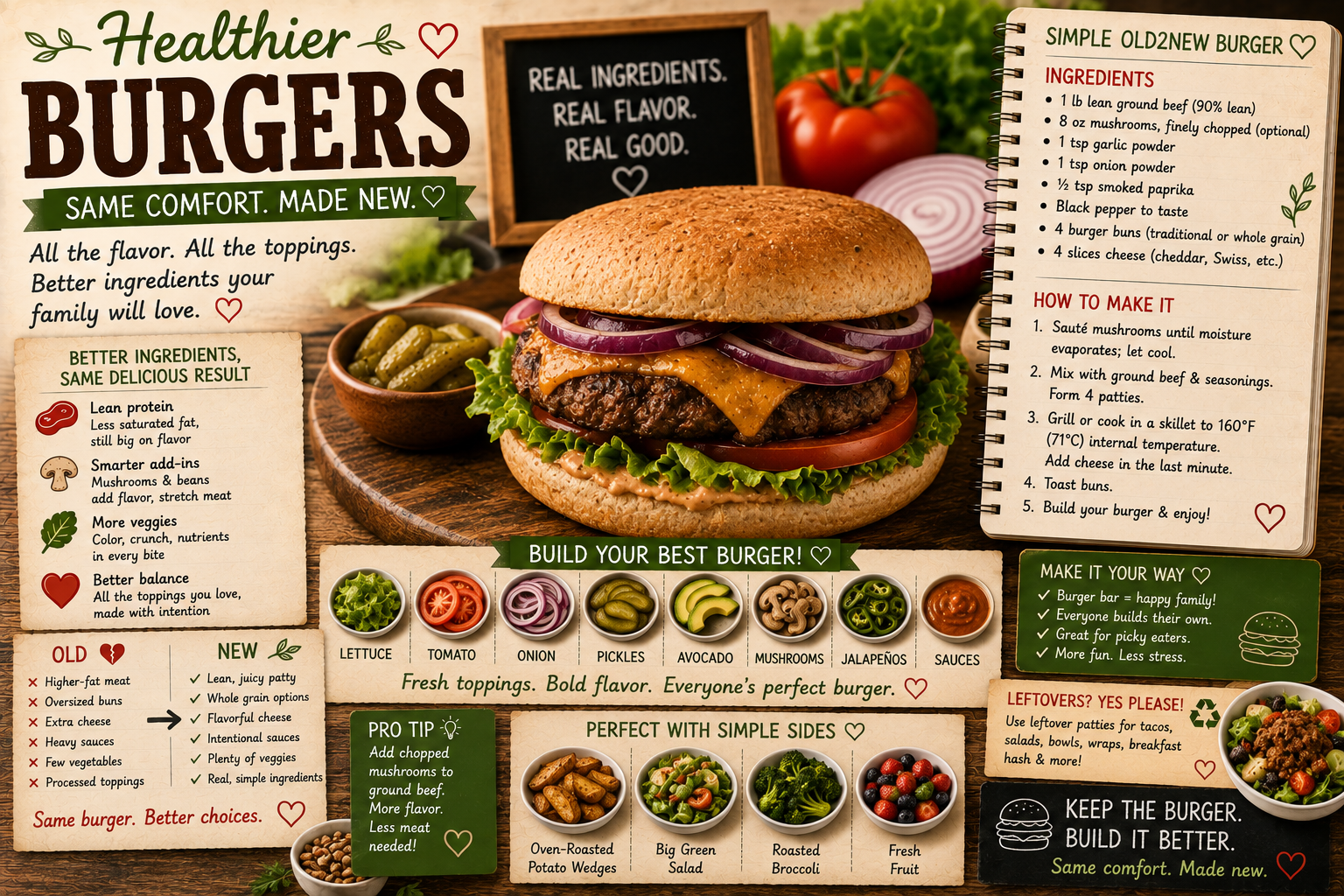
Healthier Burgers: Build a Better Burger Without Losing the Good Stuff
There is something about burger night that just works. A hot, juicy burger straight from the grill. A toasted bun. Melted cheese. Lettuce, tomato, onion, pickles. Maybe some mustard or your favorite sauce. Everyone's happy. Nobody's thinking about dinner being difficult.
Healthier burger recipes sometimes go so far in a different direction that the burger disappears entirely. Lettuce instead of a bun. No cheese. No sauce. A small, dry patty. The resulting meal technically contains hamburger ingredients but doesn't produce the burger-night feeling that makes it worth making. That's not a transformation — that's a substitution that makes everyone wish they'd had the real thing.
The burger stays. The bun stays. The cheese stays if you want it. We're building a burger someone would be genuinely excited to eat, not a burger someone tolerates because they decided to be healthier.
Start with a Good Patty
The burger is the star and it earns that status. If what you're craving is a traditional beef burger, make the beef burger. The adjustment is choosing a somewhat leaner ground beef — 90% or 93% lean — which maintains the beef flavor and enough fat for a juicy, satisfying patty while reducing the saturated fat compared to the 80% lean typically used.
Ground turkey, ground chicken, and salmon are genuine alternatives that produce excellent burgers when prepared correctly — not as consolation prizes for people who "can't" have beef, but as different, worthwhile options in their own right. A well-seasoned turkey burger with caramelized onions, avocado, and sharp cheddar is a legitimately good dinner. A salmon burger with Greek yogurt sauce and cucumber is something different from a beef burger and genuinely excellent.
The black bean or lentil burger deserves mention not as a substitute for beef but as what it actually is: a different meal that's deeply satisfying in its own right. A well-seasoned black bean patty with salsa, avocado, cheese, and pickles on a toasted bun doesn't need to pretend it's beef to be worth making.
Don't Let Lean Burgers Become Dry Burgers
The most common failure mode of "healthier" burgers is dryness — choosing very lean meat and then overcooking it into something nobody wants to eat again. Dry burgers are not a success regardless of their lean protein content; they produce the outcome where everyone wished they'd had the real thing.
Several techniques prevent this with lean ground beef. Season the meat well before forming — garlic powder, onion powder, smoked paprika, black pepper work together to build flavor that compensates for the reduced fat content. Don't press the patty while it cooks — pressing squeezes out the juices that provide moisture and flavor. Use a meat thermometer rather than guessing by color; ground beef is safely cooked at 160°F, which is fully cooked through without being completely dry if the heat is managed correctly. Let the patty rest for two minutes after coming off the grill before it goes on the bun — the juices redistribute rather than running out onto the plate.
Mushrooms Make the Beef Better
Finely chopped mushrooms sautéed until their moisture has cooked off and then combined with ground beef produce a patty that's more deeply flavored, more moist, and more substantial than a pure beef patty of the same size. The mushroom's umami amplifies the beef's savory quality, and the moisture that remains after sautéing keeps the leaner beef from drying during cooking.
The technique: chop mushrooms very finely (a food processor makes this fast), cook in a dry pan over medium-high heat until the moisture has released and evaporated and the mushrooms are slightly golden, let cool to room temperature, and mix gently into the ground beef. The ratio that works without changing the burger's fundamental character is roughly one part mushroom to three or four parts beef — enough to contribute moisture and flavor without the patty tasting like mushroom.
This is one of those improvements that most people notice as "this burger tastes really good" rather than identifying the specific change.
Keep the Bun
The bun stays. A burger without a bun is a different meal — a good meal, but not burger night. The bun provides structure, texture contrast, and the specific eating experience that defines what a burger is.
The adjustments available within keeping the bun: whole grain buns add fiber while delivering the same soft interior and slightly crispy exterior that makes a good burger bun work. Smaller buns improve the burger-to-bread ratio and make each bite more patty-forward. Sourdough buns add a slight tang that contrasts the richness of the beef and cheese.
If the household's favorite is a standard hamburger bun, use the standard hamburger bun. The improvement in the patty, the toppings, and the preparation does more work than switching the bun.
Toast the Bun
Two minutes of toasting the inside of the bun — on the grill, in a skillet, or under the broiler — transforms a mediocre bun into a significantly better one. The surface becomes slightly crisp, the interior warms and becomes fragrant, and the structure holds up better under the juicy patty and fresh toppings than an untoasted bun does. The toasted surface also prevents the bottom bun from becoming immediately soggy from the burger's juices.
This is the technique improvement that costs nothing and makes the burger noticeably better regardless of any other adjustment.
Cheese Is Allowed
Cheeseburger people: the cheese stays.
One flavorful slice placed on the patty in the final minute of cooking, allowing it to melt over the meat, does exactly what cheese is supposed to do in a burger. Sharp cheddar provides intense flavor so a smaller amount contributes as much as a larger amount of mild cheese. Swiss adds a nutty quality. Pepper jack adds heat alongside the dairy richness. Provolone melts smoothly and provides a mild, slightly smoky flavor. Any of these in a single slice produces the cheeseburger experience.
Setting out cheese separately and letting people choose their preferred type and whether they want it at all works naturally in the burger bar format where everyone builds their own.
Build the Toppings High
The toppings are where burgers become an obvious vehicle for vegetables — not because the vegetables are added as a health measure but because they genuinely improve the burger. A thin slice of sharp tomato cuts through the richness of the patty and cheese. Crisp lettuce adds cool crunch that contrasts the warm, soft burger. Red onion adds sharpness. Pickles add acid and brine that balances the fat. Avocado adds creaminess and mild flavor that pairs beautifully with beef and cheddar.
The vegetables aren't competing with the burger — they're completing it. A burger loaded with lettuce, tomato, red onion, pickles, and avocado tastes more satisfying and more complex than the same burger with a single lettuce leaf and nothing else, and the eating experience is better in every way.
Grilled mushrooms as a topping — sliced and cooked on the grill alongside the patty until they're slightly caramelized — are one of the best burger toppings available. Roasted red peppers, jalapeños, and grilled pineapple are worth exploring for households that want variety in their burger nights.
Be Intentional About Sauce
Sauce is what makes a good burger into a memorable one, and the goal isn't to eliminate it — it's to choose it deliberately. A thin spread of good mustard on one bun half and ketchup on the other is the classic for reasons that haven't changed. A dollop of Greek yogurt mixed with garlic, lemon, and dill produces a tzatziki-style burger sauce that works particularly well with turkey patties and avocado. A spread of mashed avocado with lime and cilantro is simultaneously the sauce and the vegetable topping. Salsa adds acid, vegetables, and heat simultaneously.
The adjustment from heavy mayonnaise-based sauces isn't eliminating sauce but choosing sauces that add flavor and freshness alongside the fat rather than purely providing richness.
A Simple Old2New Cheeseburger
Ingredients (serves 4)
- 1 lb lean ground beef (90% or higher)
- 8 oz mushrooms, finely chopped and sautéed until dry (optional)
- 1 tsp garlic powder
- 1 tsp onion powder
- ½ tsp smoked paprika
- Black pepper to taste
- 4 hamburger buns (traditional or whole grain)
- 4 slices sharp cheddar or preferred cheese
For the toppings:
- Lettuce
- Sliced tomato
- Red onion
- Pickles
- Sliced avocado
- Mustard, ketchup, or preferred sauce
Instructions
If using mushrooms, finely chop and cook in a dry skillet over medium-high heat until all moisture has evaporated and they're slightly golden. Cool to room temperature.
Combine mushrooms (if using) with ground beef, garlic powder, onion powder, smoked paprika, and black pepper. Mix gently — just until combined. Overmixing produces dense patties. Form into four patties slightly wider than the buns.
Cook on a grill or skillet over medium-high heat to an internal temperature of 160°F for beef, without pressing down on the patties. Add cheese in the final minute of cooking to melt.
Toast the bun cut-side down on the grill or in a skillet until lightly golden. Assemble: bun, patty, melted cheese, toppings, sauce, top bun.
Turkey Burger Tips
Turkey burgers are excellent when moisture and seasoning are addressed deliberately. Ground turkey has almost no fat to contribute moisture, so the additions matter more than with beef: finely grated onion (which releases moisture as the patty cooks), sautéed mushrooms mixed in, a tablespoon of Worcestershire sauce, and fresh or dried herbs produce a turkey burger that stays moist and flavorful rather than becoming a dry disc nobody reaches for a second time.
Turkey burgers need to reach an internal temperature of 165°F, which means they benefit from slightly lower heat and more cooking patience than beef — cooking over medium rather than medium-high prevents the outside from drying before the inside is done.
The Burger Bar Format
Like taco night and pizza night, burgers are natural candidates for the bar format: patties on a platter, buns in a basket, cheese and toppings in bowls, sauces alongside. Each person builds exactly what they want.
This format produces better individual outcomes than one assembled burger that tries to please everyone. It also makes it possible to offer multiple patty types simultaneously — beef and turkey patties cooked together allow each person to choose — and to vary the cheese and sauce options without making separate dinners for different preferences.
A Note on the Fries
Fries come up because they belong to burger night as much as the burger does. Oven-roasted potato wedges tossed with olive oil, garlic powder, and smoked paprika at 425°F for 35 minutes produce a genuinely satisfying result that doesn't require the deep fryer. Air fryer fries from sliced russets, soaked in cold water for 30 minutes to remove starch, cook at 400°F in batches into something crispy and legitimately good. Sweet potato wedges roasted at high heat caramelize into something deeply satisfying alongside a beef burger.
Regular fries served in reasonable quantity alongside a well-built homemade burger is also a completely legitimate dinner. The entire meal's balance matters more than achieving perfection in any single element.
FAQ
How do I keep burgers from shrinking dramatically on the grill? Make a slight indentation in the center of each patty with your thumb before cooking — about half an inch deep. As the patty cooks, the edges contract and the center rises to meet them, producing a flatter patty that stays close to the bun's size. Starting with patties slightly wider than the bun accounts for the overall shrinkage that happens regardless.
Can I make patties ahead of time? Yes — formed patties can be refrigerated for up to 24 hours before cooking, covered on a plate or in a container. They can also be frozen between parchment paper sheets for up to three months and cooked from frozen (add several minutes to the cooking time). Making a double batch and freezing half is a worthwhile efficiency — the work of mixing and forming patties scales minimally with quantity.
What's the best way to know when a burger is done without cutting into it? A digital instant-read thermometer inserted horizontally into the center of the patty is the most reliable method. Ground beef is safely cooked at 160°F; ground turkey at 165°F. The color of the meat is not a reliable indicator of doneness.
Continue Your Recipe Transformation Journey
Burger night is one of the most customizable and family-friendly comfort food formats. These guides will help you build on it:
- Easy Ways to Add More Vegetables Without Anyone Noticing — how mushrooms improve the patty from the inside
- What Can I Make with Avocados? — the versatile burger topping that adds healthy fat and creaminess
- Kitchen Tools That Actually Make Healthy Cooking Easier — why a meat thermometer belongs in every kitchen
- How to Make Your Favorite Recipes Healthier Without Starting Over — the philosophy behind every swap
- Easy Sheet Pan Dinners — how to make oven-roasted fries alongside the burgers
Old2New — There is good in everything.