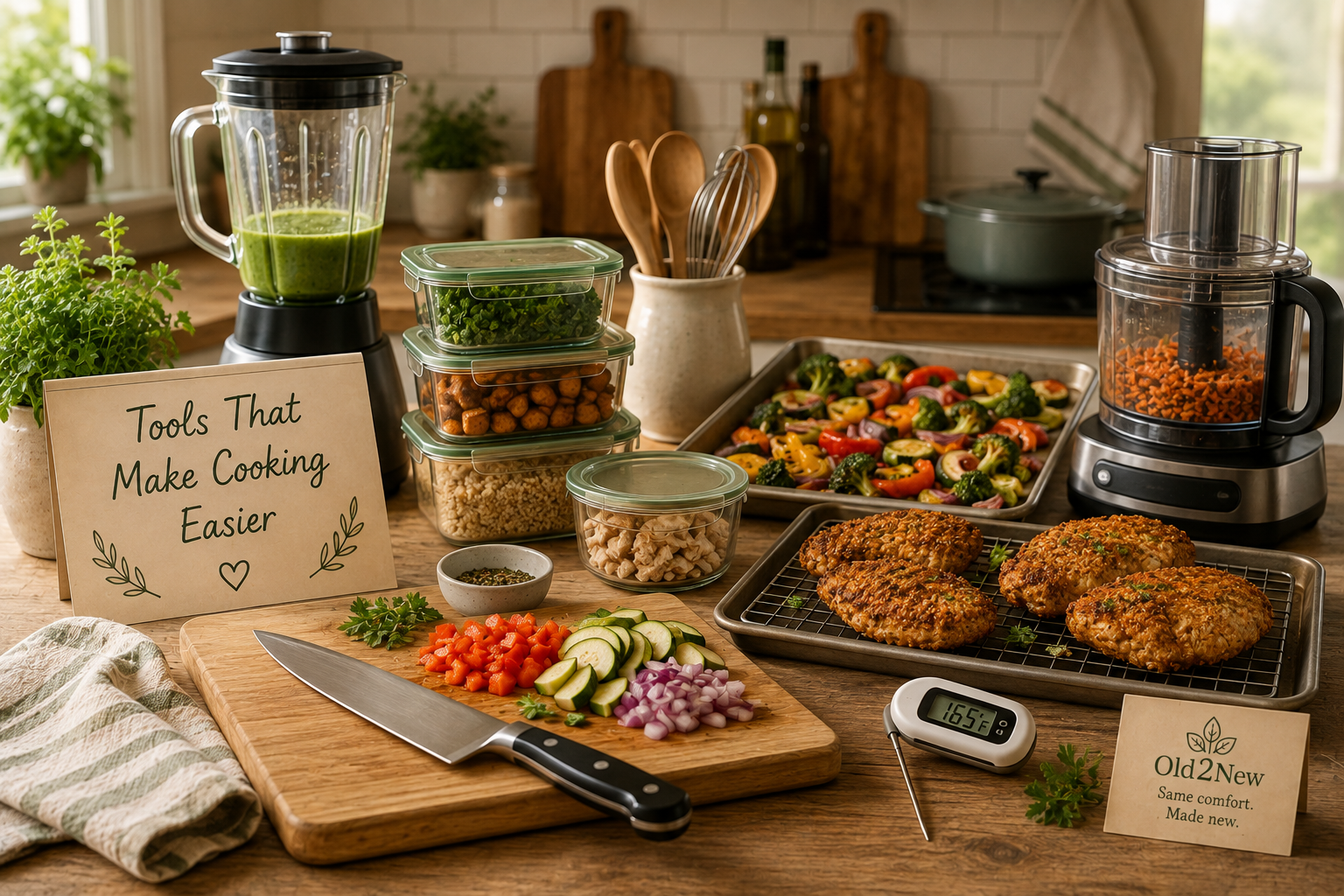
Kitchen Tools That Actually Make Healthy Cooking Easier
The best kitchen tools aren't the most impressive ones or the most expensive ones. They're the ones that solve the specific problems that make cooking feel harder than it needs to be: prep takes too long, vegetables are annoying to prepare, dinner needs to get on the table quickly, or the cleanup afterward is so extensive that starting another meal tomorrow feels unwelcome.
A kitchen full of gadgets and specialized appliances often makes cooking feel more complicated rather than less. The useful alternative is a small collection of versatile, hardworking tools that earn their counter or drawer space by appearing in meals regularly and making the cooking that happens around them genuinely easier.
These are the tools worth having — and why each one earns its place.
A Good Chef's Knife
If there's one tool worth genuine investment, this is it. A sharp, comfortable chef's knife makes the single task that precedes most cooking — chopping, slicing, and dicing — faster, easier, and more consistent. With a good knife, dicing an onion takes 90 seconds instead of four frustrated minutes. Slicing chicken takes one smooth motion rather than the sawing struggle a dull blade requires.
You don't need a large knife set. For most home cooking, one good chef's knife (8 to 10 inches) and a smaller paring knife handle the vast majority of everyday prep tasks. The chef's knife does almost everything: vegetables, fruit, herbs, boneless meat, and general cutting work. The paring knife handles smaller, more precise tasks where a large blade is awkward.
A sharp knife is also safer than a dull one — a blade that moves predictably through food requires less force and gives more control than a dull blade that slips and requires pressure. Having the knife sharpened once or twice a year and honed with a steel before use keeps it performing well. This investment in the knife and its maintenance pays dividends in every cooking session.
A Large Cutting Board
A cutting board that's too small turns prep into an obstacle course — ingredients fall off the edges, there's no room to sort what's been cut from what hasn't, and the work surface becomes a source of frustration rather than a useful platform.
A large cutting board (at least 12x18 inches, ideally larger) provides enough space to work comfortably with multiple ingredients at once and reduces the number of trips to the sink to clear the board mid-prep. Wood or bamboo boards are gentler on knife edges than plastic, though plastic boards are dishwasher-safe and preferable for raw meat.
For raw meat, poultry, and seafood, using a separate cutting board — or thoroughly cleaning and sanitizing the board and surrounding surfaces before using it for other foods — prevents cross-contamination with ready-to-eat ingredients.
Sheet Pans
Sheet pans (half-size, 18x13 inches with a one-inch rim) are the most versatile, highest-return piece of equipment in a healthy kitchen. One pan holds a complete dinner — protein on one side, vegetables on the other, seasoned together and roasted in the oven — with almost no hands-on time and a single pan to wash afterward.
The applications are extensive: roasted vegetables of every variety, chicken thighs or breasts, salmon fillets, shrimp, sausage and vegetables together, sheet pan fajitas, crispy chickpeas, homemade baked fries, and any preparation where high-heat roasting produces the caramelization and crunch that other cooking methods don't achieve. Having two or three sheet pans means roasting large quantities at once without crowding — the most common mistake that prevents proper caramelization.
The cleanup advantage is significant. A sheet pan dinner washes one pan, a knife, and a cutting board. That's one of the lowest-overhead cooking formats available, which matters for maintaining the cooking habit on days when the prospect of significant cleanup is part of what makes takeout appealing.
A Wire Rack
A wire rack set inside a sheet pan solves one specific problem elegantly: it allows air to circulate underneath food during oven cooking, which is what produces a crispy bottom rather than a steamed or soggy one.
For chicken cooked in the oven, the wire rack means the skin crisps on both sides rather than sitting in the released juices on the pan. For anything meant to be breaded and baked as a healthier alternative to frying — fish fillets, chicken cutlets, meatballs — the rack allows heat to reach all surfaces simultaneously. For roasting proteins alongside vegetables, the rack can elevate the protein so drippings fall onto the vegetables below and baste them naturally through the cooking time.
An inexpensive addition to the sheet pan setup that makes a meaningful difference in the results.
An Air Fryer
An air fryer is a countertop convection oven that circulates hot air rapidly around food, producing results closer to deep frying than standard oven baking but with minimal oil. For households that frequently want the crispy exterior that oil typically creates, it's a genuinely useful appliance.
The applications where it performs best: chicken pieces that need crispy skin, potatoes cut into fries or cubes, vegetables that benefit from caramelized edges, fish fillets, shrimp, and reheating leftovers where an oven would over-dry and a microwave would make things soggy. It also preheats in two to three minutes rather than 15 to 20, making it more practical for quick weeknight portions than the oven.
The limitation most air fryers share is capacity — most home models hold enough food for two to three portions comfortably, which makes them ideal for smaller households or for supplementary cooking alongside the oven for larger ones. It's a convenience tool rather than an essential one, but for households where it fills a regular role, the convenience is genuine.
A Slow Cooker or Multicooker
The slow cooker's greatest contribution to healthy home cooking is time displacement: the work happens in the morning, and dinner is ready when evening arrives. Chili assembled and started before leaving for the day fills the house with smell when you return and is ready to serve in minutes. Chicken cooked in broth and aromatics for eight hours shreds with a fork and becomes tacos, soup, grain bowls, or sandwiches for multiple meals.
The multicooker (electric pressure cooker, most commonly sold as an Instant Pot) does much of the same work in significantly less time — what takes eight hours in a slow cooker takes 45 minutes to an hour under pressure. It also functions as a sauté pan, a rice cooker, and a steamer in the same vessel, which reduces the number of pans involved in complex meals.
Either one addresses the same core problem: getting dinner cooking before the point in the day when hunger, tiredness, and available time all converge to make takeout feel like the only option. When dinner is already in progress, the decision is made.
A Blender
A blender transforms ingredients into foods with completely different textures and eating experiences. Cooked cauliflower, garlic, and broth blended together become a smooth, creamy soup without any cream. Frozen banana, Greek yogurt, berries, and spinach blended together become a smoothie where no individual ingredient is detectable. Roasted red peppers, olive oil, garlic, and lemon become a sauce that takes three minutes to make and tastes like it didn't.
For households that make smoothies regularly, a good blender is the piece of equipment most directly connected to that habit — a weak blender that can't handle frozen fruit or leafy greens is a friction point that undermines the habit. A capable blender that handles whatever goes in is a tool that earns its counter space.
The full-size blender handles larger quantities and tougher ingredients (ice, frozen fruit, hard vegetables) most reliably. An immersion blender handles soups and sauces more conveniently for the situations where blending directly in the pot is the practical advantage.
An Immersion Blender
For making creamy soups and sauces, an immersion blender (also called a stick blender or hand blender) is more convenient than transferring hot liquid to a countertop blender in batches. The blender comes to the pot rather than the pot coming to the blender — a meaningful quality-of-life improvement for anyone who makes soups and sauces regularly.
Its application is specific: anything that needs to be blended and is already in a pot or bowl. Vegetable soups where part or all of the soup will be pureed. Tomato sauces. Bean soups where a partially blended texture is the goal. Homemade hummus in a tall container. For these applications, the immersion blender is faster, easier, and requires fewer dishes than the countertop alternative.
A Food Processor
A food processor is the tool that removes the friction from prep-heavy cooking: the lengthy chopping session, the tedious shredding, the multiple rounds of knife work that precede dishes requiring significant vegetable preparation. For households where prep time is the primary obstacle to cooking more, a food processor directly addresses that obstacle.
The practical applications: shredding carrots for salads, slaws, and baked goods (30 seconds with the shredding disk rather than five minutes on a box grater); slicing potatoes, zucchini, and other vegetables consistently and quickly; making hummus; chopping large quantities of onions without the extended knife work; processing oats into a finer texture for baking; chopping nuts.
It's a convenience tool rather than a necessity — the same results are achievable by hand with more time — but for households where that time is the bottleneck between wanting to cook and actually cooking, the food processor can be the tool that closes the gap.
A Box Grater
A box grater is inexpensive, takes up minimal storage space, and does several different things with produce and cheese that knife work handles less efficiently.
The grating surfaces turn blocks of cheese into shreds for topping dishes, transform carrots and zucchini into shredded form for adding to sauces, meatloaf, muffins, and casseroles, reduce cabbage to a fine slaw texture, and grate potatoes for hash browns or potato cakes. The fine grating surface handles parmesan for finishing pasta and soups, citrus zest for adding bright flavor to dressings and baked goods, and fresh ginger and garlic for dispersing evenly through dishes.
Shredded vegetables add nutrition to dishes while integrating more completely into the finished product than diced or sliced vegetables — a quarter cup of shredded zucchini disappears into a pasta sauce; the same amount diced remains visible and identifiable. The box grater makes shredding fast enough that it becomes a regular technique rather than an occasional one.
A Digital Meat Thermometer
A digital instant-read thermometer removes the guesswork from cooking meat and poultry — the single most common cause of dry, overcooked protein at home is the compensatory overcooking that happens when internal doneness can't be verified.
Checking the internal temperature of chicken at 165°F, salmon at 125 to 130°F, pork at 145°F, and ground meat at 165°F produces food that's cooked safely without being cooked beyond the point where texture and moisture are still at their best. The uncertainty of cutting into protein repeatedly to check doneness — which releases juices each time — is replaced by a single five-second check with a needle probe.
An affordable instant-read thermometer is one of the most impactful purchases for home cooks who regularly struggle with overcooked meat, and it's one of the least expensive tools on this list.
Clear Storage Containers
Cooking at home becomes significantly more efficient when the work of one day contributes to future meals — and that efficiency depends on storage containers that make leftovers and prepped ingredients visible and accessible.
Clear containers allow identification of contents without opening, which means the cooked chicken from Tuesday is seen and considered for Wednesday's grain bowl rather than being forgotten until it's no longer usable. A container of cooked grains in the refrigerator becomes visible when dinner is being planned and ends up in a bowl rather than requiring 45 minutes of cooking from scratch. The cut vegetables prepped for the week are seen and used in salads and stir fries rather than being forgotten in an opaque container.
A consistent container size that stacks efficiently in the refrigerator and freezer makes storage more organized and the refrigerator easier to navigate. Having enough containers to store the components of multiple meals simultaneously — without running out and resorting to whatever is available — is worth the modest investment.
Measuring Cups and Spoons
Accurate measurement matters most in baking, where the ratios between ingredients determine the chemical reactions that produce the desired texture. In savory cooking, measurement is less critical but useful for learning recipes, achieving consistent results across multiple preparations of the same dish, and building intuition about what amounts look like.
Dry measuring cups and liquid measuring cups serve different purposes — dry cups are meant to be filled and leveled, while liquid cups are designed to be read at eye level. Having both, along with a set of measuring spoons for smaller amounts, covers the full range of cooking and baking needs.
As cooking experience accumulates, measurement becomes more instinctive and the cups and spoons are used less frequently — but they're the tool that builds that instinct.
A Few Good Pans
A cookware collection doesn't need to be large to be functional. Most weeknight cooking happens in four to five pieces of cookware: a large skillet (12 inches, ideally cast iron or stainless) for sautéing, browning, and stovetop-to-oven cooking; a smaller saucepan (2 to 3 quart) for sauces, grains, and smaller quantities; a larger pot or Dutch oven (5 to 7 quart) for soups, stews, braises, and pasta; and one or two sheet pans for roasting.
Cast iron is worth considering for the large skillet — it holds heat exceptionally well, goes from stovetop to oven seamlessly, improves with use and seasoning over years, and lasts indefinitely. A well-seasoned cast iron skillet is genuinely nonstick for most applications and requires minimal maintenance beyond drying thoroughly after washing.
More pans than this don't typically produce better cooking — they produce more storage challenges and more cleanup after each meal.
Choosing the Right Tools
Before any kitchen tool purchase, three questions determine whether the investment is worth making: Will this solve a specific problem that currently makes cooking harder? Will it actually get used regularly for how this household cooks? And can something already owned do the same job adequately?
Tools that answer yes to the first two questions earn their place. Tools purchased based on what an optimally equipped kitchen is supposed to look like — rather than what the specific household actually cooks — become the cluttered back-of-cabinet collection that makes the kitchen feel more complicated rather than less.
The goal isn't a comprehensively equipped kitchen. It's a kitchen with the right tools for the cooking that actually happens there, organized where they can be found and used without effort.
FAQ
What's the most useful tool for someone just starting to cook more at home? A good chef's knife and a large cutting board. The prep that precedes most cooking is the friction point that makes it feel harder than it needs to be, and a sharp knife on a spacious cutting board removes most of that friction. Everything else builds from there.
Is an air fryer worth buying if I already have an oven? For households that frequently want crispy textures with less oil, yes — the air fryer produces results in 10 to 15 minutes that the oven takes 25 to 35 minutes to achieve, and the results are often crispier because of the more concentrated heat circulation. For households that roast regularly in the oven and are satisfied with the results, the air fryer adds convenience rather than capability.
Do I need expensive cookware? Not necessarily. The performance difference between mid-range and premium cookware is real but marginal for most home cooking applications. The important qualities are: heat distribution that's even enough to prevent hot spots, comfortable handles that stay cool, and the right material for the intended use (stainless for high-heat searing and deglazing, nonstick for eggs and delicate fish, cast iron for sustained high heat and oven use). Buying fewer, better pieces of each type is more valuable than a large collection of lower-quality pans.
Continue Your Recipe Transformation Journey
The right tools make every cooking technique more accessible and every meal easier to execute. These guides will help you use them well:
- Healthy Cooking Methods That Still Taste Amazing — the techniques these tools enable
- Easy Sheet Pan Dinners — the format that gets the most from a good sheet pan
- Healthy One-Pan Meals — the skillet and Dutch oven doing their best work
- How to Make Creamy Recipes Without Heavy Cream — where the blender and immersion blender earn their keep
- Beginner's Guide to Meal Planning — how tools and planning work together
Old2New — There is good in everything.