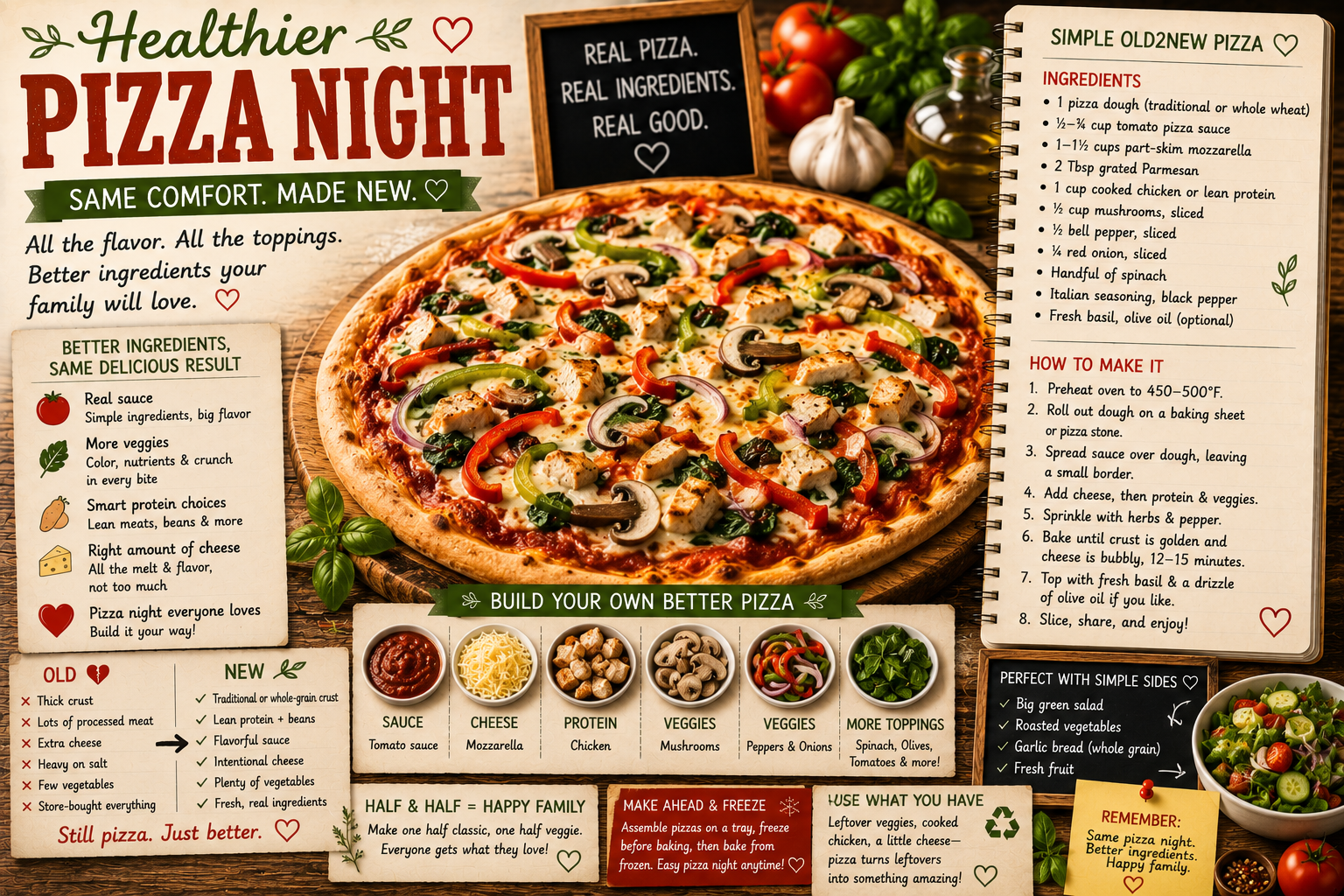
Healthier Pizza Night: Keep the Pizza, Change What Makes Sense
Pizza night is supposed to be fun. There's something about putting a pizza in the middle of the table that changes the atmosphere — everyone reaches in, everyone has their preferred slice, someone wants the corner, someone wants extra cheese, and somebody inevitably makes a move on the last piece before anyone else is ready for it.
When the topic is making pizza healthier, there's one rule that applies from the start: pizza stays pizza. Not a flatbread with toppings we're calling pizza. Not a pile of vegetables with tomato sauce on the side. Not a cauliflower-based alternative that requires explanation before anyone can identify what's being served. An actual pizza — crust, sauce, cheese, toppings — that happens to be built with better choices than the version it replaces.
The goal is a pizza satisfying enough that nobody at the table feels like they're eating the healthy version. Because the healthy version that nobody enjoys is not actually a success.
Start with the Crust
The crust is pizza. It stays. The choices available for home pizza making are genuinely broad — traditional dough produces the authentic pizza experience most households are looking for; whole wheat dough adds fiber and a slightly nuttier flavor that many people find they prefer once they've tried it; thin crust changes the ratio so each slice carries more of the topping and less of the bread; flatbread or naan-based personal pizzas are the fastest option for weeknight pizza without yeast or rise time.
Whole wheat pizza dough is available pre-made at most grocery stores or can be made from scratch with whole wheat flour in place of some or all of the all-purpose flour. The texture is slightly denser than standard dough and the flavor is nuttier and slightly earthier — qualities that work particularly well with assertive toppings like mushrooms, caramelized onions, and roasted vegetables.
Thin crust is worth exploring regardless of flour type because it shifts the overall eating experience toward the toppings rather than the bread. A thin-crust pizza with generous vegetables, protein, and appropriate cheese feels lighter than a thick-crust pizza with the same toppings because the crust-to-topping ratio is different.
Regular pizza dough remains a legitimate option. Making the crust thinner, adding more vegetables, or choosing leaner toppings improves the pizza without requiring the crust to change.
Make Personal Pizzas
The single most effective pizza night strategy for households with varying preferences is the personal pizza format — individual-sized portions of dough or individual flatbreads set out alongside a selection of toppings, with each person assembling their own.
This format turns pizza night into an activity rather than a service where one person makes decisions for the whole table. The child who will only eat cheese pizza gets exactly that. The adult who wants loaded vegetables gets every vegetable on the table. Someone can try the new topping on half their pizza while keeping the reliable combination on the other half. Nobody has to negotiate or compromise on what they want, which means nobody ends up eating pizza they find merely acceptable.
The personal pizza format also makes nutritional customization completely natural. People who want more vegetables build their pizza with more vegetables. People who want more protein add more protein. The choices are visible and self-directed rather than being imposed by whoever assembled the family pizza.
Build a Good Tomato Sauce
Pizza sauce provides the flavor foundation that everything else builds on, and a good sauce doesn't require complexity. The simplest version — crushed tomatoes with garlic, dried oregano, fresh or dried basil, and black pepper, uncooked and spread directly on the dough — develops its flavor in the oven and produces a bright, clean sauce that lets the other toppings speak.
When using jarred pizza sauce, comparing labels is worth the extra 30 seconds: sauces where tomatoes are the first ingredient, sodium is manageable (under 200mg per serving), and added sugar is minimal perform better than heavily processed alternatives where the ingredient list prioritizes water, oil, and salt over tomato. The best jarred sauce is the one with the shortest, most recognizable ingredient list.
Spreading the sauce thinly rather than generously improves the pizza — too much sauce makes the crust soggy and the toppings slide. A half cup to three-quarters cup for a standard-size pizza is usually enough.
Keep the Cheese
Cheese is in the pizza. This is non-negotiable and also correct. Mozzarella provides the classic pizza stretch and mild dairy flavor that makes pizza taste like pizza. Removing it produces something adjacent to pizza rather than pizza itself.
Part-skim mozzarella is the most direct substitution — same texture, same melt, the same visual result of golden, bubbling cheese with slightly less saturated fat. Most people find it indistinguishable from whole milk mozzarella in the finished pizza, particularly when the sauce and toppings are well seasoned.
The useful technique with cheese is distributing it intentionally rather than piling it thickly. A moderate amount of mozzarella spread across the pizza surface produces cheese in every bite without the top layer becoming so thick that it slides off the slice or dominates the other flavors. Adding a tablespoon or two of grated parmesan alongside the mozzarella amplifies the cheese flavor significantly — parmesan has a sharp, nutty intensity that makes the same total amount of cheese taste more present and satisfying.
Choose Protein That Earns Its Place
Classic pizza proteins — pepperoni, Italian sausage — are beloved and don't need to disappear entirely. The adjustment is looking at the ratio: a pizza covered edge-to-edge with processed meat is a different nutrition profile than a pizza with some pepperoni alongside mushrooms, peppers, and onions where the pepperoni provides flavor throughout without dominating every bite.
Grilled chicken is the most versatile pizza protein — mild enough to work with any topping combination, lean, and genuinely good on pizza in a way that's underappreciated. Pre-cooked chicken from a batch cooking session or a rotisserie chicken makes this a zero-additional-cook addition. Lean ground turkey or beef browned with Italian seasoning produces a sausage-adjacent pizza topping that most people find satisfying without distinguishing it from traditional sausage in a well-topped pizza. White beans scattered across a pizza add protein and a slightly earthy, creamy quality that pairs naturally with mozzarella and vegetables.
The approach of using smaller amounts of a bold, flavorful protein alongside vegetables is one of the most practical techniques: a few pieces of good pepperoni distributed across a pizza with mushrooms, peppers, and onion provides the pepperoni flavor in every slice while the vegetables contribute most of the topping volume.
Vegetables on Pizza Are Not a Compromise
Vegetables on pizza are a genuinely good idea that has nothing to do with making pizza healthier — they make pizza taste better. Mushrooms add umami depth that amplifies the cheese and sauce. Roasted bell peppers add concentrated sweetness. Red onion adds sharpness and color. Baby spinach wilts into the surface of the pizza during baking and adds dark green color and earthiness. Jalapeños add heat that balances the richness of the cheese.
The key technique for vegetable toppings is preparation before they go on the pizza. Mushrooms sliced and sautéed until their moisture has cooked off won't release liquid into the pizza during baking. Bell peppers roasted or sautéed beforehand develop sweetness and softness that raw peppers don't have on the time scale of pizza baking. Watery vegetables added raw can release moisture during baking and produce a soggy crust — a brief pre-cook eliminates this.
Don't overload the pizza. More toppings aren't automatically better — a pizza buried under too many ingredients bakes unevenly, the crust doesn't cook through properly, and the toppings steam rather than roast. A modest amount of well-prepared toppings distributed evenly produces better pizza than an ambitious pile of raw vegetables.
The Half-and-Half Strategy
When the household has genuinely different topping preferences — or when introducing something new to people who are resistant — the half-and-half pizza is the most practical middle ground. Half the pizza gets the traditional combination; the other half gets the new direction. Nobody has to commit to an entire pizza of something unfamiliar.
This is also an effective way to introduce vegetables gradually. Half cheese, half cheese-and-vegetable means everyone tries the vegetable side without feeling like the traditional option was taken away. If it's well received, the ratio can shift over subsequent pizza nights until vegetables are a standard part of every pizza without anyone consciously deciding to make that change.
A Simple Old2New Pizza
Ingredients (makes one 12-inch pizza, serves 3 to 4)
- 1 ball pizza dough (traditional or whole wheat)
- ½ to ¾ cup pizza sauce
- 1 to 1½ cups shredded part-skim mozzarella
- 2 tbsp grated parmesan
- 1 cup cooked chicken, lean ground turkey, or preferred protein
- ½ cup sliced mushrooms, pre-sautéed
- ½ bell pepper, thinly sliced
- ¼ red onion, thinly sliced
- Handful of baby spinach
- Italian seasoning and black pepper
- Fresh basil for finishing
- Red pepper flakes (optional)
- Small drizzle of olive oil
Instructions
Preheat oven to 450 to 500°F, or according to your dough instructions. If using a pizza stone or steel, allow it to preheat in the oven for at least 30 minutes before baking.
Stretch or roll the dough to your preferred thickness on a lightly floured surface. Transfer to a pizza pan or prepared stone.
Spread the sauce thinly across the dough, leaving a half-inch border. Distribute mozzarella evenly. Add the protein and vegetables. Sprinkle parmesan, Italian seasoning, and black pepper.
Bake 10 to 15 minutes until the crust is golden and the cheese is bubbling. Remove from the oven, scatter fresh basil and optional red pepper flakes, drizzle lightly with olive oil, and let rest two to three minutes before slicing.
Upgrading Frozen Pizza
Frozen pizza night is legitimate and useful. Some nights the realistic dinner is a frozen pizza, and making that pizza slightly better with available ingredients is more practical than cooking from scratch.
Starting with a frozen pizza the household enjoys and adding mushrooms, sliced peppers, spinach, leftover cooked chicken, or fresh tomatoes before baking produces a more substantial, more vegetable-rich result than the pizza alone. Serving alongside a simple salad or roasted vegetables makes the meal more complete. The pizza is still convenience food; it's simply convenience food with something added rather than eaten exactly as it came from the box.
Pizza Night as a Vegetable Cleanout
Pizza night is one of the most effective uses-what-you-have formats in the kitchen. The toppings format accommodates small amounts of whatever is in the refrigerator — half a bell pepper, three mushrooms, a handful of spinach, some leftover chicken, a little onion that needs to be used. These ingredients that might otherwise be too small to anchor a different recipe become pizza toppings that contribute to a complete dinner.
This connection between pizza night and the refrigerator's Use Me First zone is worth establishing deliberately. Before planning elaborate pizza toppings, checking what needs to be used first often produces the pizza's ingredient list with no additional shopping required.
Serve With Something Simple
Pizza doesn't need to carry the entire meal's nutrition by itself. A simple side alongside pizza — a big green salad with vinaigrette, roasted broccoli, sliced cucumbers and tomatoes, or raw vegetables with a dip — adds vegetables to the meal without asking the pizza to contain them all.
This makes the pizza itself simpler and less burdened with the task of being nutritionally comprehensive, which often produces a better pizza. The pizza is the pizza; the salad is the salad; together they're a balanced dinner.
FAQ
Is cauliflower crust worth trying? If your household enjoys it, yes — cauliflower crust is a legitimate option that some people genuinely prefer, particularly people who enjoy vegetables and are interested in lower-carbohydrate options. It requires a different baking technique (very dry cauliflower, very hot oven) to achieve a crispy rather than soggy result. It's an alternative to traditional pizza crust rather than an improvement — traditional pizza crust is still a good ingredient in the context of a well-built, vegetable-loaded pizza.
How do I prevent the crust from being soggy? Three main contributors to soggy crust: too much sauce, watery toppings added raw, and not enough oven heat. Spread the sauce thinly. Pre-cook watery vegetables (mushrooms, bell peppers, spinach) to release their moisture before they go on the pizza. Bake at the highest temperature your oven reliably reaches — 450 to 500°F — on a preheated surface. A pizza stone or steel preheated for 30 minutes before baking produces the crispiest result.
Is pizza appropriate for people on GLP-1 medications? Pizza with a reasonable amount of crust, protein, vegetables, and cheese can be part of a satisfying, balanced meal when served in appropriate portions alongside a salad or vegetables. The protein from the cheese and toppings supports satiety. The personal pizza format or conscious portion sizing makes calibrating the amount to hunger straightforward. The key is building a pizza with meaningful toppings rather than mostly bread with minimal topping.
Continue Your Recipe Transformation Journey
Pizza night is one of the most flexible comfort food formats for building better meals. These guides will help you go further:
- Easy Ways to Add More Vegetables Without Anyone Noticing — how vegetables become genuinely appealing as pizza toppings
- What Can I Make with Tomatoes? — the foundation of great pizza sauce
- How to Make Your Favorite Recipes Healthier Without Starting Over — the philosophy behind every pizza night improvement
- Buying Produce Without Waste — how pizza night uses up small amounts of vegetables
- Batch Cooking for Beginners — how batch-cooked chicken makes pizza toppings instant
Old2New — There is good in everything.