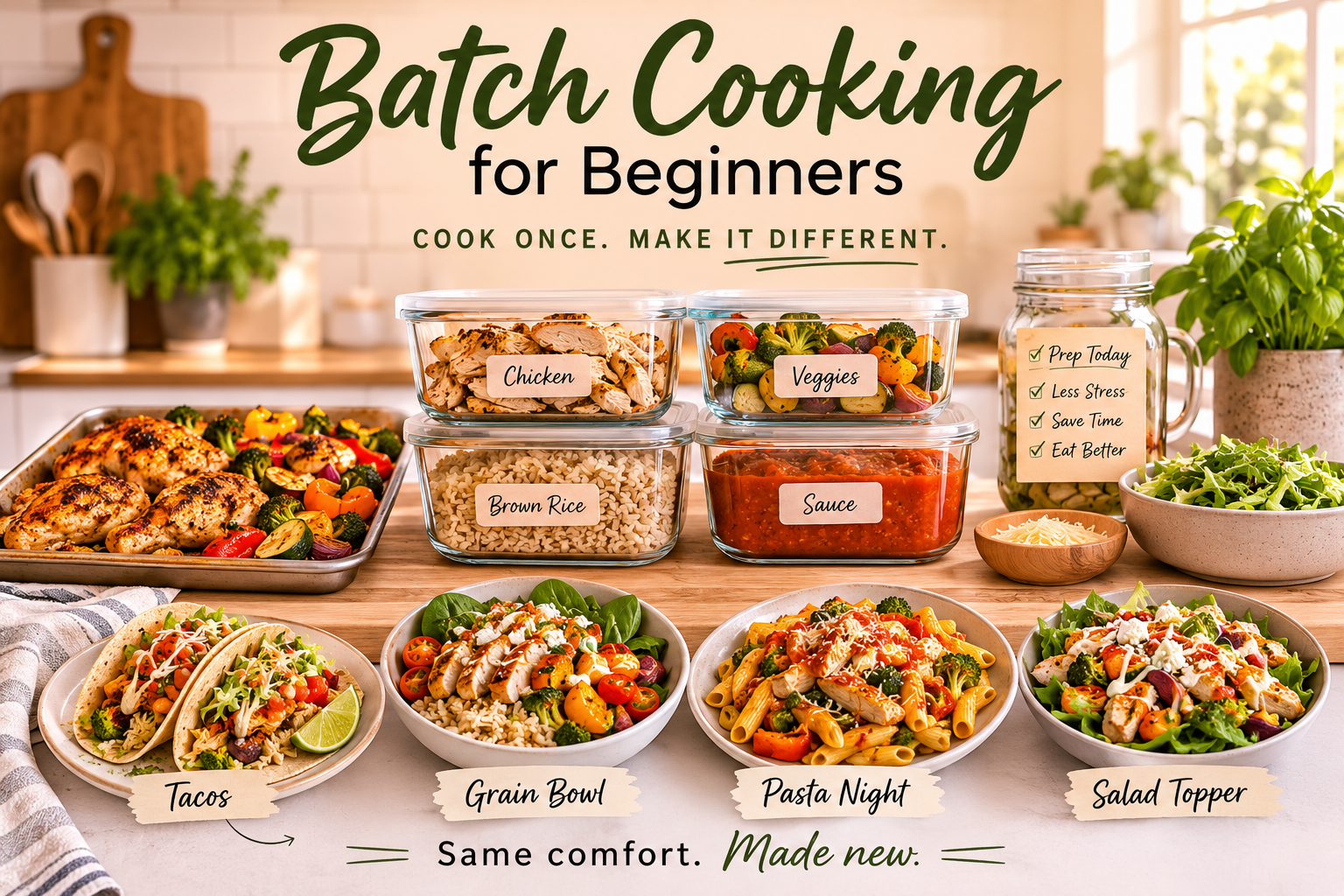
Batch Cooking for Beginners: Cook Once, Make Several Meals
The phrase "batch cooking" conjures a specific image that makes many people immediately decide it's not for them: an entire Sunday morning spent in the kitchen, twenty matching containers lined up on the counter, seven identical lunches, and a level of organizational commitment that feels more like a part-time job than a cooking approach.
That's one version of batch cooking. It exists, it works for some households, and it's not what this guide is about.
The more accessible version is simpler: make more of something while you're already cooking, so part of another meal is ready when the next one needs to happen. Cook extra chicken tonight and tomorrow's dinner has protein that only needs reheating and assembling. Make a larger pot of rice and three different grain-based meals this week have their base covered. Roast two pans of vegetables instead of one and the next two nights have a vegetable component that doesn't require any additional work.
That's batch cooking in practice. Not a dedicated cooking marathon — an adjustment to how much of something gets made when cooking is already happening.
Start with One or Two Ingredients
The beginner mistake in batch cooking is trying to prepare everything at once. Seven breakfasts, seven lunches, seven dinners, snacks for every day, and a complete meal plan that accounts for every eating occasion in the week. This approach produces overwhelming Sunday sessions, food that gets boring before it gets eaten, and a sense that batch cooking requires more discipline and organization than it's worth.
A more sustainable starting point: one protein and one grain. Cook extra chicken — enough for three meals rather than one. Make a large pot of brown rice — enough for four or five servings. That's it. Those two ingredients, combined with whatever vegetables and sauces are available throughout the week, provide the starting point for several different dinners without requiring more than an extra 15 minutes of cooking time on the day they're made.
Over time, as the habit becomes established, the scope can expand. One protein and one grain becomes one protein, one grain, and a batch of roasted vegetables. That becomes one protein, one grain, roasted vegetables, and a sauce. But starting with two ingredients and building from there is more sustainable than starting with a comprehensive system and abandoning it when it proves too demanding.
Think Ingredients, Not Identical Meals
The most important mindset shift in batch cooking is moving from "preparing meals in advance" to "preparing ingredients that can become different meals." Five identical chicken-and-rice containers produce five nights of the same dinner, which most households find boring by Wednesday and abandon by Thursday. The same chicken and the same rice used differently each night produce five different dinners with only the ingredients being shared.
Monday is roasted chicken with rice and vegetables — the straightforward version. Tuesday the chicken gets shredded and goes into tacos with salsa, avocado, and corn tortillas — a completely different meal experience. Wednesday the remaining chicken goes into pasta with roasted vegetables and tomato sauce. Thursday the rice becomes fried rice with eggs, the last of the vegetables, and soy sauce. Friday combines whatever remains in a grain bowl with whatever dressing sounds good.
Same batch of chicken. Same batch of rice. Five different dinners that don't feel like leftovers because the format, the flavor direction, and the accompanying ingredients are all different. This is the model that makes batch cooking sustainable — not eating the same thing repeatedly, but using shared ingredients as the foundation for variety.
Choosing the Protein
Protein is the most time-consuming component of most dinners, which makes it the highest-value candidate for batch cooking. A batch of cooked protein removes the longest active step from several future dinners simultaneously.
The most versatile batch proteins are the ones with mild enough seasoning to work in multiple flavor directions. A chicken breast roasted with olive oil, salt, pepper, and garlic works in tacos, pasta, grain bowls, salads, soups, and sandwiches because the base flavor doesn't commit to any single cuisine. A batch of ground turkey browned with onion and garlic (before taco seasoning, Italian herbs, or any other specific spice profile is added) divides into portions that can go in different directions — taco filling for one portion, pasta sauce base for another, stuffed pepper filling for a third.
Other high-value batch proteins: cooked beans (enormous quantities for almost no cost, freeze beautifully), lentils (cook in 25 minutes and go into soups, tacos, pasta, and grain bowls), hard-boiled eggs (ready for breakfast, lunch snacks, and salad toppings all week), and meatballs (batch in large quantities, freeze in portions, deploy in pasta and soups for months).
Preparing a Grain
One grain prepared in a large batch covers the starch component of most of the week's meals without any additional cooking. Brown rice takes 45 minutes — the same 45 minutes whether making two cups or six cups. Quinoa takes 15 minutes regardless of quantity. Making substantially more than needed for tonight takes no additional active time.
The grain choices worth batch cooking are the ones used most often in the household: brown rice for stir fries and grain bowls, quinoa for higher-protein applications and salads, farro or barley for heartier grain bowls, whole grain pasta for pasta nights and pasta salads. Choose one grain to batch cook each week based on what's planned, and let it contribute to multiple meals without repeating.
Batch-cooked grains refrigerate for five to six days and freeze for one to two months in individual portions. Freezing grain in two-cup portions means future grain bowls and stir fries have their base ready directly from the freezer — one of the most consistently useful cooking shortcuts available.
Roasting a Large Batch of Vegetables
When the oven is already at temperature and a sheet pan is already out, filling a second sheet pan takes five minutes of additional prep and no additional hands-on time during the 30 minutes of roasting. The result is twice the roasted vegetables from the same session.
Batch-roasted vegetables refrigerate for four to five days and contribute to multiple different meals without any additional cooking. Monday's roasted broccoli, bell peppers, and zucchini shows up in pasta on Tuesday, in eggs on Wednesday, in a grain bowl on Thursday, and in a stir fry on Friday — each time in a different context with different accompanying flavors.
The key is keeping the seasoning on batch-roasted vegetables relatively simple — olive oil, salt, pepper, and a mild herb like thyme or Italian seasoning — so they can absorb the flavor direction of each new dish they're added to. Heavily seasoned roasted vegetables commit to a specific flavor profile that limits where they'll work.
Making a Versatile Sauce
A batch of sauce is what transforms the same cooked chicken and rice from one meal into four different ones. The grain bowl on Monday with olive oil and lemon tastes nothing like the pasta on Tuesday with tomato sauce, which tastes nothing like the tacos on Wednesday with salsa, which tastes nothing like the grain bowl on Thursday with yogurt-herb sauce.
One sauce made in a batch — homemade tomato sauce, a Greek yogurt-herb dressing, a simple vinaigrette, homemade salsa, pesto — provides flavor variety throughout the week that makes the same base ingredients feel like genuinely different meals. The sauce is the variable that changes the experience of the dish even when the underlying components are the same.
Sauces made in larger batches refrigerate for three to seven days depending on the sauce (tomato and vinegar-based sauces keep the longest) and freeze well when made in extra quantity. A freezer with several different sauces provides immediate flavor direction for any combination of protein, grain, and vegetable without requiring any additional cooking.
Double What's Already Being Made
The simplest and most sustainable batch cooking approach requires no dedicated session and no special planning: just doubling certain things while they're already being made.
Making spaghetti sauce tonight? Fill the pot and freeze half for a future pasta night that requires only boiling pasta. Cooking taco meat? Brown enough for two taco nights and refrigerate the extra. Making soup? Use the large pot and freeze individual portions. Roasting chicken? Put an extra piece in the pan alongside what's needed for tonight's dinner.
This approach accumulates gradually rather than requiring a single dedicated session. Over the course of a month of doubling specific recipes, a meaningful supply of homemade meals builds in the freezer without any single investment of extensive cooking time. The sessions that produced them are indistinguishable from regular weeknight cooking.
A Simple 60-Minute Beginner Session
For households wanting to try a more structured batch cooking session without committing to a full afternoon, a focused 60-minute session produces enough prepared ingredients for several meals.
The session works through timing and parallel cooking: preheat the oven to 425°F while chopping vegetables. Put the vegetables on a sheet pan and put chicken in the oven alongside them. While those cook (about 35 to 40 minutes), cook a pot of rice on the stovetop. While the rice cooks, make a simple sauce or portion ingredients for the week's snacks. When the timer goes off, the chicken and vegetables come out, the rice finishes, and everything is portioned into containers while still warm.
Sixty minutes of focused work from a single set of cooking tasks — chopping, seasoning, and starting things — produces a cooked protein, a cooked grain, roasted vegetables, and a sauce. Four components that combine into three to four different dinners throughout the week. That's the practical return on a one-hour investment.
Preventing Batch Cooking Boredom
The most common reason batch cooking fails for households that try it is the repetition problem — eating from the same batch of food for days in a row feels monotonous, and by Thursday the prepared ingredients are more obligation than convenience.
The solution is built into the ingredient-not-meals approach: change the format, the accompanying ingredients, and the flavor direction with each use rather than serving the same combination repeatedly. Batch-cooked chicken in a bowl on Monday with tahini dressing, in tacos on Tuesday with salsa and avocado, in soup on Wednesday with broth and noodles, and in a salad on Thursday with vinaigrette — these are four genuinely different eating experiences even though the protein is the same.
Adding one fresh element to each batch-cooked meal also prevents the feeling of eating from a container: a fresh herb scattered over reheated components, a squeeze of lemon, a different sauce, fresh avocado or cucumber alongside. These small additions take 30 seconds and make a meal feel intentional rather than assembled from leftovers.
What to Do When You Made Too Much
The freezer solves the over-batch problem. Any cooked protein, grain, sauce, or complete meal that won't be used within the refrigerator's safe window goes into the freezer rather than into the trash or into an obligation to eat something for days past the point of enjoyment.
Freezing the excess converts too much into future convenience — the over-batch of chicken from this week's session becomes a head start for a future week's cooking without requiring a dedicated batch session that week. Over time, the combination of regular batch cooking and freezing produces a freezer with a meaningful supply of homemade meal components that make the cooking week easier without any single session being overwhelming.
FAQ
How far in advance can I batch cook? Cooked proteins keep safely for three to four days in the refrigerator. Cooked grains keep for five to six days. Roasted vegetables keep for four to five days. Sauces keep for three to seven days depending on the type. Planning the batch around what will be used within these windows, and freezing anything beyond them, produces food that's at its best quality when eaten.
Does batch cooking work for households with different preferences? Yes — the ingredient approach specifically accommodates different preferences within the same batch. A batch of cooked chicken can become tacos for one person and a grain bowl for another from the same batch. A batch of roasted vegetables can be seasoned differently at serving time for different preferences. The preparation is shared even when the finished meals diverge.
What's the easiest first batch cooking project? A batch of hard-boiled eggs and a pot of cooked grain (rice or quinoa). Both are low-effort, store well, and contribute to multiple different meals — eggs for breakfasts, snacks, and salad proteins; grain for bowls, stir fries, and side dishes. No special equipment, no complex technique, and immediate payoff throughout the week.
Continue Your Recipe Transformation Journey
Batch cooking is one of the most practical habits for making healthy home cooking sustainable over time. These guides will help you build on it:
- How to Cook Once and Eat Twice — the meal-level version of the batch cooking strategy
- How to Freeze Meals Successfully — how to extend batch cooking into future weeks
- Meal Prep Containers Worth Buying — the containers that make batch cooking storage work
- Beginner's Guide to Meal Planning — how batch cooking and planning work together
- Easy Sheet Pan Dinners — the format most naturally suited to batch vegetable cooking
Old2New — There is good in everything.