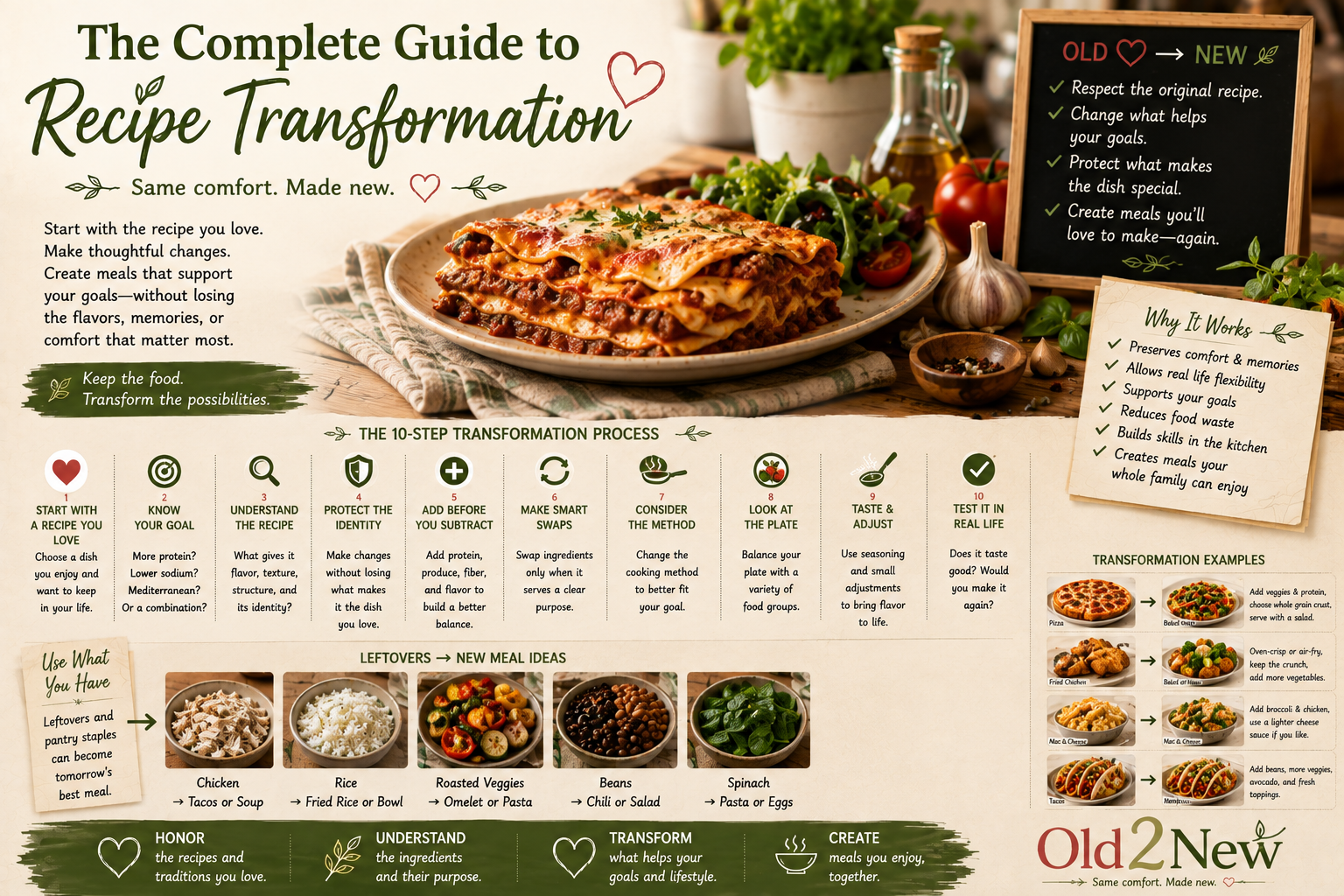
The Complete Guide to Recipe Transformation
We made it to 100. ❤️
And there really couldn't be a better article to finish the original Old2New Knowledge Library. Because everything we've talked about — from protein and portions to comfort food, ingredients, leftovers, cooking methods, and building habits — comes back to one idea: you don't have to start over. You can start with the food you already love.
The spaghetti you've made for years. Grandma's meatloaf. Friday-night pizza. Your favorite tacos. The casserole everyone asks for at Thanksgiving. The fried chicken that reminds you of home. The recipe saved on your phone that you've made so many times you barely look at it anymore.
Then ask: "How could I make this work better for me?" That's recipe transformation. And this guide brings everything together.
What Is Recipe Transformation?
Recipe transformation means taking an existing recipe and thoughtfully adapting it to better support a goal, preference, or need while preserving what makes the original dish recognizable and enjoyable. That last part matters.
We're not trying to turn tacos into salad, pizza into cauliflower with tomato sauce, spaghetti into zucchini floating in marinara, or fried chicken into a plain grilled chicken breast. Those foods may all be perfectly good. But they're different dishes. Transformation begins by respecting the original recipe. We look at what makes the dish special and then decide where change will actually help.
Sometimes that's an ingredient. Sometimes it's the cooking method. Sometimes it's the portion. Sometimes we add something. Sometimes we change what goes beside the dish. And sometimes we leave the recipe alone. That's part of transformation too.
Step 1: Start With a Recipe You Actually Love ❤️
Don't start with the food someone on the internet thinks you should be eating. Start with your food. Mac and cheese, lasagna, chicken pot pie, tacos, pizza, pancakes, meatloaf, fried chicken, spaghetti, chili, a family casserole, a recipe from your childhood, something you ordered at a restaurant and want to recreate. That's your starting point.
Because if you're going to change the way you eat for the long term, it makes sense to begin with foods you already enjoy.
Step 2: Decide What You're Trying to Accomplish 🌿
Before changing anything, know why you're changing it. Maybe you'd like more protein, more vegetables, more fiber, less sodium, a different cooking method, a Mediterranean-style approach, a recipe that better fits a particular dietary preference, or some combination of goals.
This is important because the same recipe can be transformed differently depending on the goal. There isn't one universal version of "healthy lasagna." Someone wanting more protein may make one set of changes. Someone wanting lower sodium may make another. The recipe is the starting point — your goal provides the direction.
Step 3: Understand the Original Recipe Before Changing It
This is where many recipe transformations go wrong — they start replacing ingredients before understanding why those ingredients are there. Instead, look at the recipe and ask: what gives this dish its identity? What creates the flavor? What creates the texture? What provides structure? What makes it comforting? Which ingredients are essential and which are flexible?
This is especially important in baking, sauces, casseroles, and dishes where ingredients perform specific functions. Ingredients aren't simply numbers on a nutrition label. Ingredients have jobs.
Step 4: Protect the Identity of the Dish
We call this the recognition test. Imagine putting the transformed recipe on the table. Would someone recognize it? If you transformed lasagna, does it still look like lasagna? If you transformed tacos, are there still tacos? If you transformed fried chicken, is there still crispy chicken?
If the answer is "well, technically..." we may have gone too far. Transformation isn't replacement. The original dish should still be there.
Step 5: Find the Highest-Impact Change
You don't need to replace twelve ingredients. Look for the change that could make the biggest difference without hurting the recipe. Maybe it's changing the cooking method, adding vegetables, adding protein, using a lower-sodium ingredient, adjusting the amount of one ingredient, changing the side dish, adding beans, or using herbs and spices differently.
Sometimes one good decision is more useful than ten mediocre substitutions.
Step 6: Add Before You Subtract
Before asking "what should I remove?" ask "what could I add?" Making spaghetti? Add mushrooms and spinach. Making tacos? Add black beans and vegetables. Making pancakes? Add eggs and berries. Making a baked potato? Add chicken and broccoli. Making pizza? Add vegetables or protein. Making soup? Add beans. Instead of constantly shrinking your meals, build them.
Step 7: Look at Protein
If adding protein supports your goal, start with ordinary ingredients. Depending on the recipe, you might use chicken, lean beef, turkey, fish, eggs, beans, lentils, Greek yogurt, cottage cheese, tofu, nuts, or seeds. The right option depends on the recipe. The ingredient has to belong there. Taste still gets a vote.
Step 8: Look for Produce
Vegetables and fruit can often be added without changing the identity of a dish. Mushrooms in spaghetti sauce. Spinach in eggs. Peppers in tacos. Broccoli in a baked potato. Vegetables on pizza. Carrots and celery in soup. Berries with pancakes. Produce doesn't always need to sit in a separate pile on the plate — it can become part of the recipe.
Step 9: Don't Automatically Remove the Carbohydrate
Bread, rice, pasta, potatoes, tortillas, oats, and grains have become targets in countless diet trends. But they're also foundations for many beloved meals. Instead of automatically removing them, ask: "how does this ingredient fit into the whole recipe?" Pasta with chicken and vegetables. Rice with fish and broccoli. Potatoes with chicken and green beans. Toast with eggs and fruit. Now we're looking at the meal rather than judging one ingredient.
Step 10: Respect Fat and Flavor
Fat contributes to flavor, texture, cooking, satisfaction, and the absorption of certain nutrients. A transformation might change the type or amount. But removing everything responsible for richness can leave you with food nobody wants to eat. Transformation means understanding the ingredient before changing it.
Step 11: Use Seasoning Strategically 🌿
When one ingredient changes, flavor may need help somewhere else. Garlic, onion, herbs, spices, lemon, lime, peppers, vinegars, and aromatics can all rebuild flavor when something is reduced or changed. Seasoning is especially important when reducing sodium or changing cooking methods. Healthy food should not taste like someone forgot to finish cooking it. Flavor matters.
Step 12: Consider the Cooking Method
Sometimes the recipe ingredients aren't the main opportunity — the cooking method is. Maybe something traditionally deep-fried can be air-fried, oven-crisped, roasted, grilled, or sautéed. Take fried chicken: the chicken stays, the seasoning stays, the coating stays, the crunch needs to stay — maybe the method changes. That's a transformation that respects the food.
Step 13: Look at the Whole Plate
Not every transformation needs to happen inside the recipe. Suppose you're making Grandma's meatloaf and you don't want to change it — perfect, don't. Transform the meal around it. The old version: meatloaf and a large serving of mashed potatoes. The new version: Grandma's meatloaf with mashed potatoes, green beans, and roasted carrots. The recipe remained untouched. The plate changed. That's still recipe transformation.
Step 14: Think About Portions Without Making Food Tiny
Portion balance isn't about seeing how little food you can eat. Instead of "less pasta," think: pasta AND chicken AND vegetables. Instead of "no pizza," think: pizza AND salad. Instead of "no potatoes," think: potatoes AND fish AND green beans. Sometimes a more balanced meal comes from adding variety rather than dramatically reducing the food you love.
Step 15: Make the Swap Earn Its Place
Before replacing an ingredient, ask: why am I making this swap? Does it add protein, add fiber, reduce sodium, support a dietary preference, change the cooking method, add vegetables, or help the recipe better fit the goal? If you can't explain what the substitution accomplishes, reconsider it. Every swap should have a reason — not just "healthy recipes use this ingredient."
Step 16: Remember That Swaps Have Consequences
Replace one ingredient and something else may change — texture, moisture, structure, flavor, cooking time, browning, thickness. That's why ingredient substitution isn't simply remove A and insert B. If you're replacing sour cream with Greek yogurt, the acidity, thickness, protein, fat, and cooking behavior may all be different. If you reduce sugar in baking, moisture and browning can change. Transformation requires looking at the whole recipe.
Step 17: Don't Change Everything at Once
This may be one of the biggest mistakes in recipe transformation. Start with the changes that matter most. Then taste. You can always adjust again. Changing every ingredient simultaneously makes it impossible to know what improved the recipe and what hurt it.
Step 18: Let Different Goals Produce Different Recipes
The same starting recipe can be transformed differently for different goals. Someone wanting high protein makes one set of changes. Someone wanting lower sodium makes another. Someone following Mediterranean-style eating makes different choices. Same original recipe. Different transformations. That's the power of starting with the goal rather than a generic definition of healthy.
Step 19: Goals Can Work Together
Someone may want high protein and lower sodium, or Mediterranean-style and high protein, or GLP-1 friendly and high protein. When multiple goals are used together, look for ingredients that can support more than one objective. Chicken, beans, vegetables, whole grains, herbs, and olive oil can, depending on the recipe, help accomplish several things simultaneously.
Step 20: Know When You've Gone Too Far
Just because you can combine goals doesn't mean you should combine every possible goal. High protein, lower sodium, lower carb, low fat, gluten free, dairy free, sugar free, Mediterranean-style, plant forward — and suddenly dinner is a decorative sprig of parsley beside a bowl of sawdust. The recipe still needs to work. The food still needs to taste good. When goals compete, prioritize what matters most for this recipe and this person.
Step 21: Accommodate Real Dietary Needs
There are times when an ingredient really does need replacing — food allergies, intolerances, medical guidance, religious practices, ethical preferences, personal dietary choices. Those needs should be respected. In those situations, the challenge becomes: how do we make the necessary substitution while preserving as much of the original recipe as possible? For medical or individualized nutrition needs, recommendations from a qualified healthcare professional or registered dietitian should take priority.
Step 22: Taste the Food
Please don't get so distracted by numbers that you forget this step. Taste it. Is it seasoned? Is it dry? Does it need acidity? Does it need moisture? Does it still taste like the food you were trying to make? Recipes happen in kitchens, not spreadsheets. Numbers can provide useful information. Your mouth still has a job.
Step 23: Use the Second-Bite Test
Take the first bite. Now ask: "do I want another?" If the answer is no, something needs work. A recipe isn't successful simply because the nutritional profile changed. It needs to be satisfying enough that you'd actually make it again. That's the real test.
Step 24: Use the Recognition Test
Step back and look at the finished dish. Can you recognize it? If you transformed pizza, does it look like pizza? If you transformed tacos, do they look like tacos? If you transformed chicken pot pie, does it still have that savory, comforting pot-pie experience? If the identity disappeared, revisit the transformation. The goal is: same comfort, made new.
Step 25: Use the Real-Life Test
Could you realistically make this? Does it require ingredients available to you? Does it fit your budget? Does it fit your cooking ability? Does it fit your schedule? Would your household eat it? Would you make it again? A recipe that only works in a perfect kitchen on a perfect Sunday afternoon isn't always very helpful on a Wednesday at 6:15pm. Recipe transformation needs to survive real life.
The Old2New Recipe Transformation Checklist
When you're transforming a recipe:
❤️ Protect
- What dish am I starting with? Protect its identity.
- What do I love about it? Protect the flavor, texture, comfort, or tradition that matters.
- Did I change too much? Protect the dish.
- Does it still taste good? Use the second-bite test.
🌿 Transform 5. What is my goal? Know why you're making changes. 6. What could I add? Protein, produce, fiber, flavor, or another useful component. 7. What could I swap? Only when the swap has a clear purpose. 8. Could the cooking method change? Sometimes technique matters more than ingredients. 9. How does the whole meal look? Think beyond the individual recipe. 10. Would I actually make this again? Make sure it works in real life.
Recipe Transformation Can Start With Leftovers Too
Transformation doesn't always start with a written recipe. Sometimes it starts with: "what on earth am I going to do with this?" Leftover chicken, cooked rice, half a pepper, spinach, a few mushrooms — those could become tacos, soup, a rice bowl, stir fry, an omelet, pasta, or a casserole. Leftovers aren't simply old meals. They're ingredients waiting for another idea.
Transformation Isn't About Perfection
There is no perfect recipe. No perfect ingredient. No perfect plate. No perfect way of eating. There are simply choices. Some choices support your goals better than others. Some recipes need more change. Some need less. Some meals are about nutrition. Some meals are about celebration. Some meals are about getting dinner on the table before everyone loses their mind.
All of those meals belong in real life.
Sometimes the Original Wins ❤️
You transform Grandma's lasagna. You taste it. And you know what? Grandma's version is better. Keep Grandma's version. Maybe you serve vegetables beside it. Maybe you enjoy a different portion. Maybe you change absolutely nothing. The original recipe doesn't lose simply because a transformed version exists. That's why it gets the heart.
Recipe Transformation Is a Skill
The more you practice, the easier it becomes. Eventually you start looking at recipes differently. You stop immediately thinking "I can't eat that." Instead, you notice where protein could be added, where vegetables could fit, where sodium might be reduced, where a cooking method could change, where an ingredient is essential, where a substitution would ruin the texture, and where absolutely nothing needs changing.
You begin seeing possibilities. And that's the real power of learning how to transform recipes.
Same Comfort. Made New.
After 100 articles, this sits at the heart of everything Old2New has built. Not a diet. Not a forbidden-food list. Not the idea that everything in your kitchen needs fixing. A recipe you already love. And one simple question: "what could this become?"
Maybe the answer is higher protein. Maybe it's lower sodium. Maybe it's Mediterranean-style. Maybe it's a combination of goals. Maybe it's simply using the ingredients you already have before they go bad. Maybe it's changing the cooking method. Maybe it's adding vegetables. Maybe it's changing one ingredient. Maybe it's keeping Grandma's recipe exactly the way she made it.
The answer can be different every time. That's the point. Old2New isn't about finding the one right way to eat. It's about giving you more ways to work with the food that's already part of your life.
Because meaningful change doesn't always begin by throwing away the old. Sometimes the best place to start is with something you already love.
Continue Your Recipe Transformation Journey
The complete library is yours. These are the best places to go deeper:
- What Is Recipe Transformation? — where every Old2New journey begins
- Why Recipe Transformation Works — the principles behind every transformation
- There Is Good in Every Ingredient — how we approach every ingredient before changing it
- The Story Behind Old2New — where this all started
- How to Make Your Favorite Recipes Healthier Without Starting Over — putting the framework into practice today
Old2New — There is good in everything.