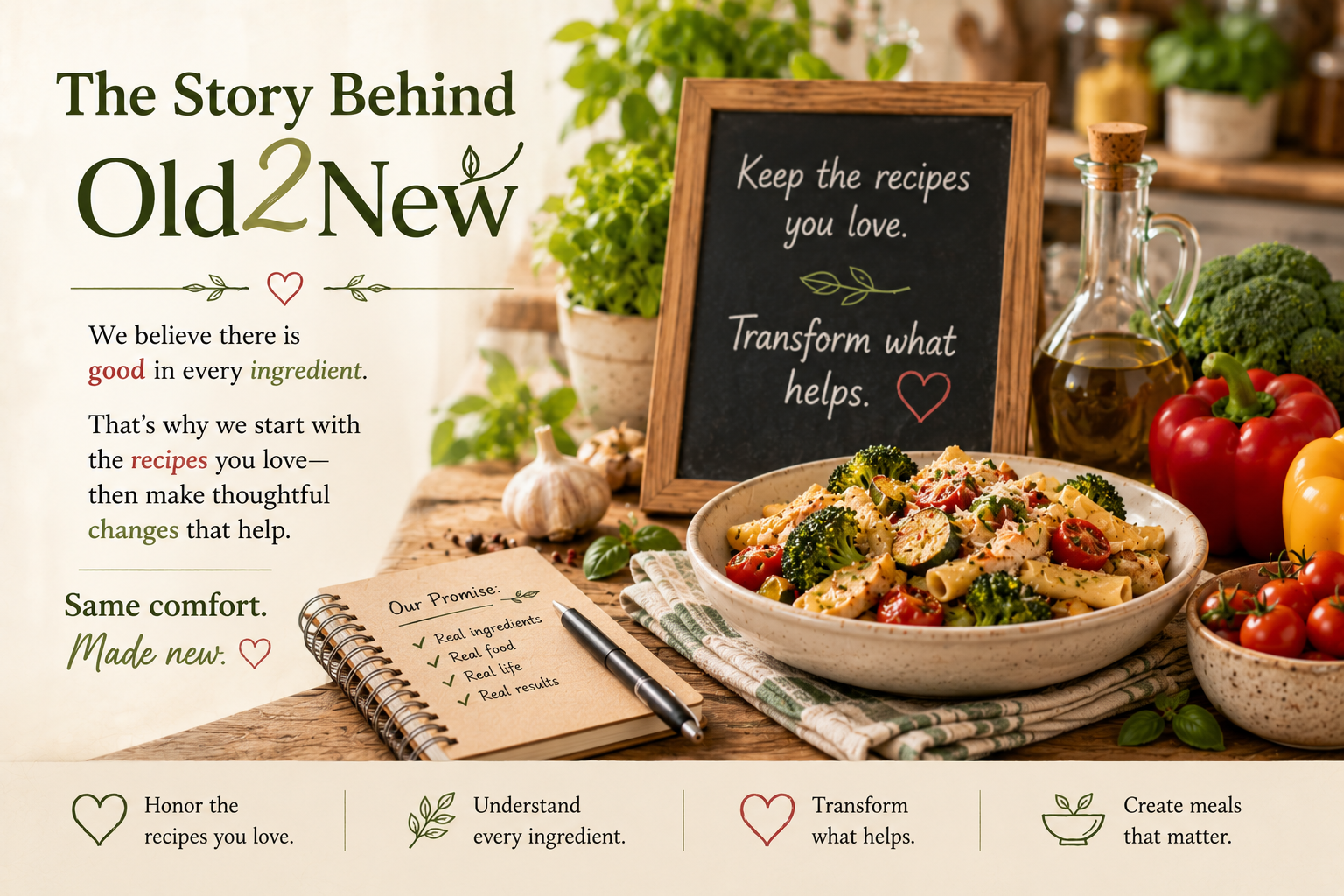
The Story Behind Old2New
Old2New started with a simple question: why does eating differently so often mean giving up the food we love?
Think about what usually happens when someone decides they want to make a change. Maybe they want to eat healthier. Maybe they're trying to get more protein. Maybe they're following a Mediterranean-style approach. Maybe they're looking for meals that better fit a specific goal or dietary preference. Suddenly, everything familiar seems to disappear. The recipes they've cooked for years. The comfort foods they grew up with. Family favorites. Sunday dinners. Pizza night. Tacos. Fried chicken. Mac and cheese. Lasagna.
The message often becomes: here's what you should eat instead. But we kept thinking: what if we didn't need something instead? What if we could start with the food people already love? That idea became Old2New.
It Started With the Food
Old2New wasn't built around the idea that food needed to be fixed. Quite the opposite. We love food. We love the recipes that get passed down through families, the handwritten recipe cards, the dishes that show up every holiday, the dinner someone makes so often they don't even need the recipe anymore, and the meals that immediately remind you of a person, a place, or a time in your life.
Food carries memories. And when people decide they want to eat differently, those memories shouldn't suddenly become something they're supposed to avoid. We wanted another option. Keep the recipe. Keep the memory. Keep the comfort. Then see what could be made new.
We Didn't Want Another Diet App
There are plenty of places that can tell you what you're allowed to eat. We didn't want to build another one. Old2New isn't here to hand you a list that says eat this, don't eat that, never eat this again, replace everything in your pantry, and whatever you do — don't look directly at a potato.
That's not how most people live. People have families, budgets, busy schedules, favorite foods, cultural traditions, food preferences, and kitchens filled with ingredients they already bought. We wanted Old2New to fit into real life.
The Original Recipe Deserves Respect
This became one of the most important ideas behind Old2New. When we show OLD ❤️ → NEW 🌿, the original recipe gets a heart. That isn't accidental. OLD doesn't mean bad. OLD means familiar, loved, comforting, traditional — the recipe we started with.
The NEW version isn't there to prove the original was wrong. It's simply another possibility. Maybe one that better supports what you're trying to accomplish today. That's a very different philosophy from "bad food becomes good food." And we think that difference matters.
There Is Good in Every Ingredient
As Old2New developed, another idea became central: there is good in every ingredient. Food has become incredibly polarized — this ingredient is good, that ingredient is bad, eat this, never eat that. But ingredients are more complicated and much more interesting than that.
Flour creates structure. Fat creates flavor and texture. Cheese brings richness, protein, calcium, and comfort. Potatoes bring versatility and nutrients. Pasta creates the foundation of countless beloved dishes. Beans bring protein, fiber, texture, and affordability. Vegetables bring color, flavor, fiber, and variety. Herbs and spices can completely change a meal. Every ingredient has a role. So before Old2New changes something, we want to understand: what is this ingredient doing here? That's how better transformations happen.
We Wanted Transformation, Not Replacement
Imagine asking for healthier green chile enchiladas and receiving a Mediterranean flatbread. It might be delicious. But where did the enchiladas go? That became another major Old2New principle: protect the identity of the dish.
If we're transforming enchiladas, they should still be enchiladas. If we're transforming meatloaf, it should still be meatloaf. If we're transforming pizza, someone looking at the plate should immediately know they're eating pizza. And if we're transforming fried chicken? There had better still be some crunch involved. Recipe transformation shouldn't erase the food — it should work with it.
Sometimes One Change Is Enough
Another thing became clear as we worked through recipes: more changes don't automatically create a better recipe. Sometimes one thoughtful change does more than ten substitutions. Maybe the cooking method changes. Maybe we add vegetables. Maybe we add protein. Maybe we adjust sodium. Maybe we change one ingredient. Maybe we simply build a more balanced plate around the original recipe.
We don't need to replace everything just because we can. That's when recipe transformation becomes thoughtful instead of mechanical.
Adding Became Just as Important as Swapping
Traditional diet thinking often starts with subtraction — remove this, cut that, use less, avoid this. Old2New asks another question: "what could we add?"
Making spaghetti? Add mushrooms and spinach. Making tacos? Add black beans. Making breakfast? Add eggs or fruit. Making a baked potato? Add chicken and broccoli. Having pizza? Add vegetables or put a salad beside it. Suddenly we're not shrinking the meal. We're building it. That became a huge part of the Old2New philosophy.
Then We Realized One Goal Wasn't Enough
People don't eat according to neat little labels. Someone might want more protein and want to reduce sodium. Someone might want Mediterranean-style meals and higher protein. Someone might be looking for GLP-1-friendly meals while also having personal food preferences. Real life overlaps.
So the idea grew beyond "make this recipe healthier." Because what does healthier even mean? Healthier for whom? Instead, Old2New could begin with two things: the recipe you love and the goal you're trying to reach. Then bring those things together.
And Sometimes Goals Need to Be Balanced
Once we realized goals could be combined, we discovered something else. Technically, you could keep going — high protein, lower sodium, lower carb, Mediterranean-style, GLP-1 friendly, dairy free, gluten free, plant forward — and eventually we're serving seasoned sawdust.
That's why the food always has to remain part of the decision. The goal isn't to pile on as many labels as possible. The goal is to create a recipe that supports what matters to you while still being worth eating.
Food Had to Stay the Hero
Old2New uses technology to make recipe transformation possible. But we never wanted the technology to become the story. The food is the story. The chicken sizzling in the pan. The pasta being twirled around the fork. The cheese bubbling on top of the casserole. The smell of garlic and onions cooking. The recipe card that's been in the family for thirty years. The ingredients sitting in your refrigerator waiting to become dinner.
Technology should help quietly in the background. Food stays front and center. That's why Old2New isn't about showing off what technology can do. It's about showing what your recipe can become.
We Started Seeing Possibility Everywhere
Once you begin thinking in transformations, your kitchen starts looking different. Three leftover chicken breasts aren't just leftovers — they're tomorrow's tacos, or soup, or pasta, or a grain bowl. Half an onion, two peppers, rice, and some beans? That's not a refrigerator full of random ingredients. That's the beginning of dinner. A family recipe that doesn't quite fit the way you want to eat today doesn't necessarily need to be given up — you can ask: "what could we change while keeping what makes this special?" That question opened up something much bigger than individual recipes.
Old2New Became About Reducing Food Waste Too
There's another side to recipe transformation that we love: using what you already have. Food gets thrown away every day because people look into their refrigerators and don't see a recipe. They see half a pepper, leftover chicken, a little rice, three mushrooms, and some spinach that needs using. Old2New sees ingredients. And ingredients are possibilities. What if those foods could become a stir fry, a bowl, a soup, an omelet, a pasta dish, or a taco filling? The idea of transformation started reaching beyond traditional recipes and became a way of looking at the kitchen itself.
We Wanted It to Work for Ordinary Ingredients
You shouldn't need a $200 grocery trip every time you want to make dinner differently. Old2New should work with foods people actually have — eggs, chicken, beans, potatoes, rice, pasta, frozen vegetables, fresh vegetables, fruit, cheese, yogurt, herbs, and spices. Normal food. Because if a transformation requires twelve specialty ingredients that will sit in the pantry for the next two years, was that really helpful?
Good transformations should make sense in real kitchens.
We Wanted Families to Be Able to Eat Together
This mattered too. When one person changes how they're eating, the entire household shouldn't necessarily need separate dinners. Imagine taco night. One person wants more protein — add chicken and beans. Someone wants more vegetables — add them. Someone wants traditional tacos — make them. Someone wants a bowl — build one. Same ingredients. Same kitchen. Same dinner table. Different versions. That's much more realistic than cooking four completely different meals.
We Wanted People to Keep Their Traditions
Some recipes should be approached carefully. Grandma's Christmas cookies. Dad's chili. The casserole that's been at Thanksgiving since before anyone can remember. Your mother's spaghetti sauce. Those recipes may be carrying something much bigger than nutrition — they're carrying people, stories, memories, and traditions.
Sometimes those recipes can be transformed gently. And sometimes? Leave Grandma's recipe alone. Old2New isn't supposed to take those things away. Having the ability to transform a recipe doesn't mean every recipe needs transforming.
We Wanted People to Feel Curious About Food Again
One of our favorite questions became: "what could this become?" That's a very different question from "am I allowed to eat this?" Look at a potato — what could it become? Look at leftover chicken — what could it become? Look at your favorite lasagna — what could it become if you wanted more protein? Look at the ingredients in your refrigerator — what could they become together?
Curiosity creates possibilities. Rules usually create boundaries. We wanted more possibilities.
The Recipe Should Still Pass the Recognition Test
As Old2New grew, a simple way of judging transformations emerged: the recognition test. If you transform a recipe and put the finished dish on the table, can someone tell what it is? Meatloaf should look like meatloaf. Tacos should look like tacos. Lasagna should look like lasagna. Pizza should look like pizza. If someone has to ask "what exactly is this supposed to be?" we may have transformed a little too enthusiastically.
And It Should Pass the Second-Bite Test
There's another test just as important. Take a bite. Now ask: do you want another one? Nutritional numbers aren't enough. Food still needs to taste good — it needs texture, flavor, aroma, satisfaction, and comfort. A recipe that perfectly matches every goal but nobody wants to eat again isn't a successful transformation. The best transformation is the one you actually want to cook again.
❤️ OLD → 🌿 NEW Became More Than a Recipe
At first, OLD → NEW described what happens to a recipe. But the more we worked with the idea, the more we realized it describes something bigger.
OLD: "I can't eat that anymore." NEW: "How could I make that work for me?" OLD: "I need an entirely new diet." NEW: "I can start with the food I already eat." OLD: "This ingredient is bad." NEW: "What does this ingredient contribute?" OLD: "I messed up. I'll start again Monday." NEW: "My next meal is another opportunity."
That's when Old2New stopped being simply about changing recipes. It became a philosophy about making change feel possible.
We Believe Small Changes Matter
Not every transformation needs to be dramatic. One vegetable. One protein addition. One cooking-method change. One different side. One lower-sodium ingredient. One way to use the leftovers. Those changes may seem small. But small changes are often the ones people can actually keep doing. And when something becomes part of everyday life? That's when it becomes powerful.
We Believe Comfort and Goals Can Share the Same Table
This is really what Old2New has been trying to prove from the beginning. You don't always have to choose between the food you love and the way you want to eat. Sometimes there's room for both. Maybe the recipe changes a little. Maybe it changes a lot. Maybe only the plate changes. Maybe nothing changes today. The important thing is having options. Because eating differently shouldn't automatically mean saying goodbye to everything familiar.
We Believe There Is Good in Everything
Not perfect. Not identical. Not appropriate for every person or every goal. Good. Something worth understanding. Something worth respecting. Something we can work with. That's how we approach ingredients. That's how we approach recipes. And that's how we approach change. We don't begin by asking what we can remove. We begin by asking what's already good here. Then we build from there.
And That's the Story Behind Old2New
Old2New began with a simple idea: maybe people don't need another reason to give up the food they love. Maybe they need a better way to work with it. A way to take the recipe they already make, the ingredients already in their kitchen, the traditions they want to keep, the comfort they don't want to lose, and the goals they're trying to reach — and bring those things together.
Not perfectly. Not with judgment. Not by turning every dinner into something it was never supposed to be. But thoughtfully. One recipe at a time. One ingredient at a time. One small change at a time.
Because sometimes creating something new doesn't mean starting over. Sometimes you start with something old that you already love.
Continue Your Recipe Transformation Journey
Now that you know the story behind Old2New, these are the best places to start your own transformation:
- What Is Recipe Transformation? — where every Old2New journey begins
- Why Recipe Transformation Works — the principles in practice
- There Is Good in Every Ingredient — the philosophy behind how we approach every recipe
- How to Eat Healthier Without Giving Up Comfort Food — applying the Old2New approach to everyday cooking
- Building a Family Recipe Binder — where your family's old recipes and their new versions live together
Old2New — There is good in everything.