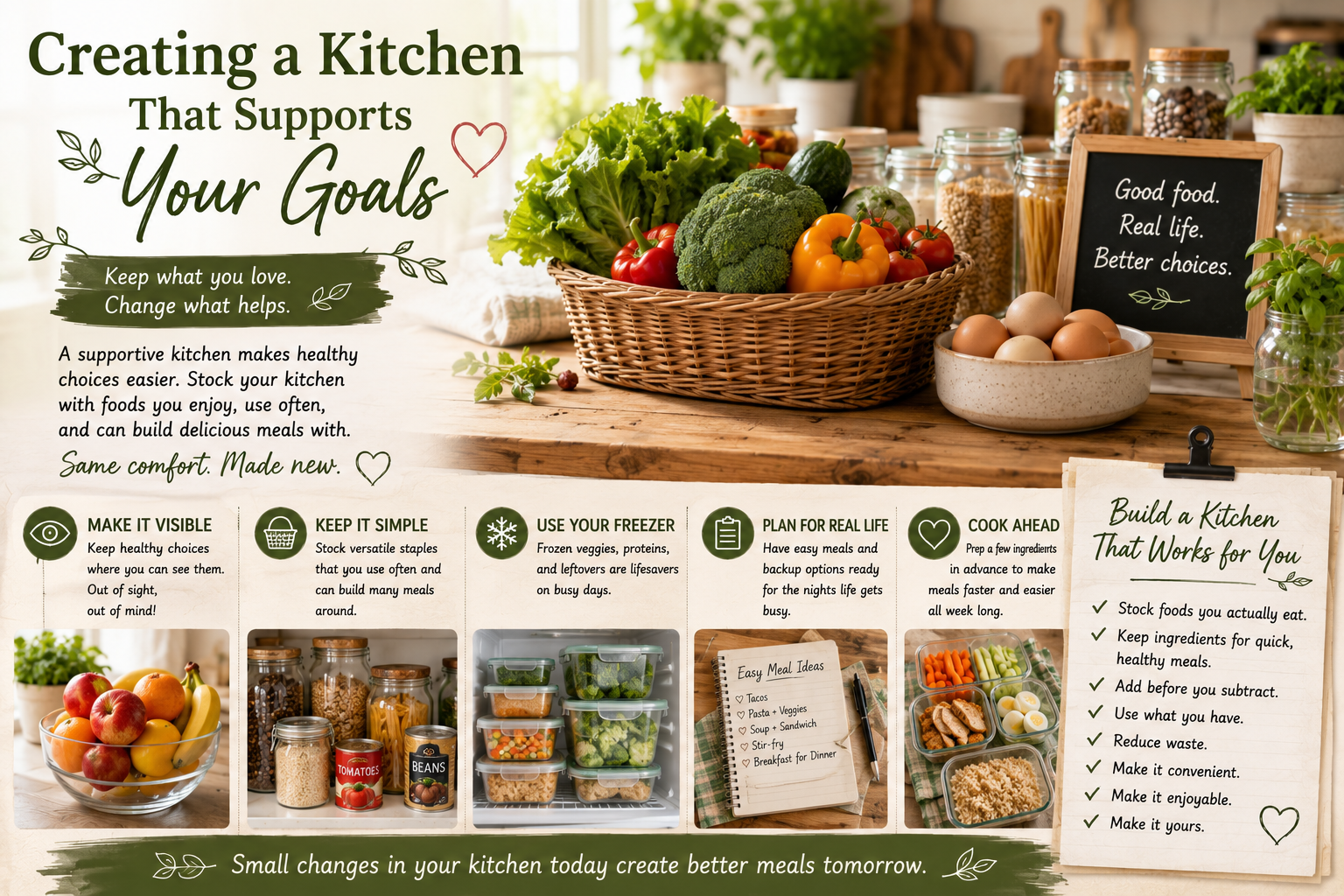
Creating a Kitchen That Supports Your Goals
Healthy eating gets a lot easier when your kitchen is working with you instead of against you.
Think about those evenings when you're hungry, tired, and standing in front of the refrigerator hoping dinner will somehow introduce itself. You open the door. Half an onion. Three condiments. Something in a container that nobody remembers making. And a bag of spinach that's beginning to reconsider its future.
Then someone asks: "What's for dinner?"
This is exactly why creating a supportive kitchen matters. Not because your refrigerator needs to look like one of those perfectly organized social-media refrigerators with matching glass containers and vegetables arranged by color. Your kitchen doesn't need to be beautiful. It needs to be useful.
At Old2New, a supportive kitchen makes the choices you want to make a little easier. You don't need a complete pantry makeover. You don't need to throw away everything you enjoy. We're going to do what we always do — keep what's working and change what helps.
Your Kitchen Is Part of Your Routine
We often think healthy eating is entirely about motivation. But your surroundings matter too. Imagine you want to eat more fruit. You buy apples. Then you put them in the bottom refrigerator drawer underneath six other things. Three weeks later: surprise apples.
Now imagine you wash them and put them somewhere visible. Same apples. Different environment. One small change made the habit easier. That's what we're trying to create throughout the kitchen.
Start with the Food You Actually Eat
Before reorganizing anything, take a look at your normal meals. What does your household genuinely eat? Maybe it's pasta, tacos, chicken, potatoes, eggs, sandwiches, pizza, soup, rice, and pancakes. Those foods become the foundation.
We're not building a kitchen for some imaginary family that eats completely differently from yours. We're building one for your actual household.
Stop Shopping for Your Fantasy Self
We've all done this. You go grocery shopping feeling extremely motivated. Suddenly you're buying seven vegetables you've never cooked, three grains you can't pronounce, a giant container of greens, and a bag of something that promised to change your life. By Thursday, everyone is asking where the normal food went.
Trying new ingredients can be wonderful. But most of your grocery cart should probably contain foods you know how to use. A supportive kitchen is stocked with ingredients that have a realistic chance of becoming meals.
Keep Your Most Useful Ingredients Visible
What we see tends to remind us what we have. Try keeping frequently used foods easy to spot — fruit on the counter, eggs toward the front of the refrigerator, Greek yogurt where it's visible, prepared vegetables at eye level, cooked chicken where you'll remember it, beans together in the pantry, rice and pasta and grains where they're easy to reach.
You're not decorating. You're reducing the number of things you have to remember.
Create a "Use Me First" Area
This may be one of the simplest kitchen habits you can create. Choose a refrigerator shelf, a basket, a clear container, or one specific area. Label it Use Me First. Put foods there that need attention — half an onion, cooked chicken, leftover rice, a few mushrooms, cut vegetables, half a container of Greek yogurt, a couple of tortillas.
Now instead of discovering them after they've gone bad, they're the first foods you see. And before making something new, you can ask: "What can I make with this?" That's good for your grocery budget and good for reducing food waste.
Build a Flexible Pantry
You don't need hundreds of ingredients. A useful pantry contains foods that can work in multiple meals. Beans can become tacos, chili, soup, bowls, or salads. Tomatoes can become pasta sauce, chili, soup, or taco filling. Rice can become a side dish, bowl, stir fry, or leftover meal.
The pantry staples worth keeping: beans, canned tomatoes, pasta, rice, oats and grains, tortillas, nut butter, broth, tomato sauce, olive oil, herbs, and spices. Those ingredients aren't tied to one recipe — they're tied to dozens. Versatility matters.
Your Freezer Is Part of the Kitchen Too
The freezer may be one of the most underappreciated tools for eating well. Frozen foods wait for you. Broccoli isn't offended because Tuesday got busy.
Keep foods that make quick meals easier: frozen vegetables, frozen fruit, fish, chicken, cooked beans, soup, chili, cooked grains, and extra portions of meals. Frozen vegetables are especially useful because there's no pressure to use them immediately — they're there when you need them.
Frozen Vegetables Absolutely Count
Fresh vegetables are wonderful. Frozen vegetables are also vegetables. You don't get bonus points because you personally chopped the broccoli. Frozen produce can be incredibly helpful when you're busy, fresh produce is running low, something is out of season, you don't want to chop, or you need dinner in ten minutes.
Keep varieties your family actually eats. That's the important part.
Keep Easy Proteins Available
Protein is often the part of dinner that requires the most planning. Keeping a few easy options around makes meals much simpler. Depending on your preferences: eggs, cooked chicken, tuna or salmon, beans, Greek yogurt, cottage cheese, turkey, nuts and nut butters, tofu, or other plant-based options.
You don't need all of these. Choose the ones you actually use.
Create a Flavor Shelf
Healthy food doesn't need to taste boring. In fact, if you're trying to build habits that last, it shouldn't. Keep ingredients that make simple food taste good: garlic, onions, lemon, lime, pepper, paprika, Italian seasoning, cumin, chili powder, fresh or dried herbs, vinegar, olive oil, mustard, and other sauces and seasonings your household enjoys.
Chicken, vegetables, and rice can taste completely different depending on how you season them. Flavor creates variety without requiring an entirely new grocery list.
Organize Ingredients by How You Use Them
You don't have to organize your pantry like a grocery store. Organize it in a way that helps you cook. Maybe taco ingredients stay near one another. Pasta and tomato sauce go together. Breakfast ingredients have their own shelf. Baking ingredients stay together. Quick snacks have a designated spot.
If your brain thinks "taco night," it can be helpful if your kitchen answers "everything's right here."
Keep Emergency Meals
Every kitchen needs a few meals for nights when the plan falls apart. Not unhealthy meals — not failure meals. Just easy meals. Eggs, toast, and fruit. Bean tacos. Pasta with tomato sauce and frozen spinach. Soup and sandwiches. Rotisserie chicken with frozen vegetables and rice. Baked potatoes with quick toppings. Sandwiches and fruit.
You should be able to make a few dinners without needing a recipe, a grocery run, or much thought. That's your safety net.
Create a 10-Minute Meal Shelf
Keep several ingredients together that can create very fast meals — tuna, beans, rice packets, whole grain crackers, soup, tortillas, nut butter, tomato sauce, and whatever works for your household. When life gets chaotic, you don't need to search the entire pantry. You already know where the quick options live.
Prep Ingredients, Not Perfection
You don't need rows of matching meal-prep containers. Prepare a few ingredients when you have time. Wash fruit. Chop vegetables. Cook rice. Hard-boil eggs. Cook some chicken. Wash greens. Now those ingredients can become different meals throughout the week. Chicken can become tacos, then a sandwich, then a grain bowl, then soup. One ingredient, several possibilities.
That's much more flexible than deciding Sunday afternoon exactly what you're going to want Thursday evening.
Make Healthy Choices Convenient
Think about the foods you want to eat more often and ask: how can I make this easier? Want more vegetables? Keep frozen vegetables. Want more fruit? Put it where you can see it. Want more protein at breakfast? Keep eggs or Greek yogurt available. Want to cook more? Keep ingredients for three easy dinners. Want to use leftovers? Create the Use Me First area. Want to drink more water? Keep your bottle somewhere visible.
The kitchen should help remove obstacles.
Don't Throw Away Your Favorite Foods
Creating a supportive kitchen does not mean cleaning out your pantry and throwing away pasta, bread, rice, potatoes, tortillas, chocolate, crackers, dessert, or whatever else somebody on the internet decided was forbidden this week. Those foods can still belong in your kitchen. The goal is to create more options, not fewer.
Think in Ingredients That Work Together
A supportive kitchen makes it possible to build meals without always following recipes. Try thinking in four pieces: protein, produce, carbohydrate, and flavor.
Chicken with broccoli, potatoes, and garlic. Fish with green beans, rice, and lemon. Beef and beans with lettuce, tomatoes, tortillas, and salsa. Eggs with spinach, toast, and avocado. Turkey with mushrooms, pasta, and tomato sauce. When your kitchen contains several choices from each category, meals become easier to improvise.
Create a "What Can I Make?" Habit
Before ordering food because it looks like there's nothing to eat, take another look. Two eggs, a potato, half an onion, spinach, and cheese — that's breakfast hash. Rice, chicken, frozen broccoli, and a sauce — that's a bowl. Tortillas, beans, cheese, and salsa — that's taco night.
Sometimes the problem isn't that there's no food. It's that the ingredients haven't introduced themselves as a meal yet.
Leftovers Are Ingredients
Yesterday's dinner doesn't have to become today's identical dinner. Treat leftovers as ingredients. Chicken becomes tacos. Rice becomes a bowl. Vegetables become an omelet. Ground beef becomes stuffed potatoes. Roasted potatoes become breakfast hash. Taco filling becomes a salad. Before putting leftovers away, ask: "What could this become?" That's one of the simplest forms of recipe transformation.
Make the Foods You Want to Use Easier to Reach
Your kitchen doesn't need a dramatic makeover. Sometimes moving something six inches changes how often you use it. If the blender is buried behind five appliances and you want smoothies regularly, maybe it needs a better home. If your cutting board is difficult to reach, move it. If vegetables disappear into an opaque drawer, try a clear container. If spices are impossible to find, reorganize them. Convenience influences behavior more than we realize.
Keep Your Goals Visible — But Keep Them Kind
If you want a reminder in your kitchen, make it encouraging. Not "don't eat this" — try "add something colorful" or "what's one thing I can add?" or "use what you have" or "build the meal." Your kitchen should support you. It shouldn't scold you.
You Don't Need to Do Everything Today
Pick one area. Maybe this week you create a Use Me First shelf. That's enough. Next week: organize your easy proteins. Later: stock a few emergency dinners. Then maybe: rearrange your pantry staples. Small changes are much easier to maintain than a giant kitchen overhaul.
Your Kitchen Should Fit Your Goals and Your Life
Different people have different priorities. Someone may want more protein. Another person may be watching sodium. Someone may be following Mediterranean-style eating. Another household may simply want to cook at home more often. Your kitchen should reflect your goals and your preferences.
This may be even more important: a kitchen for someone cooking for one person will look different from a kitchen feeding five. Someone who works long hours may depend more on frozen ingredients. Someone who loves cooking may keep more fresh ingredients. Someone with limited mobility may need frequently used foods within easy reach. There isn't one perfect healthy kitchen — only a kitchen that works well for the people using it.
Don't Build a Showroom. Build a Working Kitchen.
Your pantry doesn't need matching containers. Your refrigerator doesn't need to be color coordinated. Your produce doesn't need to live in aesthetically pleasing glass jars. If you enjoy doing that, wonderful — but organization is only useful if it helps you.
A supportive kitchen might look incredibly ordinary. Fruit on the counter. Frozen broccoli in the freezer. Eggs in the refrigerator. Beans in the pantry. Leftovers on the Use Me First shelf. Chicken thawing for tomorrow. That's not glamorous. That's a kitchen doing its job.
The Goal Is to Make Tomorrow Easier
Every time you cook, you have an opportunity to help your future self. Cook extra chicken. Make additional rice. Freeze some soup. Wash tomorrow's fruit. Put leftovers where you'll see them. Move tomorrow's protein from the freezer to the refrigerator. Small things — but tomorrow evening, when you're tired and someone asks "what's for dinner?" you may actually have an answer. And that feels pretty good.
Build a Kitchen That Says "We Can Make Something"
That's ultimately what we're trying to create. Not a kitchen filled with rules. Not a pantry divided into good foods and bad foods. Not a refrigerator designed for social media. A kitchen filled with possibility.
You open the refrigerator and see ingredients. You open the freezer and see backup options. You open the pantry and see meals waiting to happen. And instead of thinking "there's nothing to eat," you start thinking "what can I make with this?" That's when your kitchen stops being simply a place where food is stored and becomes part of the system helping you reach your goals.
FAQ
Do I need to buy special containers or organizational products to create a supportive kitchen? No — the most effective changes are often free or nearly free. Moving fruit to a visible spot on the counter costs nothing. Designating a Use Me First shelf requires only a sticky note or a label. Grouping similar pantry items together takes ten minutes. Expensive containers and organizational products can be helpful if you enjoy them, but they aren't required to create a kitchen that works better.
How do I maintain the organization once I've set it up? The most sustainable systems are the simplest ones. If putting something away in the right place requires about the same effort as putting it anywhere, the organization tends to maintain itself. Complicated systems with many specific locations that have to be memorized don't survive regular household use. The goal is a kitchen intuitive enough that anyone in the household can use it without a tutorial.
What's the single most impactful kitchen change I can make? Creating a Use Me First area produces the most consistent return for the least effort — it reduces food waste, makes meal planning faster, and changes the first question of every evening from "what do we have?" to "what needs to be used?" That one habit, practiced consistently, produces meaningful change in both how you shop and how you cook.
Continue Your Recipe Transformation Journey
A supportive kitchen is the foundation that makes everything else in this guide possible. These articles will help you stock and use it well:
- Pantry Staples Every Home Cook Should Keep — what belongs in a well-stocked pantry
- Healthy Freezer Staples — what to keep in the freezer and how to use it
- How to Organize a Healthy Refrigerator — the companion guide for refrigerator organization
- Beginner's Guide to Meal Planning — how a supportive kitchen makes planning faster
- Building Healthy Habits That Last — how kitchen setup supports lasting change
Old2New — There is good in everything.