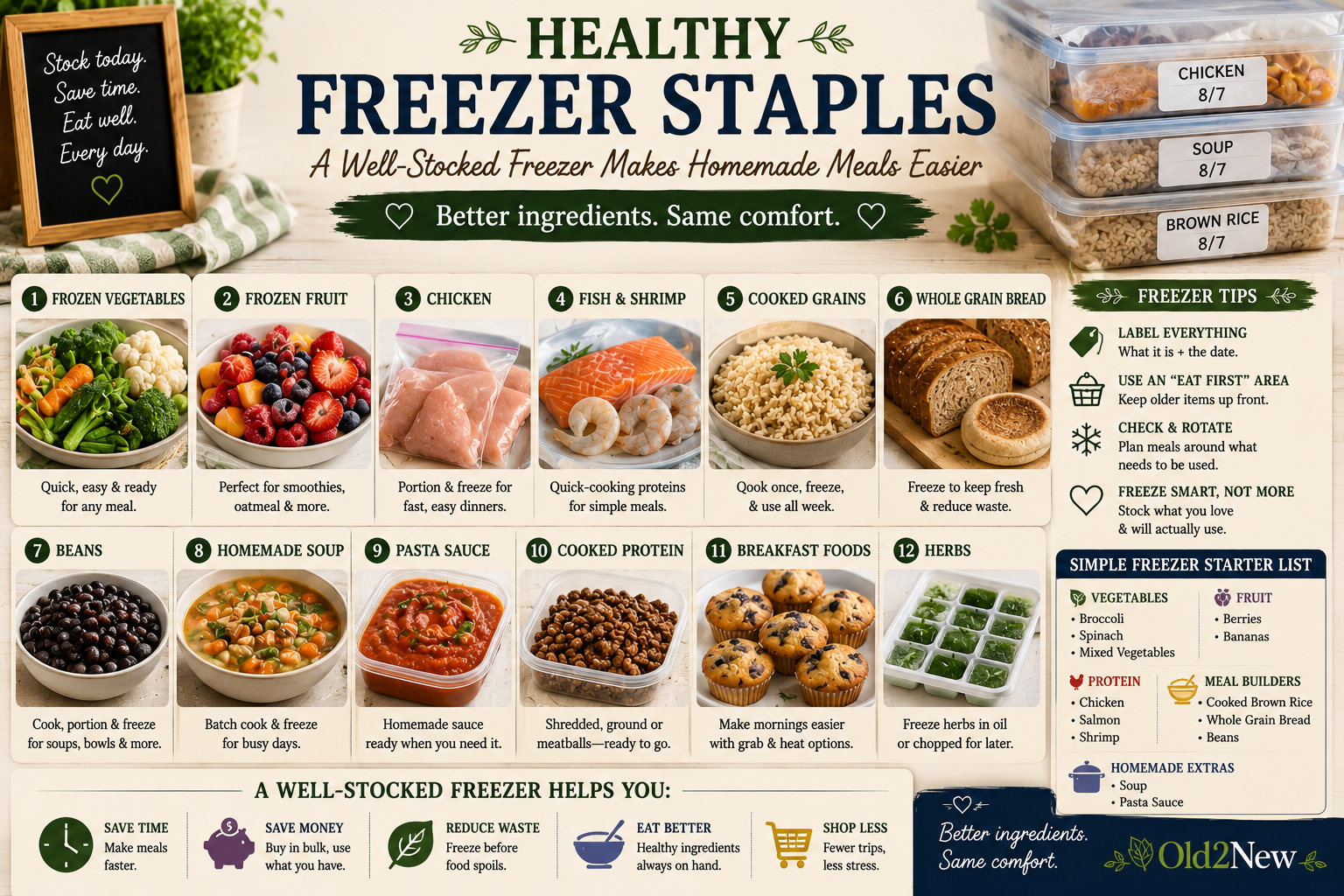
Healthy Freezer Staples
Most freezers are underutilized in the wrong direction — stuffed with things that get forgotten rather than stocked with things that make cooking easier. The bag of broccoli pushed to the back behind the ice cream. The cooked chicken from three weeks ago in an unlabeled container. The half-eaten pint of something that's been there since winter.
A freezer used intentionally is one of the most valuable tools in the kitchen. It extends the life of ingredients that would otherwise spoil. It turns extra cooking into future convenience. It means that even when the refrigerator is nearly empty and a grocery trip hasn't happened yet, dinner is still possible from what's already frozen and waiting.
The difference between a freezer that helps and a freezer that accumulates is intentionality — choosing what goes in with a specific future meal in mind, labeling it so you know what it is, and actually using it before something newer gets pushed in front of it.
Here's what's worth keeping and how to use it.
Frozen Vegetables
Frozen vegetables are the most universally useful freezer staple because they're already washed, cut, and ready to go — eliminating the prep step that slows down weeknight cooking. They go directly from the freezer into a hot pan, a pot of soup, a casserole, or a sheet pan without any defrosting or preparation.
Broccoli, cauliflower, Brussels sprouts, and green beans all roast well from frozen at high heat — spread in a single layer on a sheet pan at 425°F, they become roasted vegetables in 20 to 25 minutes. Spinach goes directly into soups, pasta sauces, eggs, and casseroles from frozen. Peas and corn add color, sweetness, and nutrition to fried rice, soups, grain bowls, and pasta dishes without any prep. Mixed vegetable blends are the most versatile — a bag of mixed vegetables can go into any soup, stir fry, or casserole as a complete vegetable component in one addition. Bell peppers frozen in strips go directly into fajitas, stir fries, and pasta dishes.
A freezer with three to four bags of different frozen vegetables means there's always something available for a vegetable component without a special shopping trip — which is the practical definition of having a well-stocked kitchen.
Frozen Fruit
Frozen fruit extends the value of fruit beyond the produce season and is often more economical than buying fresh fruit year-round. For cooked and blended applications, frozen fruit is functionally identical to fresh and often picked at a higher point of ripeness.
Blueberries, strawberries, raspberries, and mixed berries are the most useful frozen fruits — they go into smoothies, oatmeal, Greek yogurt parfaits, muffins, pancake batter, and fruit crisps without any defrosting. Frozen berries warmed in a small pan with a squeeze of lemon and a pinch of cinnamon become a warm fruit sauce that goes over oatmeal, pancakes, or Greek yogurt in five minutes. Frozen mango, pineapple, and peaches are excellent in smoothies and work in baked goods and fruit desserts. Frozen banana chunks are the base of a thick, creamy smoothie or a one-ingredient "nice cream" when blended.
Keeping a selection of frozen fruit means smoothies, fruit-based breakfasts, and fruit additions to baked goods are always possible regardless of what's in season or what's on the produce shelf that week.
Chicken
Chicken in the freezer is the foundation for dozens of quick meals — the most versatile protein available and one that thaws relatively quickly compared to larger cuts. Freezing in individual or meal-sized portions means only what's needed for one dinner needs to be thawed, rather than a large package that needs to be used all at once.
Bone-in chicken thighs freeze and reheat particularly well because their higher fat content prevents them from drying out during reheating. Boneless chicken breast works well for quick weeknight cooking when sliced and cooked from a just-thawed state. Cooked shredded chicken — made in a batch and frozen in two-cup portions — is one of the most useful freezer items available: it goes directly from the freezer into tacos, soup, pasta, grain bowls, casseroles, and sandwiches with only reheating required.
Freezing cooked shredded chicken intentionally — making extra specifically to freeze — is one of the highest-return cook-once strategies available. The cooking session produces one dinner and multiple future fast meals simultaneously.
Fish and Shrimp
Frozen seafood is one of the most practical protein options in the freezer because both salmon and shrimp can be cooked directly from frozen with minimal quality loss, and both cook quickly enough that dinner is possible in 20 minutes from a completely frozen starting point.
Individually frozen salmon fillets go into the oven at 400°F from frozen for 20 to 25 minutes. Shrimp thaw under cold running water in 15 minutes and cook in three to four minutes in a hot pan. Both pair naturally with frozen vegetables and a quickly cooked grain for a complete dinner that requires almost no planning or fresh ingredients.
Wild-caught salmon and shrimp are available frozen year-round at prices that are often lower than fresh, and the quality of properly frozen seafood is indistinguishable from fresh in most cooked applications. Keeping a few salmon fillets and a bag of shrimp in the freezer means a high-quality, high-protein dinner is available on any weeknight regardless of what else is in the kitchen.
Cooked Grains
Cooked grains are one of the most time-saving freezer items possible because they eliminate the cooking step that takes the most time in any grain-based meal. Brown rice takes 45 minutes to cook. Cooked brown rice from the freezer reheats in two minutes in the microwave with a splash of water.
Cooking a large batch of brown rice, quinoa, farro, or barley and freezing in individual two-cup portions — roughly one to two servings each — creates a supply of grain components that contribute to grain bowls, stir fries, fried rice, soups, stuffed peppers, and burrito bowls throughout the month with no additional cooking time required.
The habit of freezing extra grains after every cooking session — saving two cups from every batch rather than refrigerating them where they'll compete with other leftovers — produces a freezer supply that builds over time into a reliable convenience reserve.
Whole Grain Bread and Bread Products
Bread freezes well and defrosts in the toaster directly from frozen — which makes freezing bread the moment it's brought home (or when half a loaf remains and won't be finished before it goes stale) one of the simplest food waste solutions available.
Whole grain bread, English muffins, pita bread, tortillas, and homemade muffins all freeze well and go directly from the freezer to the toaster or oven. Having these on hand means toast, sandwiches, breakfast sandwiches, and quick quesadillas are available even when fresh bread hasn't been purchased recently.
Tortillas are particularly worth keeping frozen — they thaw in seconds and serve as the base for tacos, quesadillas, wraps, and burritos whenever the protein and filling components are available. A bag of frozen tortillas paired with frozen chicken and frozen vegetables is a taco night that requires no advance planning.
Cooked Beans
While canned beans are already convenient, cooked beans from dried legumes can be frozen in portions for even more economical and flexible use. Cooking a large batch of black beans, kidney beans, chickpeas, or cannellini beans and freezing in two-cup portions — equivalent to one can — produces a pantry supply that costs a fraction of canned beans and performs identically in any cooked application.
For households that use beans frequently, the cooking-and-freezing approach makes economic sense: a pound of dried black beans produces the equivalent of four to five cans of cooked beans at a fraction of the cost, and the frozen portions go directly into chili, tacos, soups, grain bowls, and casseroles exactly as a drained and rinsed can would.
Even without cooking beans from scratch, having a few cans available is worth noting here — their long shelf life makes them more of a pantry staple than a freezer item, but cooked leftovers from a can absolutely deserve to be frozen rather than discarded.
Homemade Soup
Soup is the ideal freezer food — it holds quality through freezing and reheating better than almost any other dish, and it produces the most significant convenience benefit when frozen because the alternative (cooking soup from scratch on a busy weeknight) requires the most time and effort.
Making a large batch of chicken vegetable soup, lentil soup, minestrone, turkey chili, or tomato soup and freezing individual portions means homemade comfort food is available in 10 minutes on the nights when there's no time or energy to cook. The frozen soup portion goes from freezer to microwave to bowl without any active cooking — and produces a result that a frozen packaged product at the same price doesn't match for quality or satisfaction.
The most effective habit is freezing soup immediately after cooking rather than refrigerating it and hoping it gets eaten — once in the freezer, it's available for weeks rather than competing with other refrigerator contents for use within three to four days.
Pasta Sauce
Homemade pasta sauce represents significant cooking time — the onion and garlic sautéed, the tomatoes simmered, the herbs added. Making extra and freezing in two-cup portions (enough for a pound of pasta) turns one cooking session into multiple future dinners.
A frozen portion of homemade tomato sauce or meat sauce thaws in the refrigerator overnight or under warm water in 20 minutes, and dinner becomes: boil pasta, heat sauce, done. The quality is significantly better than jarred pasta sauce at a lower cost, and the only work required on the night it's used is cooking pasta.
This applies equally to store-bought pasta sauce — buying quality jarred sauce and freezing what won't be used from a large jar before it goes bad in the refrigerator extends its value.
Cooked Proteins
Extra cooked ground turkey, ground beef, shredded chicken, and meatballs frozen in meal-sized portions are the cook-once foundation for fast future dinners. They're not leftovers — they're ingredients that have completed the longest and most active cooking step and are waiting to be assembled into a meal.
Frozen cooked ground turkey seasoned with taco spices goes into tacos or burrito bowls from frozen with only reheating required. Frozen meatballs go into pasta sauce or soup directly from frozen in five minutes. Frozen shredded chicken goes into any protein application from a completely ready starting point.
The mindset shift from "I'm freezing leftovers" to "I'm preparing ingredients for future meals" makes this practice feel like a cooking strategy rather than a chore — because that's what it actually is.
Homemade Breakfast Foods
The freezer can make mornings significantly easier with minimal advance effort. Whole grain pancakes and waffles made in large batches freeze in individual portions and reheat in the toaster directly from frozen — indistinguishable from fresh and ready in two minutes. Breakfast burritos assembled in batches, wrapped individually in foil and frozen, reheat in the microwave in three minutes and provide a complete breakfast with protein, vegetables, and a whole grain tortilla. Breakfast muffins made with oats, whole wheat flour, Greek yogurt, and fruit freeze well and thaw overnight in the refrigerator. Baked oatmeal portioned into individual containers freezes and reheats in two minutes.
Having these breakfast items available means the morning decision is reduced to choosing from what's already made rather than cooking from scratch — which is particularly valuable on weekday mornings when time is short.
Fresh Herbs
Fresh herbs often come in bunches larger than any single recipe requires, and the unused portion frequently wilts before it can be used. Freezing excess fresh herbs is one of the simplest ways to extend their value and eliminate waste.
Chop herbs and freeze in small portions on a sheet pan, then transfer to a labeled bag. Or freeze in ice cube trays with a small amount of olive oil — each cube becomes a ready-made flavor starter for soups, sauces, and braises that can go directly into the pot from frozen. Parsley, cilantro, basil, and chives all freeze well for cooked applications (they lose their fresh, bright quality for raw use but work perfectly in anything that's cooked). Rosemary and thyme freeze particularly well because their woody structure tolerates freezing without significant quality loss.
Labeling and Organization
The difference between a useful freezer and a frozen mystery collection is labeling. Everything that goes into the freezer should be labeled with what it is and the date it was frozen — this takes ten seconds and makes the difference between food that gets used and food that accumulates until a freezer audit discovers something that's been there for eight months.
Using clear containers or labeled freezer bags allows visible identification without having to move things to see what's behind them. Organizing by category — proteins in one area, vegetables in another, prepared meals and sauces in another — makes finding things faster and reduces the frustrated digging that leads to giving up and ordering delivery.
Creating a designated "use first" section — a small basket or front shelf space where the oldest items are moved when something newer comes in — prevents the bottom-of-the-pile food waste that happens in unorganized freezers.
FAQ
How long do frozen foods actually last? Most frozen vegetables maintain quality for eight to twelve months. Frozen raw chicken keeps for nine to twelve months; cooked chicken keeps for two to three months. Frozen fish keeps for three to six months. Cooked grains keep for one to two months before quality declines noticeably. Soups, stews, and pasta sauces keep for three to four months. Bread keeps for two to three months. These are quality guidelines, not safety guidelines — properly frozen food is safe to eat beyond these windows, but quality declines. Labeling with the date makes these timelines easy to track.
Is it safe to freeze food in the original packaging? For short-term freezing (one to two weeks), the original packaging is usually fine. For longer storage, transferring to airtight freezer-safe containers or freezer bags removes air that causes freezer burn and extends quality. Squeeze excess air from freezer bags before sealing. For soups and liquids, leave headspace in containers because liquids expand when frozen.
Can I freeze cooked pasta? Pasta freezes with mixed results — it tends to become soft and slightly mushy when reheated because the starch absorbs moisture during freezing. Pasta dishes where the pasta is combined with sauce (lasagna, baked ziti) freeze better than plain cooked pasta. For soups and casseroles, undercooking the pasta slightly before freezing helps it maintain better texture after reheating. Plain cooked pasta for future use is better refrigerated for two to three days than frozen.
What's the best way to thaw frozen chicken quickly? Place the sealed package in a bowl of cold water, changing the water every 30 minutes. A pound of frozen boneless chicken breast thaws in one to two hours this way. Never thaw chicken in warm water or on the countertop — cold water is safe and faster than refrigerator thawing. For whole chicken pieces or larger amounts, refrigerator thawing overnight is the most reliable method.
Continue Your Recipe Transformation Journey
A well-stocked freezer makes every other aspect of healthy cooking more reliable and more convenient. These guides will help you make the most of it:
- Fresh vs. Frozen Vegetables — when frozen vegetables are the better choice
- How to Cook Once and Eat Twice — how the freezer enables the cook-once strategy
- How to Use Leftovers Creatively — how to think about frozen components as future meal building blocks
- Pantry Staples Every Home Cook Should Keep — the pantry that works alongside the freezer
- Beginner's Guide to Meal Planning — how to incorporate freezer staples into weekly planning
Old2New — There is good in everything.