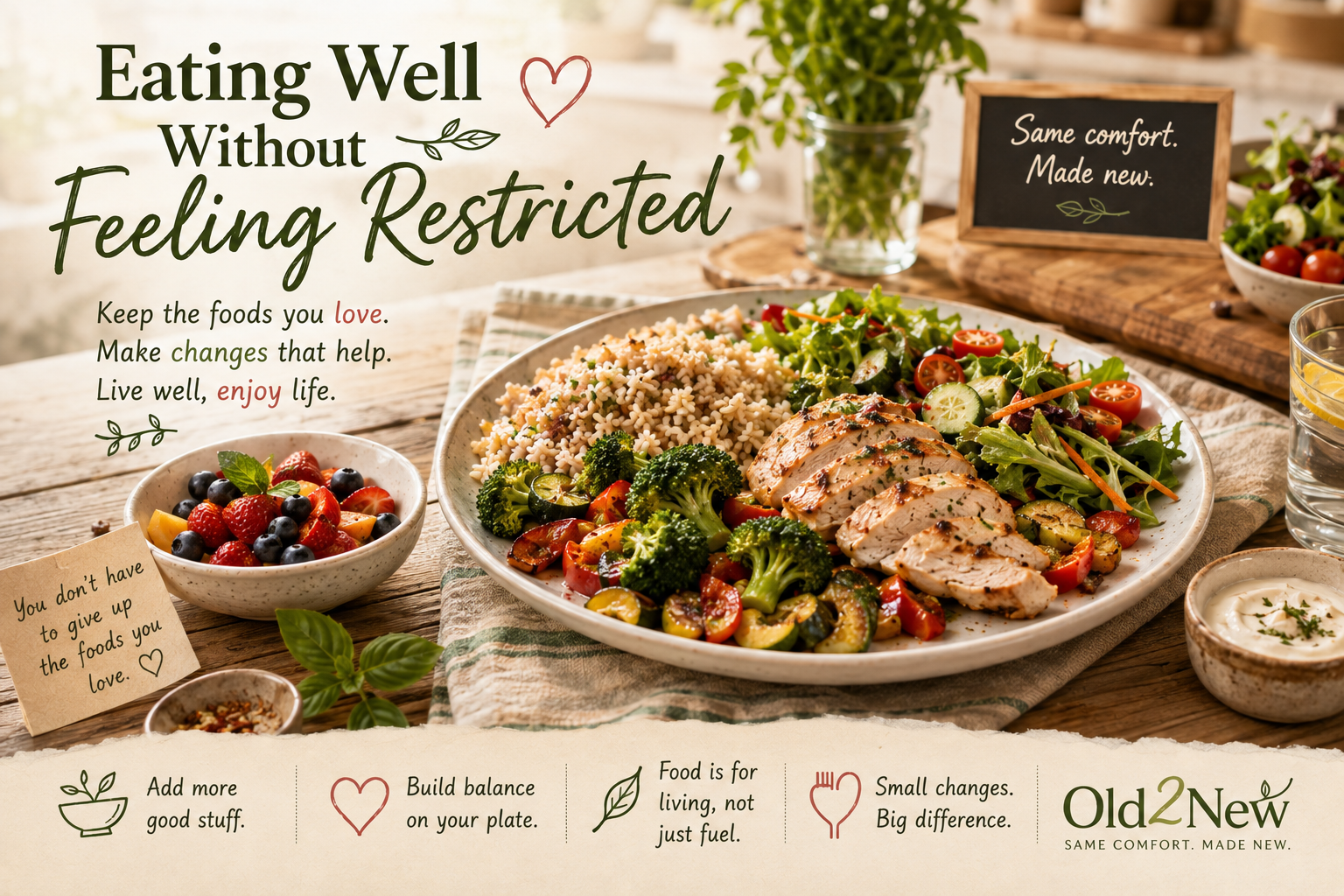
Eating Well Without Feeling Restricted
The minute someone says they're trying to eat healthier, something interesting happens. Suddenly there's a list. No bread. No pasta. No potatoes. No dessert. No pizza. No eating after a certain time. No anything that makes dinner worth showing up for.
And for a little while, that might feel manageable. But eventually Friday night comes around. Someone orders pizza. You're staring at your carefully prepared meal thinking: "Is this really how I'm supposed to eat forever?"
At Old2New, we don't believe eating well should feel like you're constantly being told no. When healthier eating becomes a long list of foods you can't have, food starts feeling less enjoyable and everyday life becomes harder than it needs to be.
We prefer a different approach. Keep the foods you love. Then look for ways to make them work better for the way you want to eat. That's not restriction. That's transformation.
Healthy Eating Should Give You More Options, Not Fewer
Think about how many foods exist — thousands. Yet somehow many diets manage to reduce dinner to chicken, broccoli, salad, repeat. There's nothing wrong with any of those foods. But there's also tacos, pasta, chili, pizza, burgers, meatloaf, lasagna, chicken pot pie, mac and cheese, pancakes, sandwiches, soups, and casseroles. All of those foods can be part of a kitchen where you're making thoughtful choices.
The goal shouldn't be to make your food world smaller. It should be learning how to work with the foods already in it.
Stop Thinking in "Allowed" and "Not Allowed"
Food doesn't need to be divided into two teams — good food and bad food. That kind of thinking makes eating unnecessarily complicated.
Take a potato. A potato is simply an ingredient. You can bake it, roast it, mash it, put it in soup, serve it alongside chicken, top it with broccoli, beans, cheese, or Greek yogurt, or turn it into fries. The ingredient itself isn't the whole story — what you make with it matters. That's why Old2New looks at the complete recipe rather than judging individual ingredients.
Keep the Food — Change What Makes Sense
Suppose you love tacos. You don't need to replace the tortillas with lettuce every time you want tacos. Maybe you keep the tortillas and change something else — lean seasoned beef, black beans, lettuce, tomatoes, peppers, avocado, cheese, and salsa. Still tacos. Still delicious. Still recognizable. That's the kind of transformation we're after.
Pasta Isn't the Problem
Pasta gets blamed for a lot. But if spaghetti night is one of your favorite meals, removing spaghetti probably isn't going to make dinner more enjoyable. Instead, build the meal. Start with pasta. Add tomato sauce. Add lean ground beef, turkey, chicken, beans, or lentils. Add mushrooms. Add spinach. Add parmesan. Now you've got a pasta dinner with several different components. We didn't need to remove the pasta to improve the meal.
Pizza Night Can Stay
Friday night pizza does not need to be canceled because you're trying to eat differently. Maybe you add mushrooms, peppers, spinach, chicken, or onions. Maybe you put a salad beside it. Maybe you make pizza at home. Maybe you order your family's favorite pizza. And sometimes you don't transform anything — you just eat the pizza.
Healthy eating happens across many meals. Friday night doesn't have to carry the responsibility for your entire week.
Don't Replace Something Just Because You Can
Just because an ingredient can be replaced doesn't mean it should be. Suppose Grandma's lasagna uses regular noodles. You could replace them — but what if the new noodles completely change the texture everyone loves? Maybe the noodles aren't where the transformation needs to happen. Perhaps you use leaner meat. Add mushrooms and spinach. Adjust the cheese. Serve a vegetable alongside it. Or perhaps Grandma's lasagna stays exactly the same and you enjoy it occasionally.
Not every ingredient needs fixing.
Add Before You Subtract
This may be one of the simplest ways to make healthier eating feel less restrictive. Instead of immediately asking "what should I remove?" ask: "what could I add?"
Making eggs? Add spinach. Making spaghetti? Add mushrooms. Making tacos? Add black beans. Having toast? Add eggs and fruit. Eating an apple? Add peanut butter. Making pizza? Add vegetables. Having soup? Add beans or chicken. Sometimes adding something changes the balance of a meal without taking anything away.
Use the "AND" Approach
Instead of pizza OR salad, try pizza AND salad. Instead of pasta OR vegetables, try pasta AND vegetables. Instead of pancakes OR eggs, try pancakes AND eggs AND berries. Instead of potatoes OR broccoli, try potatoes AND broccoli AND chicken. The word AND gives you a lot more possibilities than the word OR.
Comfort Food Still Has a Job
Food isn't only fuel. Food is also tradition, family, culture, celebration, memory, comfort, and connection. Your grandmother's soup isn't simply a collection of nutrients. The cookies made every Christmas aren't just flour and sugar. The tacos your family eats every Tuesday aren't merely carbohydrates and protein. Food carries stories.
That's why completely replacing familiar dishes can sometimes feel like losing something bigger than the recipe. Old2New isn't trying to erase that. We're trying to preserve it while giving you more ways to enjoy it.
A Healthier Version Should Still Be Delicious
Imagine transforming your favorite mac and cheese. You reduce everything — less cheese, less sauce, different noodles, no butter, no flavor. You take one bite and think: "Well, technically it's mac and cheese." That's not enough.
A transformed recipe should still make you want another bite. Texture matters. Flavor matters. Aroma matters. Comfort matters. If a swap ruins the dish, it probably wasn't the right swap. Try another approach.
You Don't Need the Lowest-Calorie Version of Everything
Sometimes healthier eating gets reduced to one number — fewer calories must automatically mean better. But meals are more complicated than that. A slightly more substantial meal containing protein, vegetables, fiber, and ingredients you genuinely enjoy may be much more satisfying than simply choosing whichever option has the smallest number. Old2New isn't about winning a contest for the lowest-calorie dinner. It's about creating food that fits your goals and still feels like food.
Portions Can Change Without Becoming Tiny
Eating well doesn't require miniature portions of everything you enjoy. Instead, look at the whole plate. Suppose dinner is meatloaf and mashed potatoes. Rather than making both disappear, build around them.
The old version: meatloaf and a large serving of mashed potatoes. The new version: meatloaf with mashed potatoes, green beans, and roasted carrots. The comfort food stayed. The meal became more varied. That's portion balance, not punishment.
Let Yourself Be Satisfied
A meal that leaves you thinking about food again twenty minutes later isn't necessarily helping. Include foods that make meals satisfying. Depending on your preferences and needs, that might mean a combination of protein, produce, carbohydrates, fats, fiber-containing foods, and flavor. Satisfaction matters because you're building a way of eating you can actually live with.
You Don't Have to Earn Your Food
You don't need to exercise to earn dinner. You don't need to skip lunch because you're going out tonight. You don't need to save all your food for a party. And you don't need to punish yourself tomorrow because you had dessert today. Food isn't a reward for being good. And eating something you enjoy isn't a failure.
Stop Calling It Cheating
"Cheat meal" is such a strange phrase when you think about it. Who exactly are we cheating? If you eat a burger, you ate a burger. If you have cake, you had cake. If you order pizza, you ordered pizza. Then the next meal happens. You don't need to restart anything. One meal doesn't erase everything else you've been doing.
Holidays Are Supposed to Have Holiday Food
Thanksgiving without the family recipes? Christmas without the cookies? A birthday without cake? No thank you. Celebration foods have a place in our lives. Maybe some recipes get transformed. Maybe some don't. Maybe Grandma's stuffing stays exactly as Grandma made it because that's the point. Healthy living has to be big enough to include real life.
Restaurants Fit Into Real Life Too
Eating well doesn't require staying home forever. When you go to a restaurant, order something you enjoy. Maybe choose vegetables as a side. Maybe take leftovers home. Maybe split something. Maybe don't. You don't need to turn dinner with friends into a nutritional negotiation. Enjoy the meal. Enjoy the people. Then continue with your normal routine.
Your Favorite Recipe Doesn't Need Twelve Swaps
This is where recipe transformation can go wrong. Suppose we're transforming chicken pot pie. We replace the crust, the filling, the sauce, the chicken, remove the potatoes, and change the seasoning. At some point we have to ask: is this still chicken pot pie?
Old2New should protect the identity of the dish. Sometimes one or two thoughtful changes are enough. More transformation isn't automatically better transformation.
Different Goals Can Still Include Familiar Food
Someone may want a recipe that's high protein, lower sodium, Mediterranean-style, GLP-1 friendly, or another preference or eating goal. Those goals can influence how a recipe is transformed. But the goal shouldn't erase the recipe. If someone asks for high-protein Mediterranean-style tacos, the result should still be tacos. If they want lower-sodium meatloaf, it should still look and taste like meatloaf.
When multiple goals are combined, there comes a point where we need to protect the food from becoming something unrecognizable. Healthy goals matter. But so does dinner.
Restriction and Preference Aren't the Same Thing
There are legitimate reasons people avoid certain foods — allergies, intolerances, religious practices, ethical choices, medical guidance, and personal preferences. Those aren't something to ignore. Recipe transformation can help people work within those needs while preserving as much of the original dish as possible.
The goal isn't "eat everything." It's "don't remove things unnecessarily." That's an important difference.
Make the Swap Earn Its Place
Before changing an ingredient, ask: what does this swap improve? Does it add protein? Increase fiber? Reduce sodium? Fit a dietary preference? Improve the cooking method? Add vegetables? Make the recipe work better for your goal?
If the answer is "because healthy recipes are supposed to use it," that's probably not a good enough reason. Every swap should have a purpose.
Some Recipes Don't Need Changing
This may sound strange coming from an app built around recipe transformation. But it's true. Sometimes you look at a recipe and decide: I love this exactly as it is. Wonderful. Keep it. Maybe you transform what you serve alongside it. Maybe you make it less often. Maybe you change the portion. Maybe you do absolutely nothing.
Having the ability to transform food doesn't mean every food needs transforming.
Healthy Eating Should Be Flexible Enough for Tuesday
It's easy to eat according to a perfect plan when nothing goes wrong. But life doesn't work that way. Tuesday gets busy. The chicken is still frozen. Someone has practice. You worked late. Nobody wants what you planned. So you make sandwiches — or eggs, or frozen pizza with vegetables, or leftovers, or takeout.
A sustainable way of eating needs room for imperfect days. Otherwise it's not really sustainable.
Ask a Better Question
Instead of "can I eat this?" try "how could I make this work for me?" That one question changes everything. Can I eat spaghetti? How could I build a spaghetti dinner that fits my goals? Can I have tacos? What ingredients would I like in my tacos? Can I eat pizza? What would make pizza night work for me? Suddenly you're making decisions instead of following a list of rules.
Food Shouldn't Feel Like a Test
There isn't a perfect score waiting at the end of dinner. You don't get extra credit because you skipped the bread. And you haven't failed because you ate dessert. Healthy eating is something you practice over time. Some meals will support your goals beautifully. Some will simply be delicious. Often they'll be both. That's the sweet spot.
Keep What You Love. Change What Helps.
Eating well doesn't have to mean giving up everything familiar. You can keep pasta, bread, potatoes, rice, tacos, pizza, burgers, pancakes, mac and cheese, dessert, and all the other foods that make your kitchen feel like your kitchen. Then make thoughtful changes when they make sense. Add something. Swap something. Change the cooking method. Adjust the portion. Build a different plate. Or leave the recipe alone.
Because the goal isn't to create a life where you're constantly thinking about what you can't eat. It's to build one where you have more ways to enjoy the food you already love.
FAQ
What if I genuinely enjoy the healthier version of a recipe? Keep it. The goal of Old2New is to help you find the version of every recipe you actually want to eat consistently — whether that's a transformed version, the original, or something in between. There's no obligation to prefer the original. If the transformed version tastes better to you, that's not a compromise. That's a win.
How do I handle social situations where I can't control what's being served? Eat what's available, enjoy the meal, and move on. Social eating is part of life, and a sustainable approach to healthy eating has to accommodate it. A meal outside your usual routine doesn't require advance planning, compensation, or apology. It's just dinner.
What's the difference between restriction and choosing not to eat something? Restriction is feeling like you can't have something — a rule imposed from outside that creates guilt or anxiety. Choosing not to eat something is a personal preference made freely. Old2New supports the second. A person who doesn't enjoy a certain food and doesn't eat it isn't being restricted — they're simply eating what they like. The distinction matters because it changes the emotional experience of making that choice.
Continue Your Recipe Transformation Journey
Eating without restriction starts with a different relationship with familiar food. These guides will help you build it:
- How to Make Your Favorite Recipes Healthier Without Starting Over — the practical framework for purposeful transformation
- Why Small Changes Matter More Than Perfect Diets — why consistency beats perfection
- Building Healthy Habits That Last — how to make the approach sustainable
- Understanding Portion Balance — how to build a complete plate without restriction
- Building a Family Recipe Binder — where the recipes worth keeping live forever
Old2New — There is good in everything.