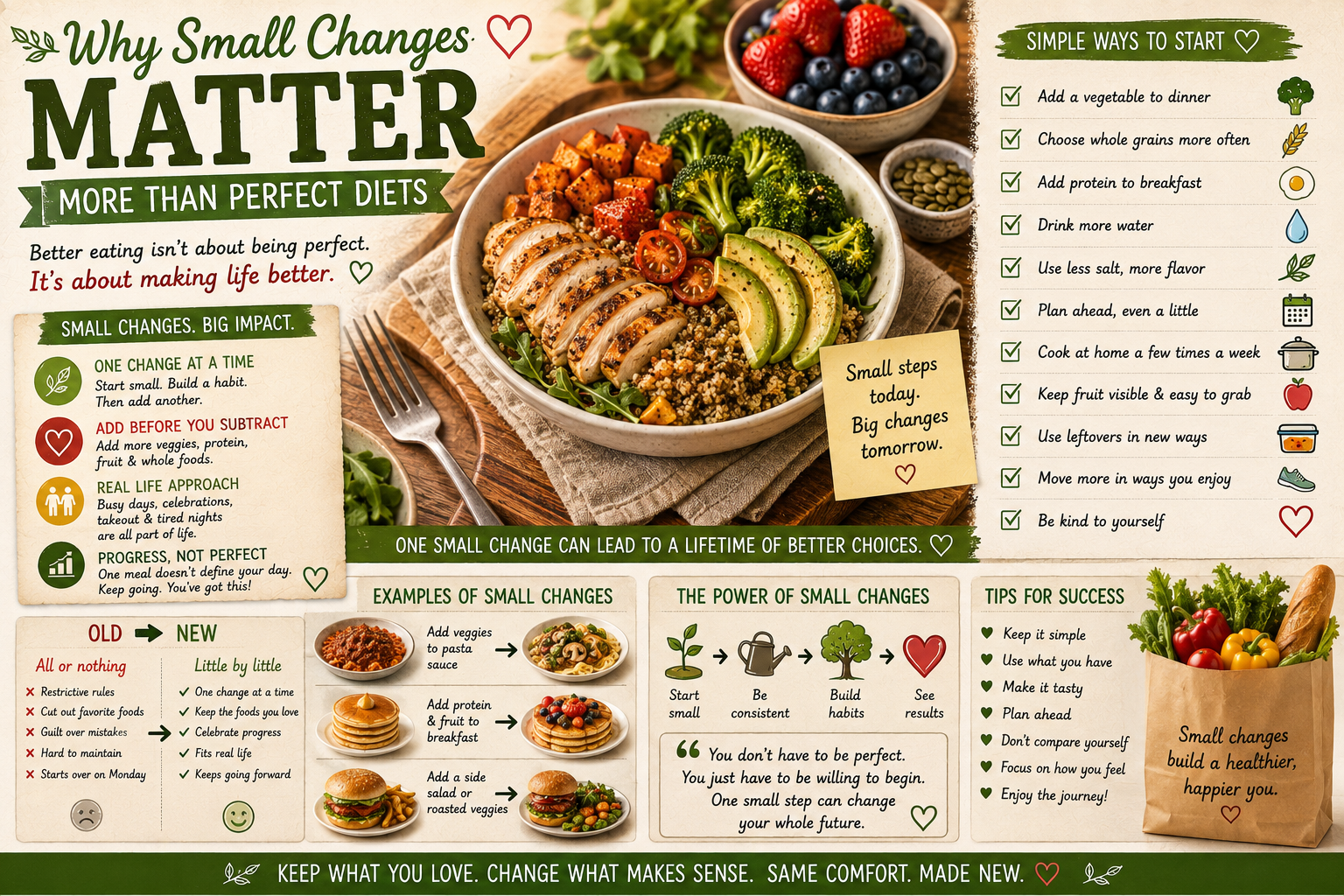
Why Small Changes Matter More Than Perfect Diets
If eating healthier feels like something that has to be done perfectly, it probably won't feel sustainable for very long.
That's where most people get stuck. The decision to eat better arrives and suddenly everything has to change simultaneously: no more favorite foods, no more desserts, no more bread, no more eating out. The refrigerator gets overhauled, the grocery cart looks nothing like it did last week, and a long list of rules appears that doesn't quite fit real life.
For a little while, it might go well. Then real life happens. Someone is tired. Someone is busy. Someone wants pizza. There's a birthday. Cooking feels like too much on a Wednesday. And one imperfect meal starts to feel like failure.
But what if healthier eating didn't require perfection in the first place? What if it started with something much smaller — one change, then another, then another? That's an approach that can actually be lived with.
The Problem with Perfect Diets
Perfect eating sounds wonderful in theory. In real life, families have schedules that don't accommodate elaborate meal planning. Budgets change. People have different tastes within the same household. There are birthdays, vacations, restaurants, dinner parties, and Tuesday nights at 6:30pm when the question is what can be made in 15 minutes.
A way of eating that only works under ideal circumstances isn't a plan — it's a temporary condition. When the circumstances stop being ideal, the plan stops working, and what usually happens next is the conclusion that this didn't work, and a return to previous habits while waiting for a better moment to try again.
The better question isn't "how do I eat perfectly?" It's "what's one thing I could make a little better today?" That question is answerable on a Tuesday night in a busy week. The first one isn't.
Small Changes Don't Look Exciting
Here's something honest about the Old2New approach: the individual changes are not dramatic.
Adding mushrooms to spaghetti sauce isn't dramatic. Choosing lower-sodium broth isn't dramatic. Adding beans to chili isn't dramatic. Putting berries beside pancakes instead of just syrup isn't dramatic. Using leaner ground beef in meatloaf isn't dramatic. Swapping sour cream for Greek yogurt in tacos isn't something anyone writes home about.
But do those things repeatedly over months and years, and they become the way the household eats. Not because of one big transformation, but because small changes accumulated into new defaults.
The power isn't in any individual swap. It's in what happens when the swap becomes so normal that it stops requiring any decision at all.
One Change Can Become a Habit
Imagine choosing one goal for this week: add a vegetable to dinner three nights. Not changing breakfast. Not changing lunch. Nobody's favorite recipes disappearing. Just adding something at dinner three times.
After a week of doing it, it's somewhat easier than the first night. After a month, putting a vegetable on the dinner table is just what happens. After three months, the absence of a vegetable at dinner starts to feel like something is missing.
Then another change: keeping washed fruit where everyone can see it in the refrigerator. Then cooking a double batch of something once a week so there's food available on the nights when cooking doesn't happen. Then using leaner ground beef in the recipes that call for it.
None of these changes transformed anything overnight. Together, over time, they changed the way the household eats — not through a dramatic overhaul but through the slow accumulation of better defaults.
Start with What You Already Eat
No entirely new menu is required. The meals the family already loves are the starting point.
If tonight is spaghetti, keep the spaghetti. Could mushrooms or spinach go into the sauce? Could lean ground beef replace the higher-fat version? Could a salad appear alongside it? Could whole grain pasta be tried at some point? Pick one of those. Not all of them. One.
If tomorrow is tacos, keep taco Tuesday. Maybe black beans join the meat. Maybe more toppings appear on the table — lettuce, tomatoes, avocado, salsa — that make the tacos feel more complete. That's a change. Not a punishment. Not a diet meal. Dinner, slightly improved.
The meal stays recognizable. The people eating it notice it tastes good. The change accumulates.
Old Doesn't Mean Bad
When the Old2New formula talks about transforming old recipes into new ones, "old" doesn't mean something that was wrong or unhealthy or worth leaving behind. The original recipe may be something the family has loved for generations. There's genuine value in that — food carries culture, memory, tradition, comfort, and connection that exist independently of its nutritional profile.
"New" simply means: what could we do differently today, if we wanted to? The answer might be nothing. The answer might be one ingredient. The answer might be several things over several versions of the same recipe across several years.
The goal isn't to judge the old meal. It's to discover possibilities inside it.
Add Before You Subtract
One of the most accessible entry points for eating differently is focusing on what could be added rather than what needs to be removed. Removal feels like loss. Addition feels like abundance.
Add vegetables to pasta. Add berries to breakfast. Add beans to tacos. Add spinach to eggs. Add mushrooms to meatloaf. Add a salad beside pizza. Add protein to an afternoon snack. Add herbs and spices for flavor that doesn't require salt.
Sometimes adding something nutritious naturally changes the balance of the meal without making anyone feel like something was taken away. That's a much more inviting way to start than building a list of forbidden foods.
Your Favorite Foods Can Stay
Pizza can stay. Burgers can stay. Mac and cheese can stay. Tacos can stay. Lasagna can stay. Pancakes can stay.
Instead of asking whether something is "allowed," look at the entire meal and the entire week. Pizza tonight can exist in a week that also contains vegetables, protein, fruit, and home-cooked meals. A burger can sit alongside roasted potatoes and a side salad. Pancakes on Sunday morning can come with eggs and fresh berries.
The comfort stays. The meal simply becomes more complete. The habit of thinking about the whole meal rather than judging individual foods is itself one of the most useful shifts available.
Don't Try to Change Everything at Once
The list of things that could theoretically be improved about most people's eating habits is long: more vegetables, more protein, more cooking at home, less food waste, more whole grains, less sodium, more water, less processed food, more meal prep.
Trying to address that entire list on a Monday morning is a reliable path to feeling overwhelmed and abandoning the effort by Wednesday afternoon. Choosing one or two things, practicing them until they become easier, and then building from there is how durable habits form.
The ambitious list is useful for knowing what direction to head. It's not useful as a simultaneous to-do list.
A Better Week Doesn't Require Seven Perfect Days
A week that looks like: Monday with a balanced home-cooked dinner, Tuesday with tacos, Wednesday with sandwiches because the day got chaotic, Thursday with chicken and vegetables, Friday with pizza, Saturday at a birthday party, Sunday with a big pot of soup — is not a failed week. It's a normal week.
Some days produce intentional, well-built meals. Some days produce whatever's fast and available. Both are part of normal life, and healthy habits have to be built into normal life rather than replacing it.
One meal that didn't go as planned doesn't erase what's working. The next meal is another opportunity. That's all it needs to be.
Stop Waiting to Start Over on Monday
One of the most unhelpful patterns in attempts to eat better is the "I'll start again Monday" response to an imperfect meal or day. The message this sends is that healthy eating requires a clean slate and perfect consecutive days, rather than being something that continues regardless of individual imperfect moments.
If lunch didn't go as planned, dinner is another opportunity. If today wasn't great, tomorrow exists without requiring a formal restart. One imperfect meal doesn't reset everything that was working before it. The work doesn't need to be undone and redone — it continues.
Make the Better Choice the Easier Choice
The environment matters more than motivation. If fruit is visible at eye level in the refrigerator, it gets eaten. If it's in a produce drawer where it can't be seen, it gets forgotten. If easy proteins are available in the freezer, quick dinners happen. If frozen vegetables are stocked, vegetables appear in meals on nights when fresh produce has been depleted.
Designing the kitchen to make better choices the path of least resistance does more work than trying to maintain motivation through willpower. Willpower is finite. The bowl of fruit on the counter is just there.
Keep "Good Enough" Meals in Rotation
Not every dinner needs to be a recipe or a production. A short list of meals that can be made without thinking — the ones that require no planning, no special ingredients, and no inspiration — is what makes consistency possible when motivation is low.
Eggs with toast and fruit. Tacos with beans and vegetables. Rotisserie chicken with frozen vegetables and potatoes. Soup with whole grain toast. A pasta with tomato sauce, lean protein, and spinach. None of these wins any awards. All of them get dinner on the table without requiring anything from a difficult day.
Good enough meals are what make the pattern of cooking at home sustainable rather than dependent on good weeks.
When a Swap Doesn't Work, Don't Keep It
Not every healthier swap is going to become a household favorite. A transformation that tastes worse than the original isn't a success, regardless of what it looks like nutritionally. If a swap produces a meal nobody wants to eat again, the answer is going back to the original ingredient or trying a different approach.
The test of any change is whether the meal is still enjoyed. If it is, the swap is worth keeping. If it isn't, the information is useful and the original can return. No permanent commitment to any individual change is required — only to the practice of occasionally looking at familiar recipes and asking whether anything could be done differently.
Think About the Next Year, Not the Next Seven Days
Instead of asking whether something can be done perfectly for the next week, the more useful question is whether it could still be happening a year from now.
Adding vegetables to dinner a few nights a week — possible for a year, and for ten years after that. Making pizza night slightly more complete with a salad alongside — sustainable indefinitely. Swearing off every favorite comfort food permanently — not realistic for most people, which is why approaches built on elimination tend to end.
Small changes that fit into real life are the ones that become part of it. Big changes that require perfect circumstances are the ones that last until the circumstances change.
FAQ
How long does it take for a small change to become a habit? Research on habit formation suggests it takes anywhere from 18 to 254 days for a new behavior to become automatic, with the average around 66 days. The range is wide because habits vary in complexity and people vary in their contexts. The practical takeaway is that the first few weeks of any change are the hardest, and the change becomes progressively easier with repetition until it requires very little active effort.
What if my family resists changes to their favorite meals? The approaches most likely to be accepted without resistance are additions rather than substitutions (adding vegetables without removing anything) and invisible changes (blending ingredients into sauces, using leaner meat in heavily spiced dishes where the difference isn't noticeable). When changes are visible and obvious, introducing them gradually and without announcement — slightly more whole grain content each time, slightly more vegetables each week — allows the palate to adjust without the psychological resistance that comes from knowing something has been changed.
What's the single most important small change to start with? The one most likely to be maintained. The change that matters most is the one that becomes a habit, not the one with the largest theoretical nutritional impact. Start with whatever is most compatible with the household's current cooking, preferences, and schedule, and build from there.
Continue Your Recipe Transformation Journey
Small changes are where Old2New begins and what makes it last. These guides help put the philosophy into practice:
- How to Make Your Favorite Recipes Healthier Without Starting Over — the practical starting point for recipe transformation
- Easy Ways to Add More Vegetables Without Anyone Noticing — the easiest category of small changes to start with
- Beginner's Guide to Meal Planning — how planning small supports better consistency
- How to Use Leftovers Creatively — one of the most impactful small changes available
- Building a Family Recipe Binder — where old recipes and their new versions can coexist
Old2New — There is good in everything.