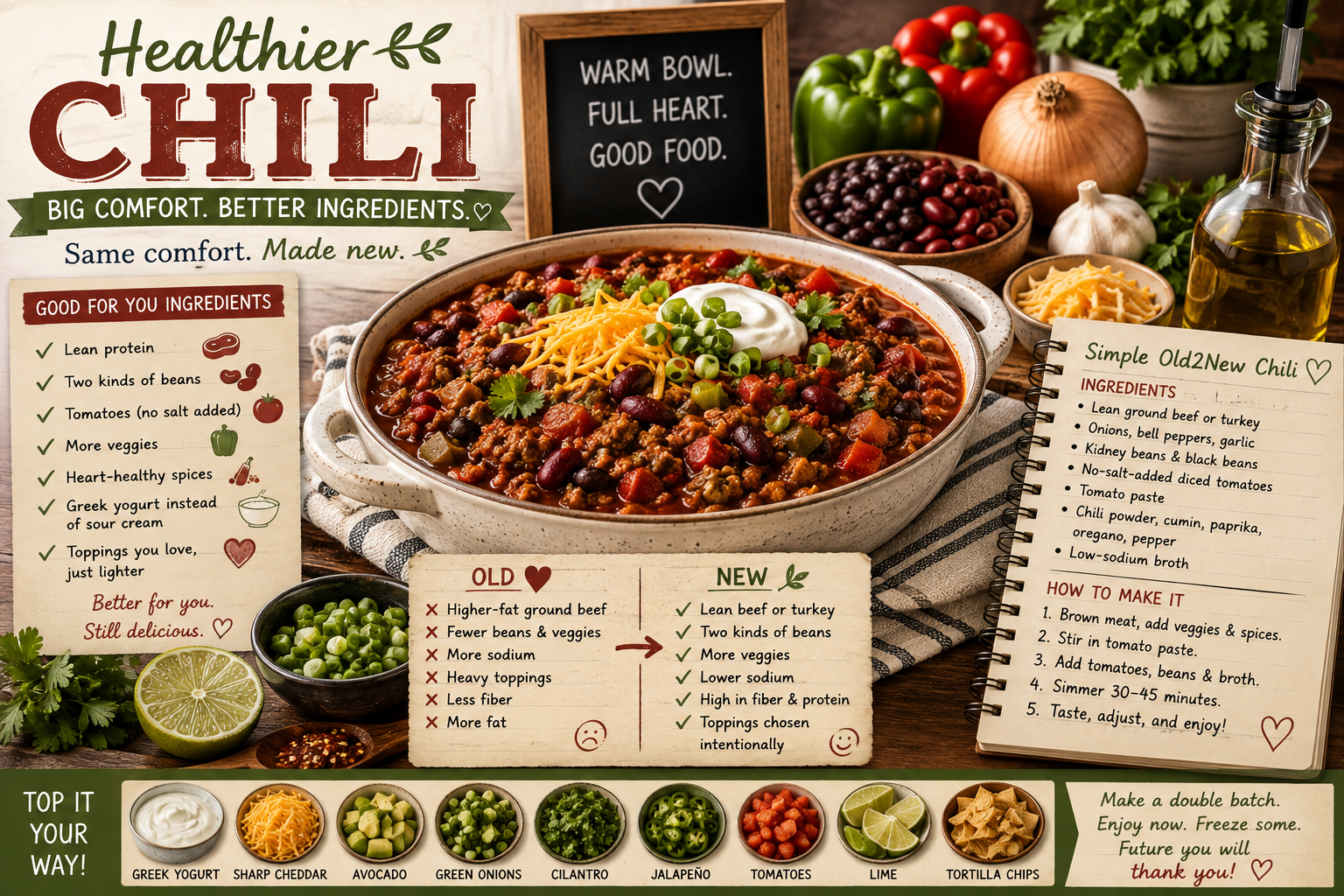
Healthier Chili: Big Comfort, Better Ingredients
There's something about a pot of chili simmering on the stove that feels like home. The smell fills the kitchen before the food is ready. The house gets warm. Everyone asks when it will be done. And it always — always — tastes better the next day.
Chili is also one of the comfort foods that needs the least transformation. The foundation is already built on good ingredients: tomatoes, beans, onions, peppers, spices, and protein. Unlike some comfort foods where the healthy version requires a complete reinvention, chili mostly needs thoughtful adjustments rather than replacement. The bowl at the end of the process should still be red, thick, hearty, and satisfying — still chili, in other words, rather than something that resembles chili conceptually but delivers something else entirely.
So instead of replacing the classic with something unrecognizable, the Old2New approach to chili builds on what already works. Because a healthier bowl of chili should still make someone reach for seconds.
Start with the Protein
Traditional chili is often made with ground beef, and ground beef doesn't have to leave. The simplest protein adjustment is choosing a leaner cut — 90% or 93% lean ground beef provides most of the flavor and texture of standard ground beef with significantly less saturated fat, and in a well-seasoned chili where tomatoes, beans, and spices are doing most of the flavor work, the difference between 80% lean and 93% lean is imperceptible in the finished bowl.
Ground turkey is the most direct substitute when the goal is leaning away from beef — it absorbs the surrounding spices completely and produces a chili most people can't identify as turkey rather than beef when it's well seasoned. Ground chicken works similarly. A combination of lean beef and turkey — half and half — is a practical middle ground that keeps the beef flavor while reducing the overall saturated fat.
The most useful protein approach for chili is the half-meat, half-beans ratio: one pound of lean ground beef or turkey combined with two cans of beans produces a chili that tastes like a meaty beef chili because it is one, while the beans add fiber, plant protein, and volume that stretches the recipe significantly further. One pound of meat feeds four as the primary protein; one pound of meat with two cans of beans feeds six to eight comfortably. That's better for dinner and better for the grocery budget.
Don't Be Afraid of Beans
Kidney beans, black beans, pinto beans, white beans — any combination of these belongs in chili without apology. Beans bring fiber, plant protein, texture, and heartiness to a pot of chili in a way that nothing else replaces. They absorb the surrounding spice and tomato flavors as they simmer, becoming infused with the seasoning of the pot rather than tasting like beans from a can.
Using two different types of beans adds visual interest and a subtle variation in texture that makes the chili more interesting to eat than a single-bean version. Kidney beans are traditional and hold their shape well through long simmering. Black beans add a slightly earthy flavor. Pinto beans become softer and almost creamy after extended cooking, adding body to the sauce.
For canned beans, drain and rinse thoroughly before adding — this removes the starchy liquid that can make the chili taste flat and reduces sodium significantly. Low-sodium or no-salt-added canned beans provide the most control over the final seasoning of the pot.
Add Vegetables Without Turning It Into Vegetable Soup
Chili is one of the most forgiving vehicles for vegetables because the long simmering time means most additions cook down and integrate completely into the sauce rather than remaining identifiably separate. Diced bell pepper becomes part of the chili's flavor rather than a distinguishable pepper chunk. Grated or finely diced zucchini essentially disappears into the sauce while adding volume and nutrition. Diced carrots soften and add a subtle sweetness that balances the chili's heat.
The vegetables worth adding most reliably: bell peppers (any color, diced), onion (which goes in regardless), diced zucchini, shredded or finely diced carrot, frozen corn stirred in near the end, and finely chopped mushrooms that add umami and a meaty texture that makes the chili feel more substantial. Mushrooms in particular are worth noting — finely chopped and cooked with the meat, they blend completely into the protein layer and add a depth of savory flavor that makes the chili taste richer without anyone identifying the mushroom.
The rule is: add the vegetables before the liquid goes in so they can soften in the hot pot and begin to develop their flavor, rather than adding them later where they'll remain distinct rather than integrated.
Let Tomatoes Build the Base
Tomatoes are the liquid foundation of most chili and the ingredient that determines how rich and deep the sauce becomes. Using multiple tomato forms — a can of diced tomatoes for texture, a can of crushed tomatoes for body, and a few tablespoons of tomato paste for concentrated depth — produces a sauce more complex than any single tomato product provides.
Tomato paste deserves specific attention because a small amount adds a disproportionate amount of flavor. Cooking the tomato paste with the meat and spices for a minute before adding the liquid concentrates and deepens it further — the sugars in the paste caramelize slightly against the hot pan and the flavor intensifies. This step takes 60 seconds and is worth doing consistently.
Look for no-salt-added or lower-sodium canned tomatoes when available — this gives more control over the final salt level of the pot, which can then be seasoned intentionally rather than adjusted around whatever sodium the canned tomatoes provided.
Season Generously
The flavor of a great bowl of chili comes from the spices, not from excess salt or heavy toppings. A well-spiced chili is satisfying before anything goes on top — the warmth from the chili powder, the earthiness from the cumin, the smoke from the smoked paprika, the depth from the garlic, the background heat from the cayenne all combine into something complex and deeply satisfying that needs very little added.
The spice combination worth knowing for chili: two tablespoons of good chili powder as the foundation, two teaspoons of cumin for earthiness and warmth, one teaspoon of smoked paprika for smoke and depth, half a teaspoon of dried oregano for a slight herbal note, black pepper generously, and cayenne to taste for heat. Garlic — fresh or powder — goes in at every stage: with the meat, with the spices, and as a finishing adjustment if the chili tastes flat.
Toasting the spices briefly in the hot pot with the meat and vegetables before adding the liquid is a technique worth building into every chili. The 60 to 90 seconds of direct heat opens up the aromatic compounds in the spices and adds a depth to the finished chili that adding spices directly to liquid doesn't achieve. The kitchen smells extraordinary while this happens, which is worth something on its own.
Give It Time
Chili rewards patience in a way that makes it particularly suited to weekend cooking or slow cooker weekday preparation. The minimum simmer time — 30 minutes — produces a chili that's cooked through and well seasoned. Sixty minutes produces a richer, more integrated sauce where the beans have fully absorbed the surrounding flavors and the sauce has thickened. Ninety minutes to two hours produces something that tastes like it's been cooking all day, because effectively it has.
During the simmer, the chili needs occasional stirring to prevent sticking and checking to maintain the right consistency — if it's thickening too much, a splash of broth or water loosens it. If it's too thin, leaving it uncovered for the last 15 minutes allows steam to escape and the sauce to concentrate.
The next-day version is genuinely better than the day-it-was-made version in most cases. The spices continue to develop overnight in the refrigerator, the beans absorb more of the surrounding liquid, and the flavors integrate in a way that fresh chili doesn't achieve. Making chili one day ahead is a legitimate cooking strategy rather than a consolation.
Rethink the Toppings
The toppings are where chili's nutritional profile can shift significantly in either direction with very little change to the chili itself. A modest amount of well-chosen toppings adds the finishing elements that make a bowl feel complete. A large amount of heavy toppings can substantially change what was otherwise a well-balanced bowl.
The toppings worth having available: a sprinkle of sharp cheddar rather than a large pile (sharp cheddar delivers more flavor per gram than mild cheddar, so less goes further); plain Greek yogurt instead of or alongside sour cream; diced avocado for healthy fat and creaminess; fresh cilantro and sliced green onions for brightness; diced fresh tomato for freshness and acid; sliced jalapeño for heat; a squeeze of fresh lime that brightens the entire bowl; and a small handful of tortilla chips for crunch if that's how the household likes to eat chili.
None of these toppings are prohibited. The adjustment is making them intentional rather than automatic — choosing them because they add something specific rather than piling them on by habit.
Greek Yogurt Instead of Sour Cream
Plain Greek yogurt is the most seamless single swap in chili toppings — same cool, creamy contrast against the hot chili, same visual presentation, significantly more protein, and a slightly tangier flavor that most people find actually complements chili better than sour cream's milder profile. The texture is essentially identical when spooned onto a hot bowl.
This swap is one most households can make without anyone noticing or objecting, which makes it particularly valuable. If the household genuinely prefers sour cream, using a smaller amount of sour cream alongside a dollop of Greek yogurt provides the familiar flavor while quietly shifting the nutritional balance in a useful direction.
A Simple Old2New Chili
Ingredients (serves 6 to 8)
- 1 lb lean ground beef (90% or higher) or ground turkey
- 1 tbsp olive oil if needed
- 1 medium onion, diced
- 1 bell pepper, diced
- 3 cloves garlic, minced
- 1 can kidney beans, drained and rinsed
- 1 can black beans, drained and rinsed
- 1 can no-salt-added diced tomatoes
- 1 can crushed tomatoes
- 2 tbsp tomato paste
- 2 tbsp chili powder
- 2 tsp cumin
- 1 tsp smoked paprika
- ½ tsp dried oregano
- Black pepper to taste
- Cayenne or red pepper flakes to taste
- ½ to 1 cup low-sodium broth or water as needed
Instructions
Heat a large heavy pot over medium-high heat. Add the ground meat and cook until browned, breaking into pieces as it cooks. Drain excess fat if necessary. Add the onion and bell pepper and cook until softened, about five minutes. Add the garlic, chili powder, cumin, smoked paprika, oregano, black pepper, and cayenne and stir to coat everything in the spices. Cook for 60 to 90 seconds until fragrant. Add the tomato paste and stir it into the mixture for another minute.
Add the diced tomatoes, crushed tomatoes, beans, and enough broth to reach the preferred consistency. Stir everything together, bring to a gentle simmer, reduce the heat, and cook uncovered for 30 to 45 minutes, stirring occasionally. Taste and adjust seasoning before serving.
Make a Double Batch
If the pot is already out and the vegetables are already chopped, making twice as much chili requires almost no additional effort. The second batch freezes perfectly in individual or family-sized portions and becomes three to four future dinners that require only reheating.
Leftover chili also transforms easily into genuinely different meals: spooned over a baked potato it becomes loaded chili potato. Stirred into cooked macaroni with a little cheese it becomes chili mac. Used as taco filling with fresh toppings it becomes chili tacos. Layered in a baking dish with tortilla chips and cheese it becomes a chili casserole. Spooned over brown rice it becomes a chili rice bowl. One pot of chili, made larger than needed, produces a week's worth of different dinners from the same cooking session.
Let the Recipe Evolve
If the family's chili recipe has been made the same way for twenty years, it doesn't need to be replaced. It needs to be looked at with one question in mind: where is one place a change could make a meaningful difference?
Maybe the ground beef becomes leaner. Maybe a second can of beans goes in alongside the first. Maybe a bell pepper gets added to the vegetable base. Maybe the sour cream topping becomes Greek yogurt. Maybe the tomatoes are no-salt-added. Each of these is a single change that doesn't alter the fundamental character of the chili but moves it meaningfully in a better direction.
Make the change that makes the most sense for this household, with this family, at this moment. The goal isn't the most nutritionally optimized chili — it's a delicious bowl of chili that's a little better suited to how the family wants to eat today.
FAQ
Can I make this in a slow cooker? Yes — brown the meat and cook the onion, pepper, and garlic with the spices on the stovetop first (the spice-toasting step doesn't work well in the slow cooker), then transfer everything to the slow cooker, add the tomatoes and beans, and cook on low for six to eight hours or high for three to four hours. The slow cooker version develops a slightly different, more integrated flavor that's particularly good for the next-day version.
How do I thicken chili that's too thin? Remove the lid and simmer uncovered for 15 to 20 minutes to allow moisture to evaporate. Alternatively, mash a portion of the beans against the side of the pot or blend a cup of the chili and stir it back in — the starch from the beans thickens the sauce naturally. A tablespoon of masa harina (corn flour) stirred in and simmered for five minutes is a traditional thickening method that also adds a slight corn flavor.
Is chili good for people on GLP-1 medications? Chili is exceptionally well-suited for anyone managing appetite or portions. The combination of lean protein and high-fiber beans produces substantial satiety per serving, and the volume of the dish — the tomatoes, beans, and vegetables providing significant bulk — means a reasonable portion is genuinely filling. The meal also reheats well, making it practical for portion-controlled lunches throughout the week.
Continue Your Recipe Transformation Journey
Chili is one of the most naturally improvable comfort foods because its foundation is already built on nutritious ingredients. These guides will help you build on it:
- What Can I Make with Black Beans? — everything black beans can do in and beyond chili
- What Can I Make with Tomatoes? — the foundation of every great chili sauce
- How to Cook with Herbs and Spices — how to build the spice flavor that makes chili great
- How to Cook Once and Eat Twice — how a double batch of chili becomes a week of different meals
- How to Make Your Favorite Recipes Healthier Without Starting Over — the philosophy behind every swap
Old2New — There is good in everything.