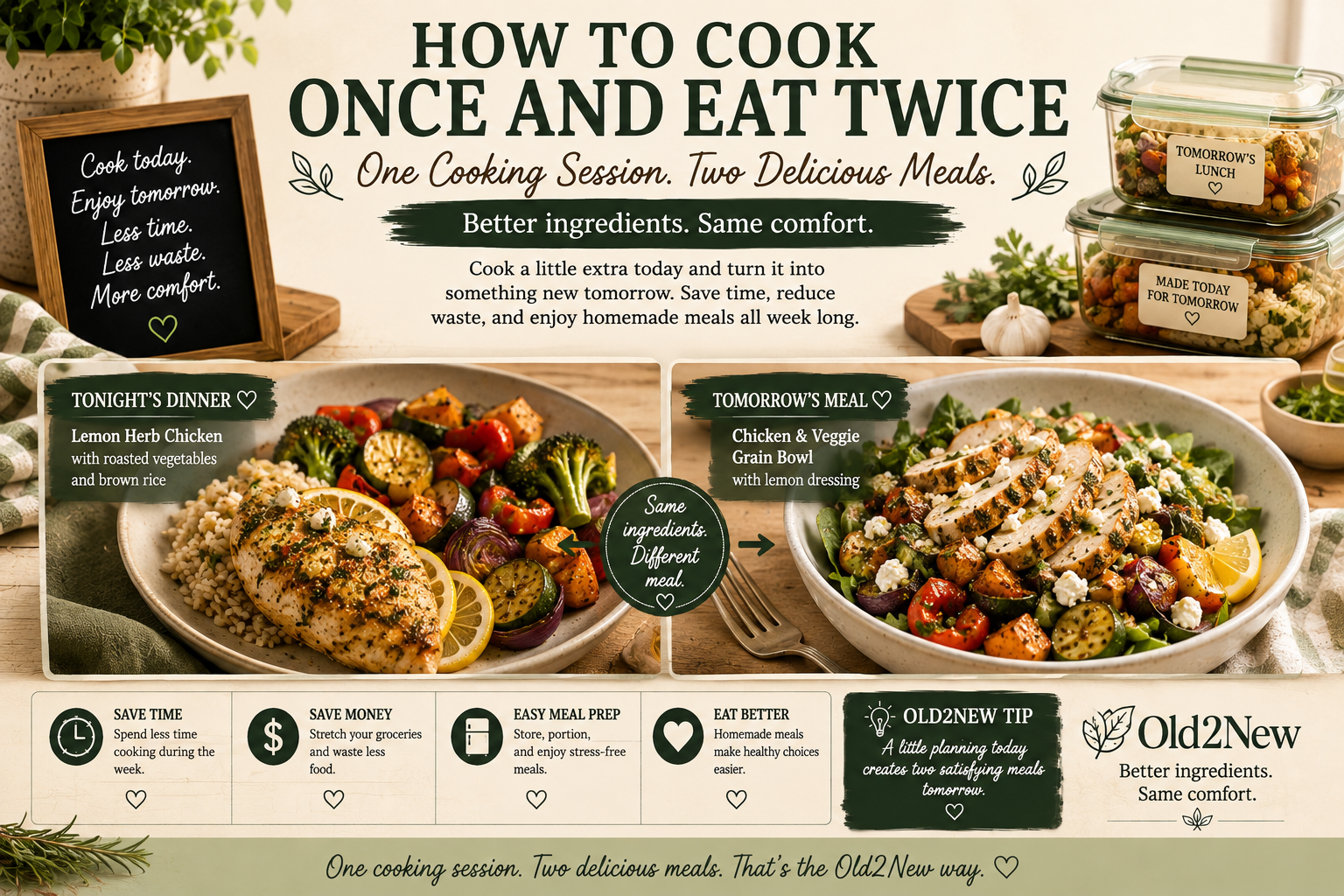
How to Cook Once and Eat Twice
The most effective strategy for cooking more healthy food at home isn't finding faster recipes or better meal plans. It's cooking a little more than you need right now so that tomorrow's meal is already partially done.
This isn't meal prepping in the elaborate Sunday-cooking sense. It's a simpler, lower-commitment version: while the oven is already on and the cutting board is already dirty, roasting an extra tray of vegetables takes two minutes of additional effort and produces a day's worth of lunch components. While browning ground turkey for tacos, browning a double batch takes the same time at the stove and produces enough for tacos tonight and stuffed peppers tomorrow. While cooking rice, making twice as much creates a refrigerator staple that contributes to three or four different meals throughout the week with no additional cooking time.
The key is thinking one meal ahead while you're already cooking — not planning an entire week in advance, just asking what tonight's cooking can set up for tomorrow.
Why Cook Once?
The reason most people order takeout or reach for processed convenience food on weeknights isn't lack of desire to cook. It's lack of available starting materials at the moment dinner needs to happen. When the refrigerator contains cooked chicken, cooked rice, and roasted vegetables, dinner is assembly — 10 minutes of combining things that are already done. When the refrigerator is empty, dinner is cooking from scratch — 45 minutes of active work at the end of an already long day.
The cook-once strategy builds up that starting material incrementally, meal by meal, rather than requiring a dedicated block of prep time. Every dinner that produces a little extra becomes the foundation for the next one. Over the course of a week, the cumulative effect is a refrigerator that always has something to work with — which changes the entire weeknight cooking experience.
It also reduces food waste and grocery spending: ingredients that are intentionally cooked in extra quantity get used, rather than fresh ingredients bought with good intentions that sit in the refrigerator until they're thrown away.
Think Beyond Leftovers
The reframe that makes this strategy work is thinking about cooked ingredients rather than leftover meals. The goal isn't eating Tuesday's dinner again on Wednesday. It's having cooked chicken available that can become a Caesar salad on Wednesday, a wrap on Thursday, and a quick soup on Friday — three different meals, none of which feel like a repeat, all built from the same cooking session.
This distinction matters because "leftovers" carries the implication of a diminished thing — the remainder after the real meal ended. "Cooked ingredient" carries the implication of a building block — something that's already done its hardest work and is ready to go in a different direction. The chicken that was dinner on Tuesday is not Tuesday's dinner again. It's a protein that's available for Wednesday, already seasoned, already cooked, already done.
Before starting to cook any dinner, ask one question: what will this become tomorrow? The answer shapes how much to make and how to store what's left over, without adding meaningful work to the cooking itself.
Proteins That Work Twice
The most valuable cook-once proteins are the ones with mild enough flavor to work in multiple directions and sturdy enough texture to hold up through storage and reheating.
Chicken is the most versatile. A batch of lemon herb roasted chicken thighs provides dinner tonight and becomes a Caesar salad, chicken tacos, grain bowls, chicken noodle soup, or a quesadilla filling over the next three days. The key is cooking more than needed for tonight and storing the extra before it's served — slicing or shredding it and storing in an airtight container in the refrigerator where it's available as a building block for whatever comes next.
Ground turkey or beef cooked in a large batch divides across multiple applications. Taco night with seasoned ground turkey leaves enough for stuffed peppers the next night, a pasta sauce the night after, and burrito bowls on Friday. The meat is already cooked and seasoned — each subsequent meal requires only assembling it into a different format.
Salmon roasted for dinner provides a protein that goes into a grain bowl or wrap the next day without any additional cooking. The richness of salmon holds up well through refrigeration and works both warm and cold, which makes it particularly flexible for next-day meals.
Shrimp cooked in a large batch divides easily — garlic shrimp for dinner tonight, shrimp tacos or fried rice tomorrow, shrimp pasta the day after. Because shrimp cooks in under five minutes, any batch is easy to make larger than needed.
Cook Extra Grains Every Time
The simplest cook-once habit available is doubling the grain whenever rice, quinoa, farro, or barley is being cooked. The same pot, the same time, twice the output. A double batch of brown rice cooked on Sunday provides the grain component for grain bowls, stir fry, fried rice, stuffed peppers, and soup additions throughout the week without any additional cooking.
Cooked grains refrigerate well for five to six days and freeze in individual portions for months. They reheat in two minutes in the microwave with a splash of water. They're the component of most grain-based meals that takes the longest to cook — having them already done transforms a 45-minute dinner into a 15-minute assembly.
The habit requires zero additional planning. Every time the rice cooker or pot goes on, make twice as much as needed for tonight.
Roast More Vegetables Every Time
The same principle applies to roasted vegetables: if the oven is already at 425°F and the sheet pan is already out, filling a second pan costs almost nothing in terms of active effort and produces a supply of cooked vegetables that goes into several subsequent meals.
Extra roasted vegetables from Monday's dinner become Tuesday's grain bowl topping, Wednesday's omelet filling, Thursday's pasta addition, and Friday's frittata base. They're already seasoned and caramelized — reheating them in a pan for two minutes or adding them cold to a salad or grain bowl requires no additional work.
This is particularly valuable for vegetables that take time to roast — broccoli, cauliflower, Brussels sprouts, sweet potatoes — where the oven time is the investment. Making more of them costs nothing beyond the additional vegetables themselves.
Smart Meal Pairings
These combinations work particularly well because the second meal is genuinely different from the first rather than feeling like a repeat.
Roast chicken → chicken soup: The leftover carcass and meat from a whole roasted chicken goes directly into a pot with broth, vegetables, and noodles for a soup that takes 30 minutes and tastes like it simmered all day. Two completely different meals from one cooking session.
Chili → loaded baked potatoes: A pot of chili that serves four at dinner serves four again the next night over baked potatoes with Greek yogurt and shredded cheese. Different format, different texture, same base — feels nothing like a repeat.
Taco meat → taco salad: The same seasoned ground turkey that filled tacos on Tuesday goes over romaine with corn, black beans, salsa, avocado, and crushed tortilla chips on Wednesday. A completely different eating experience from the same protein.
Sheet pan vegetables → pasta primavera: Leftover roasted zucchini, bell peppers, and cherry tomatoes tossed with whole grain pasta, olive oil, garlic, and parmesan becomes pasta primavera that tastes intentional and fresh rather than like an improvised use of leftovers.
Spaghetti sauce → lasagna soup: Leftover meat sauce simmered with broth, broken lasagna noodles, and ricotta dolloped on top becomes a completely different comfort food in 20 minutes.
Grilled steak → steak sandwiches: Leftover steak sliced thin over a whole grain roll with arugula, roasted peppers, and Dijon is a lunch or dinner that would be worth cooking the steak for specifically — the fact that it's made from last night's dinner makes it feel like a bonus.
Prep While You're Already Cooking
The transition from dinner to storage is the most overlooked moment in the cook-once strategy. Before cleaning up — while the cutting board is still out and the pans are still on the counter — taking five minutes to prepare the leftover components for tomorrow extends the value of the cooking session significantly.
Slice the extra chicken and store it in a container so it's ready to use rather than requiring handling when cold. Portion the extra rice into individual containers so grab-and-go lunches are already assembled. Wash and chop the extra vegetables bought for tonight so they're ready for tomorrow without any prep. Store fresh herbs properly (stems in water in a jar, loosely covered with a plastic bag in the refrigerator) so they're still good in three days when they're needed for the second meal.
These five minutes at the end of cooking are worth more than the same five minutes would be at any other point in the day, because they make the next meal faster and more likely to happen.
Freeze Future Meals
Not every cook-once second meal needs to happen tomorrow. Some components and dishes freeze so well that they become a stockpile of homemade convenience food — available weeks or months later when there's no time or energy to cook at all.
Soups and chili freeze in individual portions and reheat in minutes. Pasta sauce freezes in two-cup portions that provide a pasta dinner whenever they're thawed. Taco meat freezes in portions that go directly from the freezer to a pan for a fast weeknight taco night. Meatballs freeze individually and can be added to sauce or soup from frozen. Cooked chicken freezes in portions for soups, casseroles, and grain bowls. Casseroles and baked pasta dishes freeze in individual servings for lunches that require no additional cooking.
The most efficient approach is freezing with specific future meals in mind — portioning enough for exactly four servings of soup, or exactly two servings of pasta sauce — so that thawing produces a complete meal rather than an ambiguous amount of something.
FAQ
How far in advance can I prepare the second meal's components? Most cooked proteins hold in the refrigerator for three to four days. Cooked grains hold for five to six days. Roasted vegetables hold for four to five days. Soups and stews hold for three to four days. Planning the second meal within this window — usually the next one to three days — means the components are at their best quality when used.
Does cooking twice as much take twice as long? Almost never — and often not at all. Doubling a batch of rice or grains takes no additional time because the cooking time is the same regardless of quantity. Roasting a second sheet pan of vegetables adds the time it takes to cut and season them (five minutes) but not additional oven time if both pans go in together. Browning a larger batch of ground turkey takes only a few minutes longer because a larger quantity in the same pan takes slightly longer to brown. The active time investment is small; the return in future meal components is significant.
What's the best container setup for storing cook-once components? Clear, same-size containers that stack efficiently make storing and accessing components straightforward. Having a consistent container size means they stack predictably in the refrigerator and stack efficiently in the freezer. Labeling with the ingredient and date removes uncertainty about what something is and how long it's been there. Individual portion-sized containers for proteins and grains make grab-and-go assembly fast.
How do I avoid getting bored eating from the same components multiple days in a row? Change the format and the seasoning rather than the component. Cooked chicken in a grain bowl with tahini dressing on Wednesday is a different meal experience from chicken tacos on Tuesday even though the protein is the same. Changing the format (bowl versus taco versus soup), the accompanying ingredients (different vegetables, different grains), and the flavor direction (Mediterranean versus Mexican versus Italian) makes the same component feel like a new meal each time.
Continue Your Recipe Transformation Journey
The cook-once strategy is one of the highest-leverage habits for making healthy home cooking sustainable over time. These guides will help you build on it:
- How to Use Leftovers Creatively — the mindset that makes leftover components into new meals
- Beginner's Guide to Meal Planning — how planning ahead makes cook-once more intentional
- Easy Sheet Pan Dinners — the format that most naturally produces cook-once components
- Healthy One-Pan Meals — another format that scales easily for extra portions
- Pantry Staples Every Home Cook Should Keep — the ingredients that complete second-day meals quickly
Old2New — There is good in everything.