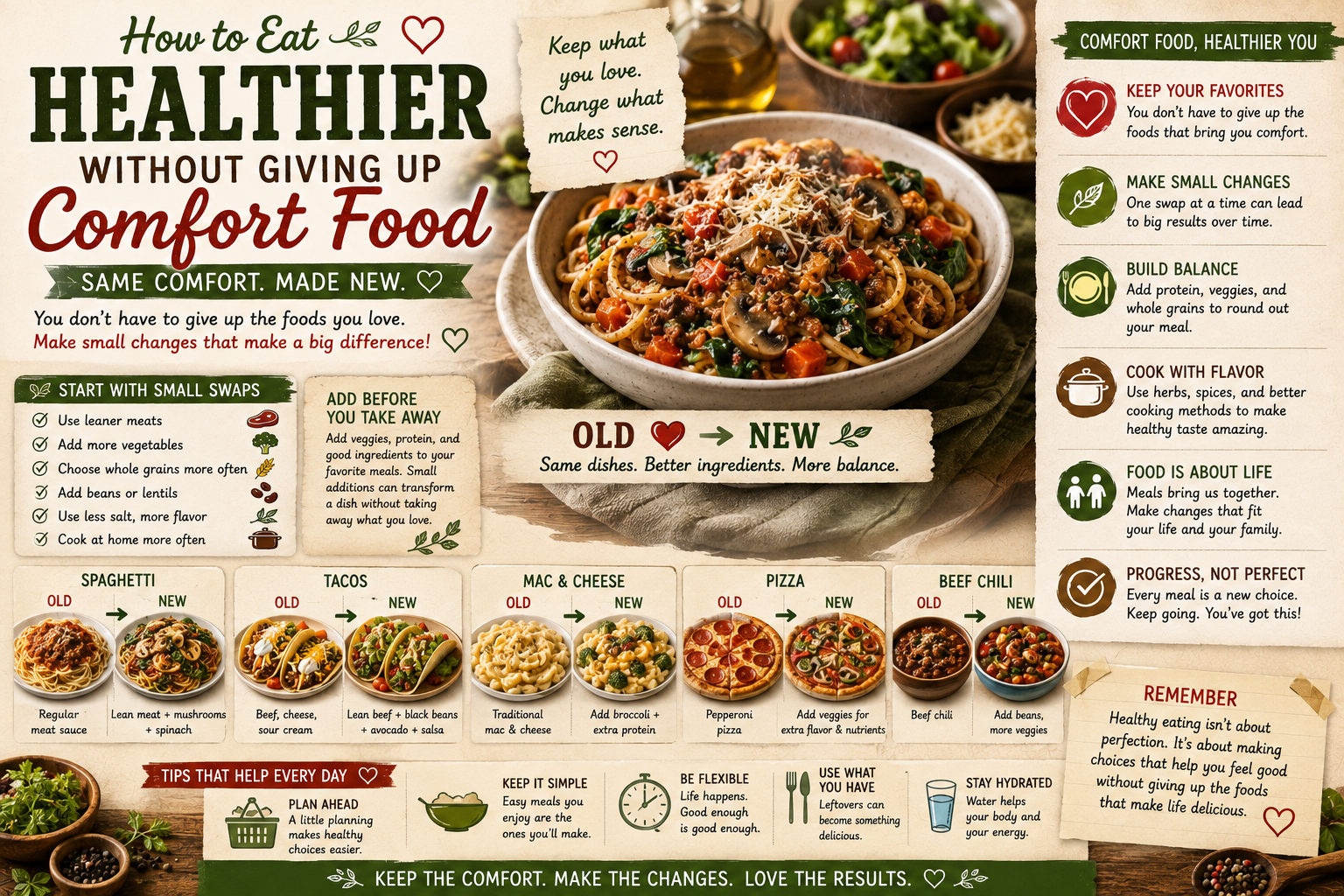
How to Eat Healthier Without Giving Up Comfort Food
Healthy eating has a reputation problem. Somewhere along the way, the idea took hold that eating better means giving up the foods you actually enjoy — no more mac and cheese, no more pizza, no more tacos, no more mashed potatoes, no more burgers, and definitely no dessert. Instead, you're supposed to suddenly crave plain chicken and steamed vegetables every night for the rest of your life.
That's not how most people eat. More importantly, that's not how it has to be.
Instead of asking "what foods do I have to give up?" the more useful question is: "how can I make the food I already love work better for me?" That's where recipe transformation begins, and that's what Old2New is built on.
Comfort Food Is More Than Food
Think about a specific favorite comfort food. Maybe it's your mother's meatloaf. Grandma's lasagna. The chili that's been made the same way for twenty years. Sunday morning pancakes. Chicken pot pie. The mac and cheese that appears at every family holiday.
Those foods carry something beyond ingredients. They carry memories, associations with specific people and places, celebrations and family traditions, the feeling of being cared for. That's why telling someone to simply stop eating the foods they love isn't always the helpful advice it's intended to be. Food is part of life — not just sustenance but connection and comfort and culture.
So instead of throwing those recipes away, the work is to work with them.
Start with the Dish You Already Love
If tonight is spaghetti, make spaghetti. Don't replace it with something entirely different because healthier eating is the current goal. Make spaghetti, then look at the recipe with one question in mind: where is one place a better ingredient could fit?
Could the ground beef be leaner? Could mushrooms go into the sauce? Could spinach be added? Could whole grain pasta be tried once? Could a salad appear alongside it? You don't need to do all five. Choose one. The meal still looks like spaghetti. It still smells like spaghetti. It tastes like dinner.
That's the Old2New test: after transforming something, does it still taste like the dish it's supposed to be? If yes, the transformation works. If the dish has changed so much that it no longer delivers the experience it was supposed to deliver, it hasn't really succeeded regardless of how its nutritional profile has changed.
Old Doesn't Mean Bad
The "Old" in Old2New doesn't mean the wrong version or the version to be embarrassed about. The original recipe may be something the family has loved for generations. That matters. Food carries culture and history and connection that exist independently of its nutritional composition.
"New" simply means: what could be done differently today, if anything? Sometimes the answer is nothing — the recipe stays exactly as it is. Sometimes the answer is one ingredient. Sometimes several things change gradually across many versions of the same recipe over several years. The direction of change is toward something slightly better, not away from something that was wrong.
Don't Replace Everything at Once
Imagine taking a favorite lasagna and changing the noodles, the meat, the cheese, the sauce, the seasoning, and the portion simultaneously. At some point, it's not the lasagna anymore. The transformation has replaced what made it the specific dish it was rather than making it better.
The more useful approach is identifying which ingredients are most worth changing and leaving the rest. Keep the noodles, keep the mozzarella, keep the tomato sauce. Use leaner meat and add mushrooms and spinach. The lasagna has changed meaningfully without losing its identity — still layered, still cheesy, still the dish that was asked for.
That's the sweet spot: improvement that's invisible in the finished dish because it happened in the ingredients rather than in the character of the meal.
Keep the Carbs
Potatoes, rice, pasta, bread, and tortillas don't automatically need to disappear from a healthier diet. The more useful question is what surrounds them rather than whether they belong at the table at all.
Pasta with lean ground meat, vegetables, and a well-seasoned tomato sauce is a complete, balanced meal. A baked potato with chicken, broccoli, Greek yogurt, and cheese is a balanced meal built around a potato. A taco with lean seasoned meat, black beans, lettuce, tomatoes, and avocado is a balanced meal in a tortilla.
The carbohydrate isn't the problem. The carbohydrate as the only component, without protein or vegetables or anything else contributing to the meal's balance, is where the problem lies. Build around it rather than removing it.
Keep the Cheese
Cheese stays. It brings flavor, texture, richness, and satisfaction to food in ways that few other ingredients replicate. The useful technique is choosing cheeses that contribute more flavor per gram — sharp cheddar instead of mild cheddar, parmesan instead of a larger amount of something milder, feta crumbled over a dish instead of a thick layer of mozzarella — so the same or lesser amount of cheese does more work.
A small amount of parmesan over pasta or a sprinkle of sharp cheddar over chili provides more cheese flavor than a larger amount of mild cheese with less character. The cheese stays; it's used thoughtfully rather than automatically.
Add Before You Take Away
The most accessible entry point for transforming comfort food is focusing on addition rather than removal. What could be added to this meal that would make it more complete?
Add mushrooms to meat sauce. Add black beans to tacos. Add broccoli to mac and cheese. Add spinach to scrambled eggs. Add vegetables to chili. Add berries to pancakes. Add a salad beside pizza. Add protein to a snack that needs more staying power.
Adding nutritious ingredients naturally changes the balance of a meal without making it feel restrictive or diminished. That's a fundamentally different experience from building a mental list of foods that are forbidden and feeling deprived.
Use Protein to Make Meals More Satisfying
Protein is what makes meals and snacks sustaining rather than just temporarily filling. The options are varied enough that virtually any household's preferences are accommodated: chicken, eggs, fish, lean beef, turkey, beans, lentils, Greek yogurt, cottage cheese, nuts, seeds.
The simplest protein addition is often the most effective. Adding an egg to a bowl of oatmeal. Adding a can of chickpeas to a pasta dish. Using Greek yogurt as a taco topping in place of sour cream. Keeping hard-boiled eggs in the refrigerator for afternoon snacks. None of these requires a major cooking change, but each adds protein that changes how long the meal sustains.
Make Vegetables Part of the Meal Rather Than the Side
A pile of plain steamed broccoli sitting beside a favorite dinner is less likely to be eaten with enthusiasm than broccoli that's part of the dinner itself. Working vegetables into the dishes people already love is more effective than serving them separately and requiring everyone to eat them.
Peppers and onions in tacos. Mushrooms in meatloaf. Spinach in lasagna. Carrots in chili. Broccoli stirred into mac and cheese. Vegetables on pizza. Zucchini in spaghetti sauce. When the vegetable is part of the dish rather than adjacent to it, it gets eaten as part of dinner rather than avoided as the obligatory healthy component.
Use Cooking Methods That Build Flavor
Healthier food shouldn't mean flavorless food. The cooking method is often what determines whether a healthier version of a dish is genuinely satisfying or merely acceptable.
Roasting vegetables at high heat until their edges caramelize produces something genuinely craveable — a different ingredient than the same vegetable steamed or boiled. Grilling adds smokiness that baking doesn't provide. Air frying produces crispiness with less oil than deep frying. Sautéing aromatics in olive oil builds a flavor foundation that permeates everything cooked in the same pan. The method matters.
Fried chicken breaded with seasoned panko and parmesan, marinated in buttermilk, baked or air fried at high heat until golden — produces an eating experience with crispy coating, tender meat, and comfort-food satisfaction. Different from traditional deep-fried chicken, yes. But genuinely good, on its own terms, and worth making again.
Build Around the Comfort Food
Sometimes the most effective transformation happens alongside the comfort food rather than inside it. The dish itself stays the same; what changes is what keeps it company.
Having pizza? Add a salad. Having a burger? Add roasted potatoes and corn. Making pancakes? Add eggs and fresh berries. Having meatloaf? Serve roasted green beans. Making mac and cheese? Add chicken and broccoli on the side or folded in.
The comfort food doesn't always need to change. Sometimes it simply needs better company on the plate.
Some Recipes Don't Need Changing
Not every recipe needs transforming. The holiday cake someone's grandmother made every Christmas should be made exactly as she made it. The restaurant burger someone genuinely loves should be ordered and enjoyed. The Thanksgiving stuffing that's been the same for three decades doesn't need to be reimagined.
Healthy living happens across days, weeks, months, and years. One meal doesn't define how someone eats. Enjoying something unchanged and unremarkable about it is completely compatible with eating well overall. The goal isn't to earn every eating occasion through nutritional optimization — it's to build habits that work across the full range of real life.
Stop Calling It a Cheat
Words matter more than they seem. Calling a favorite meal a "cheat meal" implies that eating it constitutes doing something wrong — that enjoying a burger or a slice of pizza represents a failure of some kind that needs to be compensated for or started over from.
Food isn't a test anyone is trying to pass. A burger, eaten and enjoyed, is a meal. The next meal is simply the next meal — not a correction or a punishment or a restart. Removing the moral framework from food choices removes a significant source of the anxiety and guilt that makes healthy eating feel difficult and unsustainable.
Find Your Version
Healthier eating becomes personal when the changes that actually get made are the ones that fit a specific household's preferences rather than a generalized prescription.
If leaner ground beef is an easy change but changing cheese is a non-starter, lean ground beef is the change worth making and the cheese stays. If whole grain pasta works in bolognese but not in mac and cheese, use it in bolognese. If vegetables in scrambled eggs work but vegetables in chili generate complaints, put them in the eggs. The changes most likely to last are the ones that feel like improvements rather than deprivations.
The Second-Helping Test
Here's the most practical quality test for any recipe transformation: would you willingly make it again?
Not: is it healthier? Not: did it have more vegetables? Not: was the protein content higher? First and most importantly: did you enjoy eating it? Because if the transformed version tastes disappointing, eventually the original returns and the transformation doesn't stick. A version that's slightly less optimal nutritionally but genuinely enjoyed and made repeatedly produces far more value than a nutritionally superior version that nobody wants a second helping of.
The transformation that earns its place is the one that tastes good enough to make again.
FAQ
How do I know which changes are worth making in a recipe? Start by identifying the ingredient doing the most nutritional work and the ingredient doing the most flavor work. Changes to the nutritional-work ingredients (the fat content of the meat, the type of grain, the amount of added sugar) tend to be less noticeable because the flavor-work ingredients (the cheese, the seasonings, the sauce) are providing most of what people taste. Experiment with one change at a time and evaluate whether the dish is still enjoyable — that answer tells you whether the change is worth keeping.
What if my family resists every change I try? Focus on additions before substitutions. Adding a vegetable to a dish that didn't have one is much less likely to generate resistance than replacing an ingredient someone already expects. Invisible additions — mushrooms blended into meat sauce, spinach wilted into eggs, grated zucchini in muffin batter — are the lowest resistance entry point. Visible changes to beloved dishes require more gradual introduction.
Is it okay to eat unhealthy food sometimes? Yes. Healthy eating is a pattern over time, not a requirement for every individual meal. A diet where 80% of meals are intentionally built and 20% are just what was available, what was celebratory, or what was genuinely craved is a reasonable and sustainable approach. Attempting to make every meal meet some standard of nutritional perfection is both unrealistic and unnecessary.
Continue Your Recipe Transformation Journey
This is where the Old2New approach comes together — not in any single recipe change but in the habit of looking at familiar food and asking what could be better. These guides will help:
- How to Make Your Favorite Recipes Healthier Without Starting Over — the practical framework for every transformation
- Why Small Changes Matter More Than Perfect Diets — why consistency beats perfection
- Easy Ways to Add More Vegetables Without Anyone Noticing — the addition approach in practice
- Building a Family Recipe Binder — where old recipes and their new versions coexist
- Healthy Cooking Methods That Still Taste Amazing — how technique changes flavor without changing ingredients
Old2New — There is good in everything.