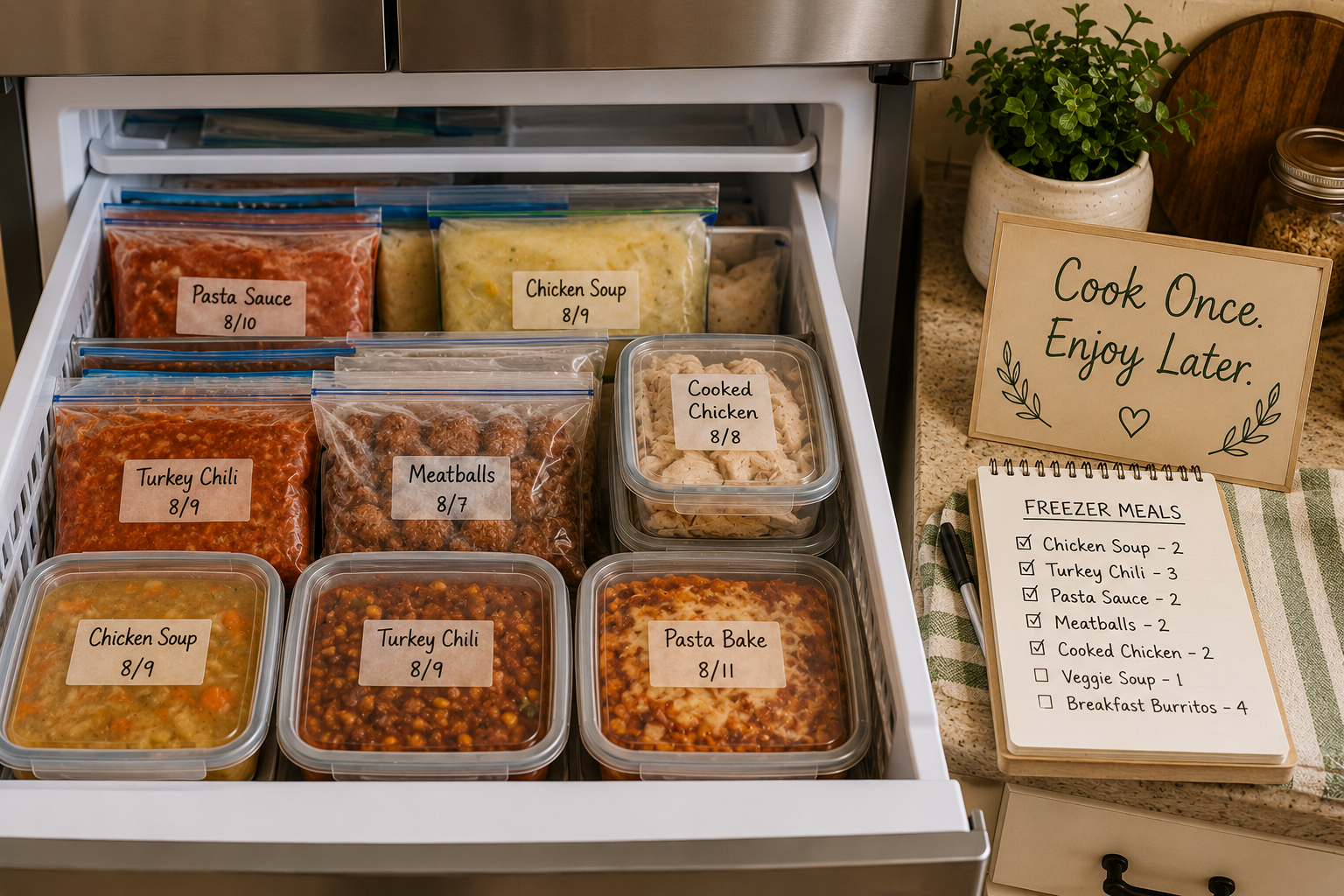
How to Freeze Meals Successfully
There are nights when cooking dinner sounds completely reasonable. And then there are the other nights — the ones where opening the refrigerator feels like the beginning of a problem rather than the beginning of a solution, where the energy to cook simply isn't there, and where the fastest path to eating is the one that doesn't involve the kitchen at all.
The freezer, used intentionally, is the answer to those nights. Not in a meal-prep-influencer way that requires an entire Sunday of cooking and thirty matching containers arranged in size order. In a simpler, more sustainable way: make a little extra when you're already cooking, freeze the extra, label it, and discover weeks later that tonight's dinner is already done.
One pot of chili makes dinner on Sunday and dinner on three different future nights with almost no additional work. A double batch of meatballs produces enough for tonight's pasta and enough frozen portions for two future meals with exactly the same cooking time as a single batch. That's not more work — that's making the work that's already happening count twice.
Foods That Freeze Well
The most important starting point for building a freezer meal practice is knowing which foods are reliable freezers — the ones that come out of the thawing and reheating process tasting essentially the same as they went in.
Soups and stews are the most reliable freezer foods available. The liquid base protects the other components and the reheating process restores the original temperature and texture completely. Chicken noodle soup, vegetable soup, lentil soup, minestrone, beef stew — all freeze for three to four months and reheat beautifully. The only adjustment worth making is slightly undercooking pasta or noodles that will be frozen in the soup, as they continue softening during the reheating process.
Chili freezes as well as any food can freeze — it arguably improves with freezing and reheating, as the flavors continue to develop and integrate. A large batch of chili portioned into individual or family-sized servings provides dinners for weeks with no additional cooking. Tomato-based sauces — marinara, meat sauce, arrabbiata — freeze perfectly and thaw in under an hour for a pasta dinner that tastes homemade because it is.
Casseroles, meatballs, shredded meats (chicken, pork, beef), cooked beans and lentils, and cooked grains all freeze with minimal quality loss. Breakfast burritos assembled and individually wrapped before freezing produce a fast, protein-rich breakfast from the toaster oven or microwave. Muffins and quick breads freeze for up to three months and thaw overnight on the counter.
Individual components — cooked chicken portioned in two-cup amounts, cooked ground turkey, cooked rice, cooked beans — are worth freezing separately because they provide building blocks for multiple different future meals rather than committing frozen meals to one specific preparation.
Foods That Don't Freeze as Well
Not every food survives the freezer with its texture and character intact. Understanding which foods change in freezing helps avoid the disappointment of thawing something that doesn't perform as expected.
Raw vegetables with high water content — lettuce, cucumber, celery, raw tomatoes — lose their structural integrity completely when frozen and thawed. They become soft and watery in ways that make them unsuitable for raw applications, though some (tomatoes, peppers) still work in cooked dishes after freezing. Cooked vegetables that are crispy or have a specific texture by design — roasted broccoli, fried onions, crispy chickpeas — lose their texture through the moisture that accumulates during thawing.
Cream-based sauces and dairy-heavy dishes can separate when frozen and reheated — the fat and liquid components sometimes no longer integrate smoothly. This is manageable for some applications (stirring vigorously while reheating often reintegrates the sauce) but can significantly affect the texture of dishes where creaminess is the defining quality. Dishes where cream is replaced with blended cottage cheese or Greek yogurt often freeze better than traditional cream-based versions.
Fried foods lose their crispiness when frozen and reheated via any method other than a very hot oven or air fryer — the coating absorbs moisture during freezing and becomes soft. For foods where the crispy texture is essential to the experience, making fresh is the better approach.
When uncertain about a specific dish, freezing a small portion first and testing how it reheats before committing an entire batch to the freezer is the practical approach. The experiment costs nothing and confirms whether the dish will work as intended.
Cool Food Before Freezing
Hot food placed directly into the freezer raises the temperature of the surrounding frozen items and creates condensation that contributes to ice crystal formation. For food safety, cooked food should not sit at room temperature for more than two hours before refrigerating or freezing.
The practical approach for large batches: divide into smaller or shallow containers immediately after cooking rather than refrigerating one large vessel. Smaller portions cool faster, which reduces the time food spends in the temperature range where bacterial growth can occur. Once cooled in the refrigerator (usually one to two hours), portions can be transferred to the freezer.
Cooling before freezing also produces better texture in the frozen product — food that goes into the freezer already cold freezes more quickly, which means smaller ice crystals and less cell damage in foods where texture matters.
Freeze in Useful Portions
The portion size at the point of freezing determines the flexibility of the frozen meals. Freezing an entire batch of chili in one large container means the entire batch must be thawed when only two servings are needed. Freezing the same batch in individual or two-serving portions means exactly what's needed can be thawed with nothing wasted.
Think about how each specific meal will actually be eaten before deciding on portion sizes. A soup that feeds two adults for dinner belongs in containers that hold two servings. A pasta sauce that goes over a pound of pasta for four people belongs in two-cup portions — roughly the amount for a pound of pasta. Cooked grains are most useful frozen in one to two cup portions that contribute to single bowls or side dishes.
A freezer full of appropriately portioned food is more useful than one with large containers that require thawing more than needed. The extra few seconds of thinking about portioning at the time of freezing saves significant effort and waste on the future night when a frozen meal is needed.
Remove Extra Air
Air exposure in the freezer contributes to freezer burn — the drying and oxidation that affects the surface of frozen food and reduces its quality over time. Minimizing air contact protects the food and extends its quality through longer storage.
For freezer bags, gently press out as much air as possible before sealing, pressing from the bottom of the bag toward the zipper. Bags can be filled with food, laid flat briefly to spread the contents evenly, then sealed as air is pressed out. For containers, choosing a container size appropriate for the amount of food — rather than putting one portion into a container designed for four — reduces the air space above the food that contributes to freezer burn.
Vacuum sealing provides the most air-free storage and produces the best quality over extended freezer periods, but requires specialized equipment and bags. For most home freezing purposes, well-sealed freezer bags with excess air pressed out or well-sealed containers sized appropriately for their contents are sufficient.
Freeze Soups and Sauces Flat
One of the most effective freezer organization strategies is freezing liquid foods flat in bags before storing them. Soups, chili, pasta sauces, beans, and shredded meats placed in quart or gallon freezer bags and laid flat to freeze produce flat, stackable packages that take a fraction of the space of rigid containers.
Once frozen solid (usually overnight on a flat surface in the freezer), these flat packages stack like files — upright in a basket or in a section of the freezer like books on a shelf. A freezer organized with flat-frozen packages of soups and sauces holds significantly more food in the same space than one with rigid containers of various shapes, and individual meals are immediately visible and accessible without digging.
This technique is most useful for the liquid or semi-liquid foods that occupy the most freezer space in rigid containers — chili, soups, sauces, beans — and less useful for solid foods that don't conform to the flat shape of a bag.
Label Everything Clearly
The label is what makes a freezer full of food useful rather than a collection of frozen mysteries that require opening and smelling to identify. Three months from now, the contents of an unlabeled container are genuinely uncertain, which leads to either discarding food that might have been good or eating something past its useful window.
A freezer label needs two pieces of information: what it is and when it was frozen. Everything else is optional but potentially useful — the number of servings, reheating instructions, what it goes well with. A roll of freezer tape and a permanent marker produces labels that stay attached through freezer temperatures and provide the information needed to make the freezer functional.
A simple freezer inventory — a piece of paper attached to the freezer door listing what's inside and being crossed off as items are removed — removes the need to excavate the freezer to assess its contents. Knowing that there are two portions of chicken soup, three of turkey chili, and a batch of meatballs makes meal planning easier and makes the freezer more likely to be used as the resource it represents.
How Long Frozen Meals Keep
Most frozen meals maintain best quality for two to three months, though they remain safe to eat indefinitely when kept consistently frozen. The quality guideline matters because texture, flavor, and nutritional quality all gradually decline with extended freezer time, even when safety is maintained.
Cooked proteins (chicken, turkey, beef): two to three months for best quality. Soups, stews, and chili: three to four months. Pasta sauces: three to four months. Cooked grains: one to two months. Baked goods (muffins, quick breads): two to three months. Breakfast burritos: one to two months.
Labeling with the freeze date makes tracking these windows straightforward. A freezer where items are rotated — newest items going to the back, oldest to the front — naturally ensures older meals are used before they pass their quality window.
Thaw Safely
The safest and most convenient thawing method for most frozen meals is moving them from the freezer to the refrigerator the night before they'll be eaten. An individual portion of soup or chili thaws overnight in the refrigerator and is ready to reheat for dinner without any additional planning.
For faster thawing, sealed containers can be submerged in cold water and the water changed every 30 minutes until the food is thawed — this is safe and significantly faster than refrigerator thawing for meals needed the same day. Microwave thawing using the defrost setting works for most frozen meals and produces ready-to-reheat food in minutes.
Food should not be thawed at room temperature for extended periods — the outer portions of the food warm to temperatures where bacterial growth can occur while the center remains frozen. Once thawed, food should be reheated thoroughly to an internal temperature of 165°F and eaten promptly rather than re-refrigerated multiple times.
Build the Freezer Stash Gradually
The sustainable approach to freezer meal building isn't a dedicated cooking day that produces thirty containers — it's the habit of making a little extra whenever something that freezes well is already being cooked.
Making chili? Use the large pot and make enough for six servings rather than four. The extra two portions go into the freezer with almost no additional work — the vegetables were already being chopped, the pot was already on the stove, the kitchen was already being cleaned afterward. Making meatballs? Double the batch. Making pasta sauce? Fill the pot and freeze half. Making soup? The large pot takes the same amount of tending as a small one.
Over the course of several weeks of regular cooking, this habit produces a freezer with a meaningful supply of homemade meals — without any single investment of extensive cooking time. The stash builds gradually, meal by meal, and the future nights that benefit from it arrive without any awareness of the modest extra effort that created them.
FAQ
Can I refreeze food that was previously frozen? Food that has been thawed in the refrigerator can be refrozen before cooking if it remains cold throughout the thawing process. Food that was thawed at room temperature or in water should not be refrozen without cooking first. Cooked previously-frozen food can be refrozen once, though quality declines with each freeze-thaw cycle. For best results, freeze in portions sized for single use so refreezing isn't necessary.
Why does my frozen food sometimes have ice crystals inside? Ice crystals inside frozen food indicate that the food was not cooled quickly enough before freezing, was frozen slowly, or has been stored for an extended period. Hot food placed directly into the freezer freezes slowly from the outside in, which produces large ice crystals that damage cell walls and affect texture. Cooling food in the refrigerator before freezing produces faster, more uniform freezing with smaller ice crystals and better texture retention.
How do I prevent freezer burn? Minimize air exposure by using appropriately sized containers or pressing air from freezer bags before sealing. Use containers specifically designed for freezer storage. Don't store food in the freezer for longer than the recommended quality window. Keep the freezer at 0°F or below consistently. Wrapping food tightly in plastic wrap before placing in a freezer bag provides an additional moisture barrier for foods prone to freezer burn.
Does freezing affect nutritional value? Freezing preserves nutritional content well — the frozen state slows the enzymatic processes that degrade vitamins and other nutrients over time. Some vitamin loss occurs during the cooking that precedes freezing, but that loss is the same as in any cooked food. For most nutrients, a properly frozen homemade meal retains nutritional value better than the same meal held in the refrigerator for several days.
Continue Your Recipe Transformation Journey
A well-stocked freezer of homemade meals is one of the most practical tools for making healthy cooking sustainable over time. These guides will help you build and use it well:
- How to Cook Once and Eat Twice — the cooking strategy that naturally builds a freezer stash
- Meal Prep Containers Worth Buying — the containers that make freezer storage work
- How to Use Leftovers Creatively — how frozen components become new meals
- Healthy Freezer Staples — what else is worth keeping in the freezer alongside meals
- Beginner's Guide to Meal Planning — how the freezer integrates into weekly planning
Old2New — There is good in everything.