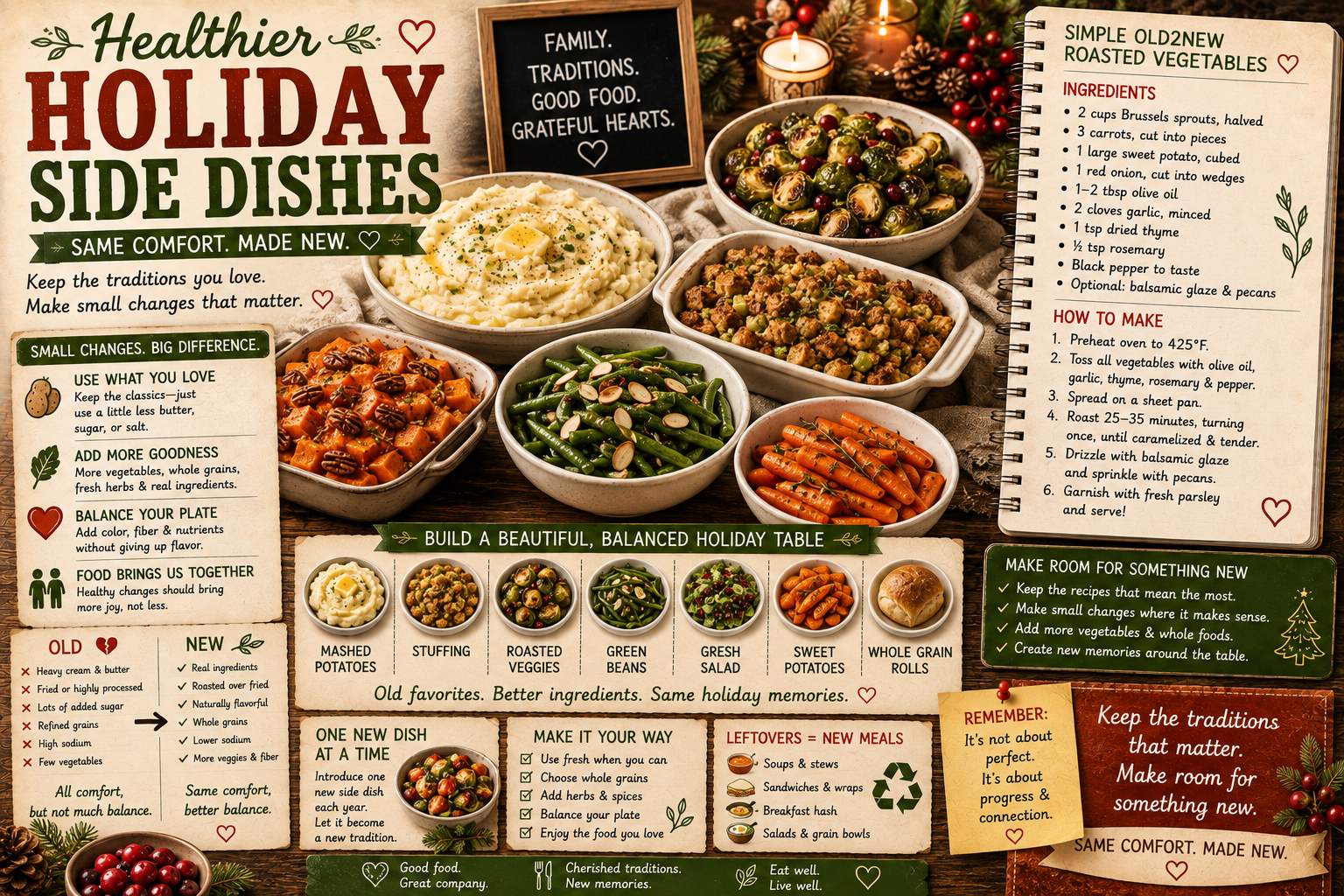
Healthier Holiday Side Dishes: Keep the Traditions, Make Room for Something New
Holiday meals are different. This isn't just dinner — these are the dishes people wait all year to eat. The mashed potatoes made the way your family has always made them. The green bean casserole. The stuffing. The sweet potatoes. The mac and cheese. The casserole that has appeared on the table every Thanksgiving since before you can remember.
Each dish belongs to someone. Each one carries a specific memory. Each one is the reason someone in the family asked to be in charge of that dish rather than letting someone else make it differently.
So when the topic is making holiday side dishes healthier, there's an important starting principle: don't ruin Thanksgiving trying to make Thanksgiving healthy. The holiday meal happens once or twice a year. The relationship with family food traditions runs much longer than any individual nutritional decision. Some recipes should stay exactly as they are because they're part of the family, and that's reason enough.
The Old2New approach to holiday meals keeps what matters and adds balance around it — not by replacing beloved dishes with healthier substitutes, but by looking at the whole table and finding where a new addition might earn its place alongside the traditions.
Start by Deciding What Stays Untouched
Before changing anything, the most useful question is: which dishes would everyone notice if they were different? The answer identifies the recipes to leave alone.
If the stuffing is the reason half the family shows up for Thanksgiving, Thanksgiving is not the occasion to announce a whole grain substitution. If the green bean casserole has been on the table every year for three decades, it stays. If the mac and cheese belongs to someone who has made it the same way since before most of the people eating it were born, it continues to be made that way.
These are the recipes where the healthiest choice is simply enjoying them as they are. They happen occasionally. They carry meaning beyond nutrition. The relationship with these foods is worth preserving exactly as it exists.
Then there's the rest of the table — the dishes where adjustments are possible, where something new might be welcomed, and where adding balance produces a better holiday meal without touching what everyone came to eat.
Mashed Potatoes Can Stay
Potatoes belong at the holiday table without apology. The adjustment in mashed potatoes is often simply technique: warm milk rather than cold milk produces a creamier mash with less butter required to achieve the same richness, because the warm milk incorporates more easily and the potato releases its starch into the liquid more smoothly. Many families find they need meaningfully less butter once they've made mashed potatoes with properly warm dairy.
Greek yogurt stirred in alongside the butter adds creaminess and protein with a subtle tang that most people find actually improves the potatoes. A quarter cup for four pounds of potatoes is enough to contribute creaminess without making the potatoes taste like Greek yogurt.
The cauliflower-potato blend is available for households where it would be welcomed — but the rule that applies throughout this series applies here too: cauliflower joins the potatoes rather than replacing them. Three parts potato to one part cauliflower produces a mash that tastes like mashed potato with a slightly lighter texture. If the family accepts it, the ratio can shift gradually over time. If they don't, the potatoes stay exactly as they are.
And if it's Christmas and the recipe calls for the full amount of butter that has always gone in? Make them. Holiday meals are not the primary lever for nutritional change.
Give Sweet Potatoes Room to Be Themselves
Sweet potatoes already possess natural sweetness, creaminess, and depth of flavor that compete with the most elaborate preparations. The most interesting holiday sweet potato dishes are often the simplest ones — allowing the sweet potato itself to provide the character rather than burying it under sugar, butter, marshmallows, and syrup.
Roasted sweet potato cubes with cinnamon, nutmeg, a light drizzle of maple syrup, and a handful of toasted pecans produce a side dish that's genuinely beautiful on the holiday table and requires almost no active preparation. The roasting concentrates the sweet potato's natural sugars and caramelizes the edges into something that needs very little added to be worth eating.
For families where the marshmallow-topped sweet potato casserole is non-negotiable tradition, it stays. The recipe is part of the holiday. No adjustment required. What might be worth trying alongside it is whether anyone would welcome an alternative sweet potato preparation that shows a different face of the same vegetable.
Green Beans That Earn Their Place
Green beans at their best are one of the freshest, brightest things on a holiday table heavy with cream and butter — if they're allowed to be themselves rather than buried in a casserole.
Sautéed green beans with garlic, olive oil, black pepper, and toasted almonds take 12 minutes and produce something vibrant, crisp-tender, and genuinely appealing. The garlic develops quickly in the hot oil, the beans cook until bright green and just tender, and the toasted almonds add crunch and richness that makes the dish feel complete without any cream.
Roasted green beans at 425°F for 12 to 15 minutes until the edges blister and slightly char produce an even more flavorful result — the char adds sweetness and complexity that no other cooking method provides.
A More Homemade Green Bean Casserole
For families where green bean casserole is the non-negotiable, the adjustment that improves it without changing its character is making the mushroom sauce from scratch rather than from a can. A quick sauce of sautéed mushrooms and onion with a roux, broth, and milk takes 15 minutes and produces a more deeply flavored, significantly lower-sodium base than cream of mushroom soup from a can. Fresh or frozen green beans hold their texture better than canned beans in the final dish.
The crispy onion topping stays — it's the defining element of green bean casserole and removing it produces something that's not the same dish. Store-bought fried onions work fine; a homemade version of onion rings finely sliced, lightly battered, and baked at high heat is a project worth attempting for households where everything homemade matters.
Stuffing That Still Tastes Like Stuffing
Stuffing should taste like stuffing: bread, onions, celery, herbs, and broth. The foundation is already relatively straightforward, and the improvements are additions rather than replacements.
Using a combination of traditional bread and whole grain bread produces a stuffing with more complex flavor and additional fiber that most people find they actually prefer to the all-white-bread version — the slightly denser texture and nuttier flavor of whole grain bread distributes through the dish rather than being separately identifiable.
The vegetables and aromatics are where stuffing gains depth: mushrooms sautéed until golden add umami; finely diced apple (Granny Smith or Honeycrisp) adds sweetness and moisture; generous amounts of fresh sage, thyme, and parsley add the herbal character that makes stuffing smell like Thanksgiving before it's even finished cooking.
Using low-sodium broth and a modest amount of good butter — enough to provide flavor without making the bread greasy — produces a stuffing that holds together and tastes rich without being heavy.
Add Roasted Vegetables to the Table
The easiest way to add something new to a holiday table without touching any traditional recipe is a big pan of roasted vegetables — brought to the table on the sheet pan or transferred to a serving dish, deeply caramelized and herbed, contributing color and freshness to a table that may otherwise be primarily brown and cream.
A combination of Brussels sprouts halved and roasted until the cut faces are golden and slightly crispy, carrots cut into chunks and caramelized, cubed sweet potato, and red onion wedges tossed with olive oil, garlic, thyme, rosemary, and black pepper produces a pan of vegetables that looks genuinely beautiful alongside the traditional dishes and appeals even to people who don't identify themselves as vegetable enthusiasts.
This pan requires 35 minutes in a hot oven and almost no active work — making it one of the most practical additions to a holiday table where the oven and attention are already committed to other dishes. It can go in while something else is resting.
Brussels Sprouts Worth Eating
Halved Brussels sprouts roasted at 425°F until the cut faces are deeply golden and the outer leaves are slightly crispy and caramelized bear almost no resemblance to the boiled Brussels sprouts that created their reputation as an objectionable holiday side dish.
The crispy outer leaves, the slightly sweet, slightly nutty flavor of the caramelized surface, and the tender center produce a vegetable experience that converts people who have insisted for years that they don't like Brussels sprouts. Finishing with a small drizzle of balsamic glaze, a handful of toasted pecans, or a light sprinkle of parmesan adds one more element that makes the dish holiday-worthy rather than merely acceptable.
Once Brussels sprouts roasted this way appear on a holiday table, they tend to reappear the following year by request. That's the trajectory of a new tradition.
A Simple Old2New Roasted Holiday Vegetables
Ingredients (serves 6 to 8)
- 2 cups Brussels sprouts, halved
- 3 carrots, cut into 1-inch pieces
- 1 large sweet potato, cubed
- 1 red onion, cut into wedges
- 1 to 2 tbsp olive oil
- 2 cloves garlic, minced
- 1 tsp dried thyme
- ½ tsp rosemary
- Black pepper to taste
- Optional: drizzle of balsamic glaze, toasted pecans, or pomegranate seeds
- Fresh parsley for serving
Instructions
Preheat oven to 425°F.
Cut all vegetables into similar-sized pieces for even cooking. Combine on a large sheet pan (use two pans if needed — crowding prevents caramelization). Add olive oil, garlic, thyme, rosemary, and black pepper and toss until evenly coated.
Spread in a single layer with space between pieces. Roast for 30 to 40 minutes, turning once halfway through, until tender inside and caramelized at the edges.
Transfer to a serving dish or bring the pan directly to the table. Finish with fresh parsley and any optional additions.
A Fresh Salad as Contrast
A fresh salad on a holiday table provides the crisp, bright contrast that cuts through the richness of the other dishes. Mixed greens with sliced apple or pear, toasted walnuts or pecans, dried cranberries, a small amount of crumbled cheese, and a simple apple cider vinaigrette is light enough to sit alongside everything else without competing and beautiful enough to earn its spot on a holiday table.
This doesn't replace any traditional dish. It adds something the rest of the table doesn't provide: freshness, acidity, and crunch.
The "One New Dish" Strategy
The most sustainable way to introduce change to a holiday table is adding one new dish per year alongside the established ones. The first year it's a curiosity. If it's well received, the second year it's expected. The third year it's tradition.
"Are you making those Brussels sprouts again?" is the sentence that indicates a new recipe has earned its place. That sentence doesn't come from announcing that the dish is healthy or replacing an established one — it comes from making something genuinely delicious that showed up on the table and let the recipe speak for itself.
Don't introduce the new dish as "the healthy option." Don't announce what's been changed about an existing recipe. Just make the food and put it on the table. If it's good, it stays.
Holiday Leftovers Transformed
Holiday leftovers are among the most versatile refrigerator assets of the year. Turkey becomes sandwiches on day two, soup on day three, tacos on day four, and grain bowls on day five. Roasted vegetables become breakfast hash with eggs, a pasta sauce base, a frittata filling, or a soup starting point. Mashed potatoes become potato cakes pan-fried until crispy. Stuffing becomes a savory breakfast skillet.
Freezing appropriate portions — turkey in two-cup amounts for future soups and tacos, remaining roasted vegetables for future soups and pastas, stuffing for a future weeknight side dish — extends the value of the cooking session for weeks beyond the holiday itself.
Your Family Recipes Belong Here
Some recipes aren't just recipes. They're the handwriting on an old index card. The casserole that appears because someone would notice if it didn't. The dish someone learned by watching rather than measuring. The recipe that carries a person who is no longer at the table.
Food carries stories. Making healthier choices doesn't require erasing those stories. Some recipes can evolve, a little more butter here, a few more vegetables there, a whole grain quietly joining the bread. Some recipes should stay exactly as they are because they're part of the family, and that's reason enough.
Both choices are available. Both are correct.
Closing the Comfort Food Series
This is the final article in our Comfort Food Series, and it feels right to end here — at the holiday table, surrounded by the dishes that matter most, with the principle that started the whole series: Old2New isn't about deciding that the way we used to cook was wrong.
It's about looking at the foods we already love and asking what should stay, what could change, and what new traditions might be worth starting. The answer is different for every family, every recipe, and every table.
Maybe Grandma's stuffing stays exactly as she made it. Maybe the mashed potatoes get warm milk instead of cold. Maybe roasted Brussels sprouts become the dish someone asks for every year. And maybe twenty years from now, someone is making these recipes and calling someone to ask for the recipe because the holiday wouldn't feel right without it.
That's how comfort food grows with a family. That's Old2New.
Continue Your Recipe Transformation Journey
Holiday cooking brings together everything in this Comfort Food Series. These guides cover the individual dishes:
- Healthier Mac and Cheese — keeping the holiday mac and cheese but making it work a little harder
- What Can I Make with Sweet Potatoes? — everything sweet potatoes can become on and off the holiday table
- Building a Family Recipe Binder — where holiday recipes belong, alongside their new versions
- How to Use Leftovers Creatively — what holiday leftovers can become in the days after
- How to Make Your Favorite Recipes Healthier Without Starting Over — the philosophy behind every swap throughout this series
Old2New — There is good in everything.