Easy Weeknight Dinner Strategies
It's 5:30. Everyone is hungry. The question "what's for dinner?" has arrived — for the 300th consecutive weeknight — and the answer involves either cooking something or choosing not to.
Weeknight cooking doesn't usually fail because people don't know how to cook. It fails because the 5:30 dinner decision arrives at the exact point in the day when mental and physical energy are lowest, when there are competing demands from family and the end-of-day backlog, and when the fastest possible path to food starts looking more appealing than the most nutritious one.
The solution isn't a more elaborate meal plan or more impressive recipes. It's having a few reliable strategies in place before the hungry moment arrives — strategies that reduce the number of decisions that need to be made in the moment, make cooking faster and simpler on the nights when simplicity is what's needed, and ensure that something is almost always available to work with.
Stop Planning Seven Completely Different Dinners
The first and most relieving strategy: stop trying to have a different impressive dinner every night of the week. Seven distinct dinners, each requiring different ingredients and different techniques, is an ambitious system that works perfectly until Monday's dinner takes longer than expected, Wednesday's ingredients weren't bought, and Thursday's plan gets derailed by something that came up. By Friday, the carefully constructed plan has collapsed and takeout arrives.
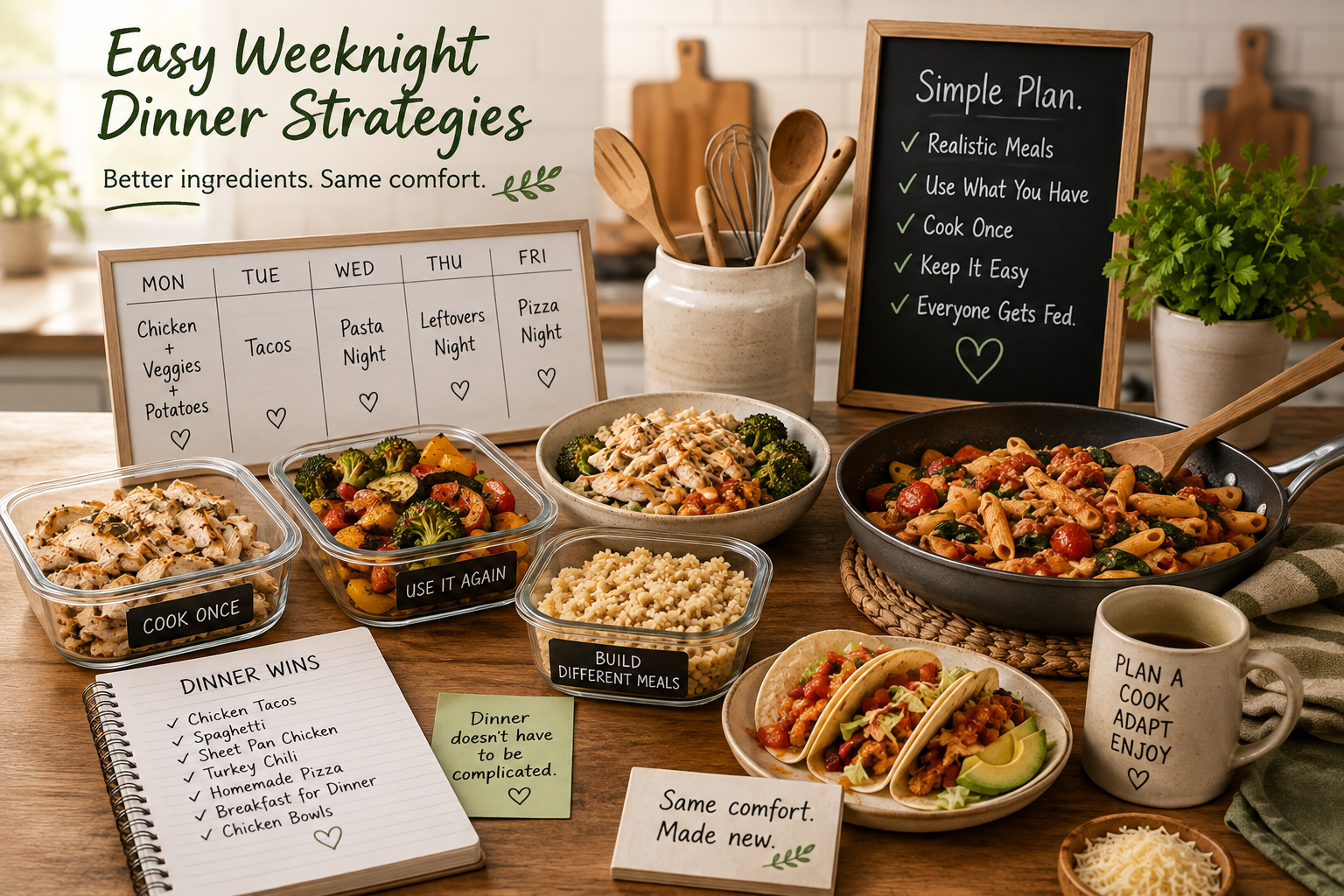
A more realistic week looks like four or five dinners that the household actually enjoys, with deliberate room for leftovers, a freezer meal, eating out, or simply changing plans when life changes them. Monday is chicken and vegetables. Tuesday is tacos. Wednesday is pasta. Thursday is leftovers from Monday or Tuesday, possibly transformed into something different. Friday is whatever sounds good or whatever is easy.
That's not settling for less. That's building a system that works consistently rather than one that's impressive in theory and frequently abandoned in practice.
Give Each Night a Theme
Meal themes solve the decision problem without eliminating variety. The theme provides direction — Taco Tuesday, Pasta Wednesday, Sheet Pan Thursday — while leaving the specific recipe open to whatever version sounds good that week. Taco Tuesday is chicken tacos one week, black bean tacos the next, shrimp tacos the week after, and fish tacos two weeks later. The category stays the same; the content varies.
The value of a theme isn't the specific meal — it's that the hardest decision ("what should we have tonight?") is already made when the day starts. What type of taco, what protein, what toppings can be decided at 5:30 without the same cognitive overhead as deciding from scratch among all possible dinners. The theme is the category; the household fills in the details.
Themes that work for most households: Meatless Monday (plant-based, any format); Taco Tuesday (any taco or Mexican-inspired preparation); Pasta Wednesday (any pasta dish); Sheet Pan Night (protein and vegetables roasted together); Soup Night (particularly useful in fall and winter); and Pizza Friday (homemade or otherwise). These themes have enough flexibility to provide variety over many weeks without requiring daily decision-making.
Use the Protein + Vegetable + Side Formula
Dinner doesn't need a recipe. It needs a structure. One protein, one or two vegetables, and one starch or grain, combined with seasoning and a sauce or dressing, is a complete dinner that can be assembled in 20 to 30 minutes from components that are already available.
Chicken breast plus broccoli plus potatoes — roasted together on a sheet pan, seasoned with olive oil, garlic, and herbs — is dinner. Salmon plus green beans plus rice, the salmon pan-seared and the green beans and rice cooked simply, with a squeeze of lemon and fresh dill, is dinner. Turkey meatballs plus zucchini plus pasta with marinara is dinner. Beans plus bell peppers plus brown rice with cumin and salsa is dinner.
This formula works because it doesn't require following a specific recipe — it requires having ingredients that fit the three categories and a seasoning direction. Once the formula is internalized, walking into the kitchen and looking at what's available produces dinner options rather than a blank. Chicken in the refrigerator, broccoli in the freezer, rice already cooked from earlier in the week — dinner is there. The formula reveals it.
Keep Emergency Meals Ready
Emergency meals are the specific dinners that happen when the original plan isn't happening — when the planned ingredients weren't bought, when cooking time is shorter than expected, when energy is genuinely low, or when the refrigerator reveals that whatever was planned is no longer available.
Every household benefits from having three to five emergency meals defined and the ingredients for them consistently stocked. These aren't special meals — they're the most reliable, simplest combinations that work regardless of what else is or isn't available. Scrambled eggs on whole grain toast with fruit is an emergency meal. Pasta with jarred tomato sauce and whatever vegetables need to be used is an emergency meal. Bean tacos from canned beans, salsa, and tortillas take 10 minutes and require no fresh ingredients. Chicken quesadillas from cooked chicken (refrigerator or freezer), a tortilla, and cheese take 8 minutes.
The meals on the emergency list are defined in advance rather than improvised in the moment of hungry desperation. Knowing that eggs and toast is a legitimate dinner — and having eggs and bread available for exactly this situation — means the decision is already made when it needs to be made.
Let the Freezer Do Work
The meals frozen during better-planned cooking sessions exist specifically for the nights when cooking from scratch isn't realistic. Frozen soup from three weeks ago is dinner tonight with only the time it takes to reheat it. Frozen chili becomes the protein and sauce for dinner when served over rice or in a baked potato. Frozen meatballs in pasta sauce is a 20-minute dinner from entirely frozen starting materials.
Making the freezer meal practice work on weeknights requires one small planning habit: moving the frozen meal to the refrigerator the night before it will be eaten, so it thaws overnight and is ready to reheat rather than requiring hot water or microwave thawing at the hungry moment. The dinner decision on Monday evening is moving Tuesday's frozen meal to the refrigerator — ten seconds of action that makes Tuesday's 5:30 moment much easier.
Keep Useful Shortcut Ingredients Available
Healthy cooking doesn't require starting every meal from the most whole, unprocessed form of every ingredient. There are shortcut ingredients that meaningfully reduce prep time without meaningfully affecting the quality of the finished meal — and using them on weeknights is smart strategy rather than compromise.
Frozen vegetables eliminate the washing and chopping that adds 10 to 15 minutes to vegetable preparation. Pre-washed salad greens and spinach eliminate the time that prevents greens from being used spontaneously. Canned beans provide the same protein and fiber as dried beans with none of the soaking and cooking time. Jarred tomato sauce on a night when time is short is a better dinner than no homemade sauce because the evening ran out. Frozen brown rice reheats in two minutes. Rotisserie chicken provides cooked protein that can become tacos, salads, pasta, or soup without any cooking.
These shortcuts matter most on the nights when their alternative is abandoning dinner entirely. A dinner assembled primarily from shortcuts that still involves cooking at home and uses real ingredients is a better outcome than the takeout that would have happened without them.
Use the Sheet Pan as a Weeknight Anchor
Sheet pan dinners have appeared throughout this guide because they solve the core weeknight dinner problem: a complete meal from one cooking vessel with minimal hands-on time and minimal cleanup. Protein and vegetables together on one pan, in a hot oven, producing dinner in 30 to 45 minutes while something else happens in the background.
The weeknight advantage of sheet pan cooking is not just the cleanup — it's the hands-off nature of the oven. Once the pan goes in at 425°F, it runs itself. There are 35 minutes to help with homework, handle the other end-of-day demands, or simply decompress. When the timer goes off, dinner is done. That's the right level of effort for a Wednesday when the day was already full.
Sheet pan dinners also scale naturally: one pan feeds two, two pans feed four or five, and the prep time scales only slightly with quantity because the chopping and seasoning is the active work and it's proportional to the amount of food, not the number of servings.
Transform Leftovers Rather Than Repeating Them
Leftovers presented as "yesterday's dinner again" are less appealing than the same ingredients presented in a different format. The question to ask when facing a refrigerator of leftovers isn't "do we want the same thing tonight?" — it's "what can these become?"
Leftover roasted chicken becomes taco filling with cumin, chili powder, and salsa. Leftover roasted vegetables become an omelet filling with eggs and cheese. Leftover rice becomes fried rice with an egg, frozen peas, and soy sauce. Leftover meatballs become a meatball sub with jarred tomato sauce and a toasted whole grain roll. Leftover roasted potatoes become breakfast-for-dinner hash with eggs.
The ingredient is the same; the meal is genuinely different. This reframe makes leftovers a resource rather than a repetition — the starting point for tomorrow's dinner rather than yesterday's dinner warmed up.
Breakfast for Dinner Is Real Dinner
Some evenings don't need the full protein-vegetable-starch construction. Scrambled eggs with vegetables and whole grain toast is a complete, protein-rich dinner that takes 10 minutes. An omelet with spinach, mushrooms, and cheese is genuinely satisfying. Oatmeal with Greek yogurt, fruit, and nuts is a filling dinner that costs almost nothing and requires almost nothing.
Breakfast foods are universally familiar, fast to prepare, inexpensive, and often better received by families than more elaborate weeknight cooking. The cultural designation of "breakfast foods" as morning-only is a convention rather than a rule. Eggs are nutritious and satisfying regardless of when they're eaten. Serving them for dinner on a Wednesday when cooking time and energy are both limited is not a failure — it's a practical choice that produces a good meal efficiently.
Keep a "Dinners We Actually Like" List
The most consistently useful weeknight dinner tool is a list of dinners the household has already proven it enjoys — documented somewhere accessible so that the "what should we have for dinner?" question has a starting point that doesn't require inspiration.
This list grows naturally over time. When a weeknight dinner works well — when the meal comes together quickly, everyone eats it willingly, and it felt sustainable to make — it goes on the list. When the list is consulted at 5:30 on a night when decision-making capacity is low, the answer doesn't require creativity or energy. It requires choosing from a set of already-proven options.
The list is not a meal plan and not a commitment. It's a reference that prevents the blank-refrigerator-stare experience by providing a starting point. Ten dinners that work are more valuable than a rotating catalog of aspirational meals that require more planning than a weeknight allows.
Prep Tomorrow While Cooking Tonight
The most efficient dinner prep isn't a dedicated Sunday session — it's the small, incremental preparation that happens during the few minutes of active cooking each night. While the sheet pan is in the oven or the pasta water is boiling, there are two or three minutes of available time that can make tomorrow easier.
Chopping tomorrow's onion while tonight's chicken cooks. Washing tomorrow's vegetables while the rice finishes. Moving a freezer meal into the refrigerator to thaw overnight. Cooking extra rice to refrigerate for tomorrow. Seasoning another piece of chicken for tomorrow's dinner while the pan is already seasoned.
These additions take two to five minutes and remove the equivalent amount of active work from the following evening. Accumulated over the week, the small incremental prep prevents the situation where every dinner requires starting completely from scratch in the most tired moments of the day.
FAQ
What if I don't know what to cook even with a theme system? Keep a list of three to five specific recipes for each theme — three pasta dinners, three taco variations, three sheet pan combinations — and rotate through them. Within a theme, the decision narrows from "what should we have?" to "which version of pasta sounds good tonight?" That's a much smaller and faster decision.
How do I get my family to be flexible about dinner when plans change? Framing helps: "We're having Plan B tonight" acknowledges that the original plan isn't happening without framing the alternative as inferior. Keeping emergency meals that the household genuinely enjoys (rather than tolerable backup options) means Plan B is often welcomed rather than resented. Involving family members in building the emergency meal list produces better buy-in for those meals when they're used.
What's the fastest realistic weeknight dinner? Eggs in any form — scrambled, fried, omelet — take eight minutes. Sheet pan shrimp with frozen vegetables takes 15 minutes. Pasta with jarred sauce takes 12 minutes. A grain bowl assembled from batch-cooked components takes five minutes of reheating and assembly. Any of these are realistic 15-minute dinners for nights when faster is essential.
Continue Your Recipe Transformation Journey
The strategies in this guide work together with the broader Old2New approach to make weeknight cooking sustainable. These guides will help you build on them:
- Beginner's Guide to Meal Planning — how to set up the week so fewer decisions happen at 5:30
- Batch Cooking for Beginners — how to prepare components that make weeknights faster
- Easy Sheet Pan Dinners — the most reliable format for weeknight cooking
- How to Use Leftovers Creatively — how to transform leftovers into genuinely different dinners
- How to Freeze Meals Successfully — how the freezer becomes a weeknight rescue tool
Old2New — There is good in everything.