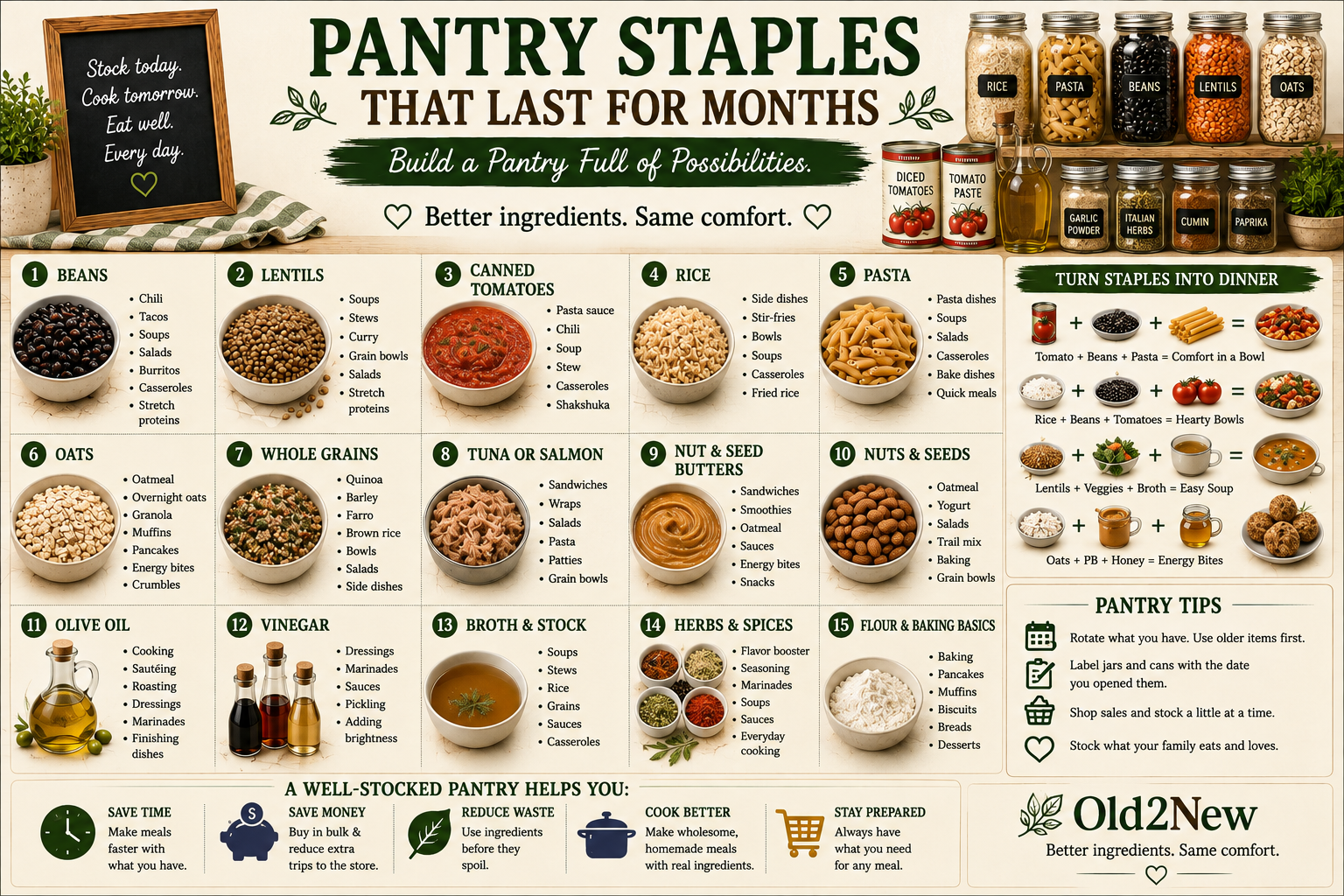
Pantry Staples That Last for Months
The difference between a kitchen that produces home-cooked meals consistently and one that defaults to takeout on busy nights often comes down to what's in the pantry when dinner needs to happen and no grocery trip has occurred. A pantry with the right staples turns whatever fresh ingredients are available into a complete meal. A pantry without them leaves you staring at possibilities that don't quite connect.
The goal isn't a fully stocked pantry with every possible ingredient. It's a useful pantry — one that contains the building blocks for the meals your household actually eats, in ingredients that store for months without requiring rotation. A can of diced tomatoes sitting on the shelf in October is still a can of diced tomatoes in March — and in the meantime it's the beginning of pasta sauce, chili, soup, shakshuka, or braised chicken on any of the nights between now and then.
Here's what's worth keeping and what each ingredient can do.
Beans
Beans are among the most versatile, most economical, and longest-lasting ingredients available. A can of black beans, pinto beans, kidney beans, chickpeas, or cannellini beans stores for two to three years and goes into chili, tacos, soups, grain bowls, salads, burritos, casseroles, and dips without any preparation beyond opening and draining.
Their protein and fiber content makes them genuinely filling — meals built around beans are meals that hold people until the next one, which is one of the most practical qualities an ingredient can have. They also stretch meat-based dishes further: a pound of ground turkey cooked with a can of black beans for tacos feeds more people than the same pound of turkey alone, at lower cost per serving and with more fiber per plate.
Keeping three to four different varieties of canned beans provides enough variety for different meal directions throughout the week. Dried beans store even longer (one to two years) and cost less, but require soaking and longer cooking time — a worthwhile trade-off for households that use beans frequently.
Lentils
Lentils are the most underestimated ingredient in most pantries. They require no soaking, cook in 20 to 30 minutes depending on variety, cost almost nothing, and provide more protein per dollar than almost any other pantry ingredient. A single bag of dried lentils makes enough soup, chili, or taco filling for eight to ten servings.
Brown lentils are the most versatile — they hold their shape enough to be identifiable in soups and stews while becoming tender enough to blend into sauces. Red lentils dissolve completely when cooked, creating a naturally creamy texture that's excellent in soups and curries without any blending. Green and black lentils hold their shape best and work well in salads and grain bowls where texture matters.
Adding lentils to familiar dishes — mixing them into ground meat for tacos, stirring them into chili alongside beans, using them as the base of a vegetable soup — adds protein and fiber to meals without changing their fundamental character.
Canned Tomatoes
If there's one pantry ingredient that enables the greatest number of different meals, canned tomatoes make a strong claim for that title. Diced tomatoes, crushed tomatoes, tomato paste, and tomato sauce are collectively the foundation of pasta sauce, chili, soup, stew, shakshuka, braised chicken, pizza sauce, and casseroles. They store for a year or more and cost very little.
Tomato paste deserves particular mention because of how much flavor it contributes per tablespoon — concentrated, deeply savory tomato that adds richness to sauces and braises in ways that diced or crushed tomatoes don't. A small can of tomato paste opened and used by the tablespoon (freeze the remainder in tablespoon portions on a sheet pan and transfer to a bag) produces flavor that would otherwise require long cooking times to achieve.
Having all four forms — diced, crushed, paste, and sauce — covers every tomato-based application and provides flexibility that one form alone doesn't.
Rice
Rice is the grain that requires the least explanation — it pairs with virtually every protein, vegetable, and flavor direction, cooks reliably, and provides a satisfying, filling base for any meal. A bag of brown rice stores for a year or more and produces enough grain for dozens of meals.
Brown rice has more fiber and nutrients than white rice and a slightly nuttier flavor that most people find easy to enjoy. White rice cooks faster and has a lighter, more neutral flavor — a practical choice for households where the preference is clear. Basmati and jasmine rice have distinctive aromatic qualities that pair particularly well with Indian and Southeast Asian-inspired dishes.
The most efficient use of rice is cooking in double or triple batches — the rice cooker or pot takes the same time regardless of quantity, and extra cooked rice refrigerates for five to six days or freezes indefinitely.
Pasta
Pasta earns pantry space because it pairs with virtually any protein, vegetable, or sauce and comes together faster than most other complete meals. A box of pasta plus a can of tomatoes plus garlic and olive oil is a 20-minute dinner from entirely pantry ingredients. Add a protein from the refrigerator or freezer and the meal is complete.
Whole wheat pasta and protein-enriched pasta add fiber and protein compared to standard semolina pasta and work well in dishes with bold sauces where the slightly different texture and flavor are enhanced rather than diminished by the sauce. Chickpea pasta and lentil pasta are worth keeping as alternatives — they have a different texture but work well in applications like pasta salads and dishes with strong sauces.
Keeping two or three different shapes covers most applications: spaghetti or linguine for tomato and olive oil sauces, penne or rigatoni for baked pasta and chunky sauces, rotini or farfalle for pasta salads.
Oats
Old-fashioned oats have more roles in a well-stocked pantry than almost any other single ingredient. They make stovetop oatmeal and overnight oats for breakfast. They go into granola, muffins, energy bites, and fruit crisps for snacks and desserts. They serve as a binder in meatloaf and meatballs in place of breadcrumbs. They form the base of homemade granola bars and breakfast cookies.
One large container of old-fashioned oats costs very little and contributes to weeks of breakfasts, snacks, and baking. Quick oats have a different texture and work for some applications but not all — old-fashioned oats are more versatile and worth keeping as the primary pantry oat.
A Whole Grain Beyond Rice and Oats
One additional whole grain beyond rice and oats adds variety to the grain rotation without requiring a specialty grocery store or a large investment. Quinoa is the most practical choice because it cooks in 15 minutes, provides complete protein, and works in everything from breakfast bowls to dinner grain bowls. Barley adds a slightly chewy texture and a mild, slightly nutty flavor that works particularly well in soups and stews. Farro is heartier and more filling than rice with a pleasant chewiness that holds up well under assertive dressings and sauces.
The choice matters less than the habit of having one. Rotating between different grains adds variety to grain-based meals that would otherwise always taste the same.
Canned Tuna and Salmon
Shelf-stable canned tuna and salmon are the most underappreciated protein in the pantry — ready to eat with no cooking required, high in protein and omega-3 fatty acids, and versatile enough to go into sandwiches, wraps, pasta, salads, grain bowls, and homemade fish cakes without any preparation beyond opening the can.
Canned salmon deserves more attention than it typically gets. Wild-caught canned sockeye salmon has a richer flavor than standard canned tuna and works beautifully mixed with Greek yogurt, Dijon, and fresh herbs for a salmon salad that's genuinely good. The soft bones in canned salmon are edible and add significant calcium.
Having two or three cans of each provides a protein option that requires no refrigerator space, no thawing, and no cooking — the fastest possible weeknight dinner protein when everything else requires more time.
Nut and Seed Butters
Peanut butter and almond butter belong in the pantry as both a snack component and a cooking ingredient. They go on toast, on apple slices, into smoothies, into overnight oats and energy bites, into Thai-inspired peanut sauces for noodles or stir fries, and into baked goods as a fat and flavor component.
A jar of natural peanut butter with no added sugar or oil is the most versatile and economical option. Almond butter provides a slightly different flavor and works well in applications where a milder nut flavor is preferred. Tahini — sesame seed butter — is worth keeping for hummus, grain bowls, salad dressings, and Middle Eastern-inspired preparations where its nutty, slightly bitter flavor adds distinctive depth.
Nuts and Seeds
A small selection of nuts and seeds adds texture, healthy fat, and protein to dishes that would otherwise lack crunch and satiety. Walnuts and pecans pair naturally with salads, grain bowls, oatmeal, and baked goods. Almonds work sliced on oatmeal and salads or whole in trail mix. Pumpkin seeds add a savory crunch to soups, salads, and grain bowls. Chia seeds thicken overnight oats, smoothies, and chia pudding. Sunflower seeds are the most economical option and work in any application where a tree nut-free alternative is needed.
Storing nuts in the refrigerator or freezer extends their shelf life significantly — the oils in nuts go rancid more quickly at room temperature, particularly in warm kitchens.
Olive Oil and Vinegar
These two ingredients do more to improve cooking than almost any other pantry addition. Olive oil is the default cooking fat for sautéing, roasting, dressing, and finishing — a single bottle covers most cooking situations and its flavor actively contributes to finished dishes in a way that neutral oils don't. A good everyday extra virgin olive oil is worth keeping on hand; a more expensive finishing oil for salads and drizzling is worth keeping as a separate addition if the budget allows.
Vinegar — particularly apple cider vinegar, balsamic vinegar, and red wine vinegar — adds brightness, acidity, and depth to dressings, marinades, braises, sauces, and slaws. A splash of vinegar at the end of cooking is often the element that makes a dish taste complete — it lifts the other flavors and adds a brightness that more salt doesn't replicate. Combined with olive oil, Dijon, garlic, and herbs, any of these vinegars becomes a salad dressing or marinade without any additional purchase.
Broth
Low-sodium chicken broth, vegetable broth, and beef broth serve as the liquid base for soups, stews, braises, grains cooked in broth instead of water, and pan sauces that collect the fond from seared proteins. Cooking rice or quinoa in chicken broth instead of plain water adds a savory depth to the finished grain that requires no additional seasoning.
Shelf-stable cartons are the most convenient pantry format — they keep for a year or more unopened and for a week in the refrigerator after opening. Having two to three cartons of different broths provides flexibility for different cooking directions without requiring a dedicated stock-making session.
Herbs and Spices
A functional spice collection enables dramatically different flavor directions from the same core ingredients — the same chicken and vegetables seasoned with Italian herbs tastes entirely different from the same chicken and vegetables seasoned with cumin and chili powder. Building this collection gradually around the flavors the household actually uses is more practical than buying everything at once.
The most universally useful spices: garlic powder and onion powder as savory foundations; smoked paprika for depth and color; cumin for Mexican, Middle Eastern, and Indian-inspired dishes; Italian seasoning for pasta and chicken; black pepper for everything; cinnamon for both sweet and savory applications; and crushed red pepper for heat. These eight cover the vast majority of cooking situations and enable dozens of different flavor profiles.
Baking Basics
Even a kitchen that doesn't bake regularly benefits from keeping flour, baking powder, baking soda, and vanilla on hand — they're useful in unexpected savory applications as well as the obvious baking ones, and having them available enables weekend baking projects without a special shopping trip.
All-purpose flour thickens sauces and soups as well as forming the base for pancakes, muffins, and quick breads. Baking powder and baking soda are leaveners required for most baked goods. Vanilla extract adds depth to oatmeal, smoothies, and baked goods. A small container of cornstarch provides a thickener for Asian-inspired sauces and stir fry glazes that flour doesn't replicate as well.
Building the Pantry Over Time
A useful pantry doesn't require a single large investment. It builds gradually — adding one or two items when they're on sale, replacing things as they run low, discovering what the household actually uses and stocking more of that.
The most practical approach: start with the items that appear most frequently in the household's cooking, keep them consistently stocked, and add new items one at a time as specific meals call for them. A pantry built around what the household actually cooks is more valuable than one stocked according to a generic list that includes ingredients nobody ever reaches for.
Rotating through what's there — checking dates, moving older items forward, planning a meal around something that's been sitting for a while — keeps the pantry functioning as a working resource rather than accumulating into a storage space for things that should have been used months ago.
FAQ
How long do pantry staples actually stay good? Dried beans and lentils: one to two years in an airtight container. Canned goods: one to three years (use by the date on the can, but most remain safe well beyond it). Whole grain pasta and rice: one to two years in a sealed container. Oats: one to two years. Olive oil: one year from opening, longer if kept away from light and heat. Dried spices: one to two years for ground spices, two to four years for whole spices. Nut butters: one year sealed, three to four months open at room temperature or up to a year refrigerated.
Is it worth buying dried beans instead of canned? For households that use beans multiple times per week, dried beans are significantly more economical — a pound of dried beans costs roughly the same as one can and produces the equivalent of three to four cans of cooked beans. The trade-off is soaking time (six to eight hours or overnight) and cooking time (one to two hours). For households that use beans occasionally, the convenience of canned beans typically outweighs the cost savings of dried.
What's the most important thing to keep stocked? Canned tomatoes and dried beans or lentils cover the largest number of different meal situations from pantry ingredients alone. With those two plus garlic, olive oil, and whatever grain the household prefers, dinner is possible from the pantry on any night — which is the core purpose of keeping pantry staples.
Continue Your Recipe Transformation Journey
A well-stocked long-lasting pantry is the foundation that makes everything else in healthy cooking possible. These guides will help you put it to use:
- Pantry Staples Every Home Cook Should Keep — the companion guide covering refrigerator and freezer staples alongside pantry
- Healthy Freezer Staples — what to keep in the freezer that works alongside the pantry
- How to Cook with Herbs and Spices — how to get the most from the spice collection
- Smart Grocery Swaps That Save Money — how to build the pantry economically
- Beginner's Guide to Meal Planning — how to plan meals around what's already in the pantry
Old2New — There is good in everything.